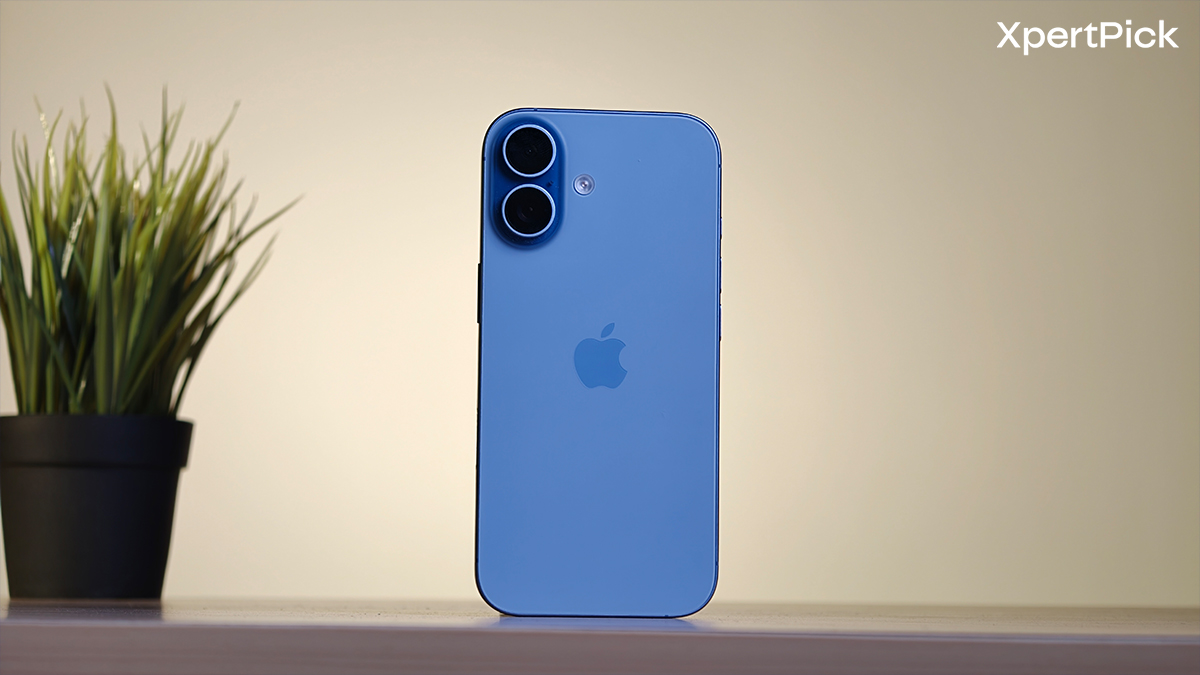
The Apple iPhone no longer lives in a world where incremental upgrades automatically excite people. Prices are higher, phones last longer, and the question users increasingly ask is not what’s new, but what actually feels better to live with. Against that backdrop, the Apple iPhone 17 doesn’t arrive with dramatic reinvention or radical design changes. Instead, Apple appears to be doubling down on something far more subtle: refinement.
I’ve been using the iPhone 17 as my primary phone for the past few months, switching over from the iPhone 15 Plus and spending enough time with it to understand where it meaningfully improves the everyday experience and where it simply continues Apple’s long-standing formula. This review is based on the 512 GB variant, which currently retails in India for around ₹1.02 lakh, while the 256 GB model starts at approximately ₹82,900. For the first time in years, Apple has removed the 128 GB base storage option entirely, making 256 GB the new entry point, a move that feels long overdue given how storage demands have changed.
What stands out almost immediately is how difficult it is to find glaring flaws in the iPhone 17’s execution. It is a phone that rarely draws attention to itself while you are using it, which, in many ways, might be its biggest compliment.
Design: Familiar, But With Fewer Compromises
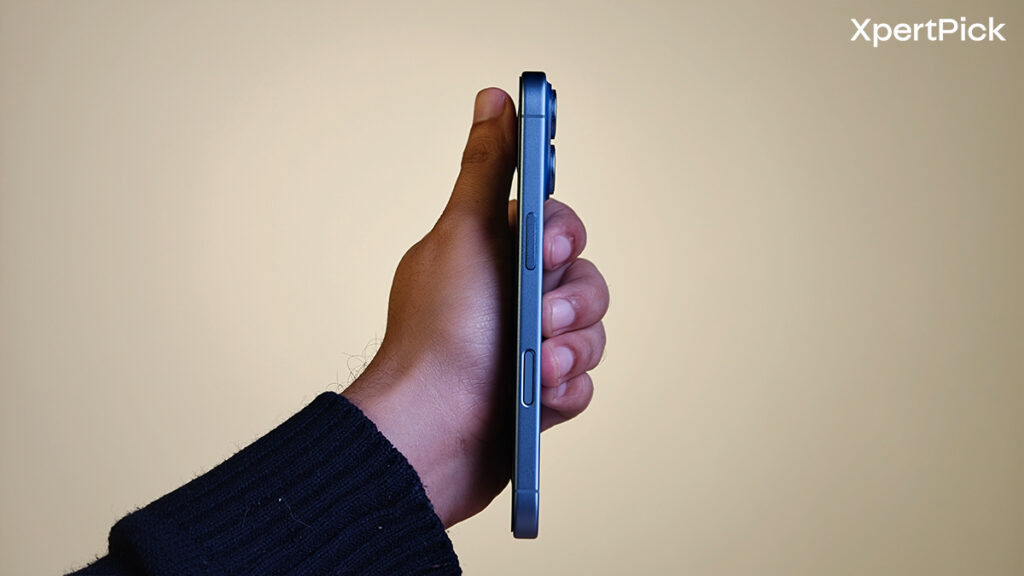
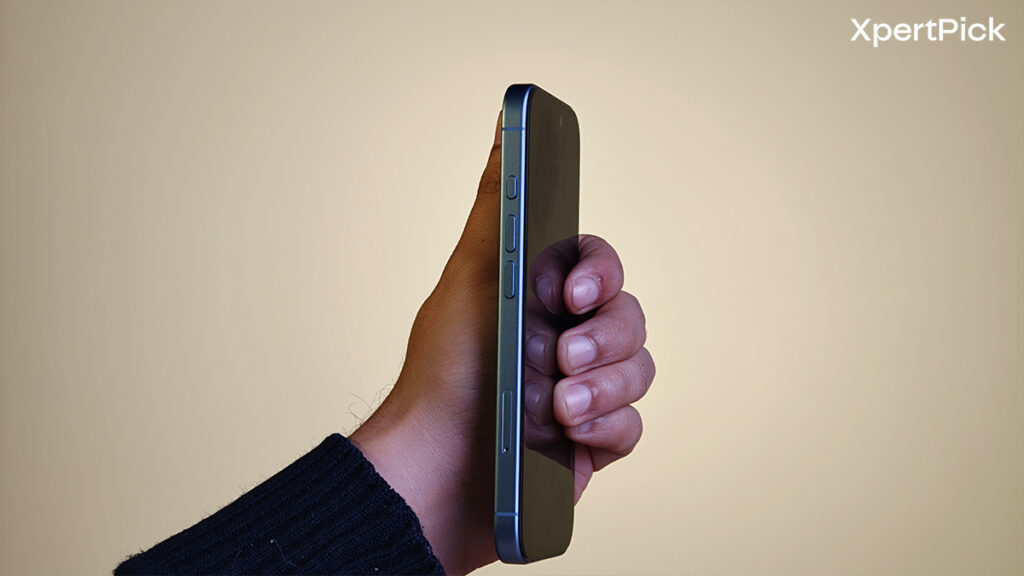
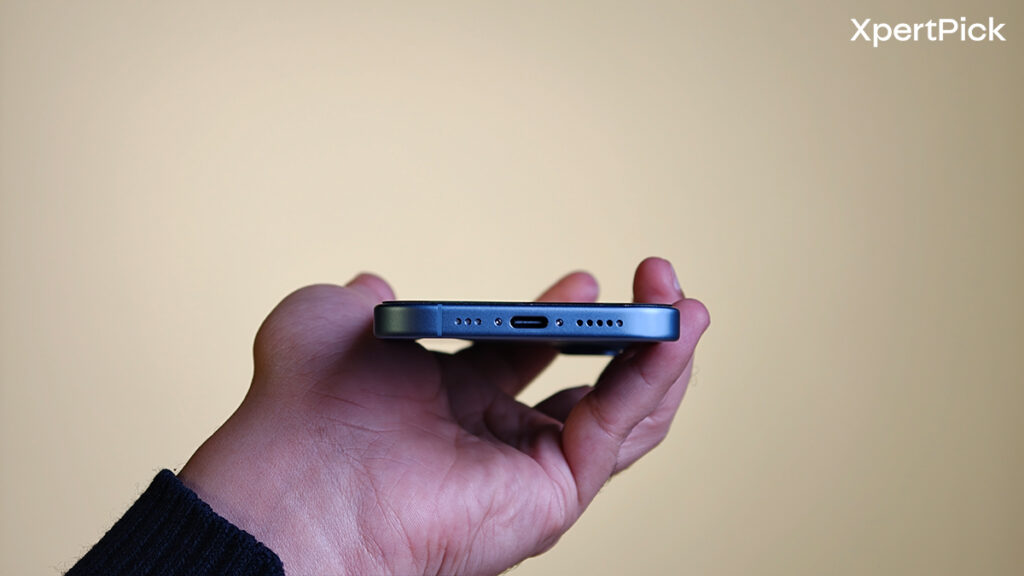
The iPhone 17 feels unmistakably like an iPhone the moment you pick it up. It is familiar, predictable in the best way, and engineered to simply get out of your way. Apple continues with an aluminium frame, flanked by the expected physical layout. The volume buttons and Action Button sit on the left, while the power button and Camera Control key occupy the right side. Antenna lines run across the aluminium chassis, including one along the top, and the bottom houses the speaker, microphone and USB-C port.
That USB-C port is one of the few areas where the base iPhone still concedes ground to the Pro models. It operates at USB 2.0 speeds, which means slower data transfer compared to the faster interfaces found on the Pro variants. For most users who rarely move large files off their phones, this will not be a daily limitation, but it remains a technical compromise worth noting.
Physically, the iPhone 17 stays very close to last year’s design language, but with subtle refinements. It is slightly narrower and marginally shorter than the iPhone 16, while also being around 7 grams heavier. These are not differences that radically alter how the phone feels in hand, but they do affect compatibility with older cases. An iPhone 16 case, for instance, does not fit the iPhone 17 due to these dimensional changes.
Display: No Longer a “Base Model” Experience
One of the most meaningful upgrades on the iPhone 17 is its display, and it is here that Apple has most clearly closed the gap between the base and Pro models.
The screen now measures 6.3 inches, up slightly from the previous generation, and the improvement is not just in size. For the first time, the standard iPhone gains a 120 Hz ProMotion panel, bringing smoother scrolling and animations that were previously reserved for the Pro lineup. The presence of a frame rate limiter option down to 60 Hz in the settings confirms that this is indeed a variable refresh rate display.
Apple has also enabled the Always-On Display on the base model this year, complete with the same customisation options found on the Pro devices, including notification visibility and widget support. In daily use, this makes the iPhone 17 feel far closer to Apple’s flagship experience than previous non-Pro models ever did.
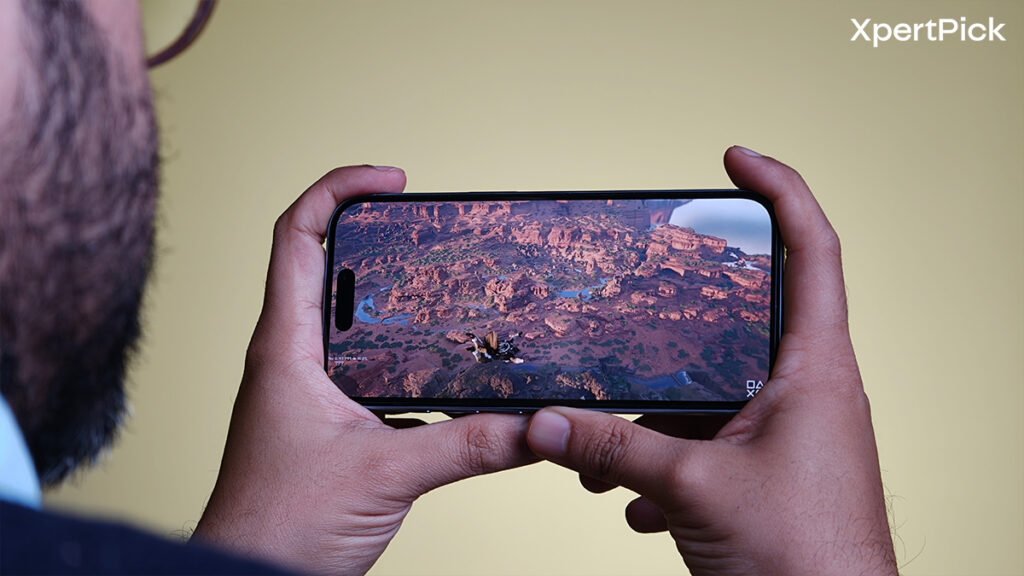
Brightness is another area where compromises are notably absent. The iPhone 17 reaches up to 3,000 nits, matching the Pro and Pro Max variants, and in direct sunlight, the difference is immediately visible. Even under harsh outdoor conditions, the display remains legible and consistent, without aggressively dimming after short periods.
A particularly welcome addition is Apple’s new approach to PWM handling. Under Accessibility settings, users can now enable Display Pulse Smoothing, which effectively reduces or disables traditional pulse-width modulation for dimming the OLED panel. For users sensitive to PWM flicker, this can significantly reduce eye strain, nausea or headaches, issues that often go unnoticed but affect a sizable portion of users. There is a slight trade-off in low-brightness performance under certain conditions, but in practice, the feature works well and makes extended use far more comfortable for those affected.
Gaming, Benchmarks and Thermal Tests: Strong Numbers, Sensible Temperatures
The iPhone 17 proves to be a surprisingly strong gaming device, delivering consistently high frame rates across both competitive and visually demanding titles. In high-refresh esports-style workloads, the device pushes well beyond the 100 FPS mark, showing that Apple’s A19 chip has no trouble handling extreme frame rate targets when thermals allow it. Even more impressive is the stability, with the 5% low staying close to triple digits, which means frame pacing remains tight and gameplay rarely feels erratic or jittery during intense moments.
In visually heavier games like Minecraft running at the highest graphical preset, the iPhone 17 holds a steady 60 FPS cap for most of the session, with occasional drops of 9-10 FPS reflected in the 5% low. This indicates that while the GPU is clearly working near its limits at max settings, the experience remains smooth and entirely playable, without constant stutter.
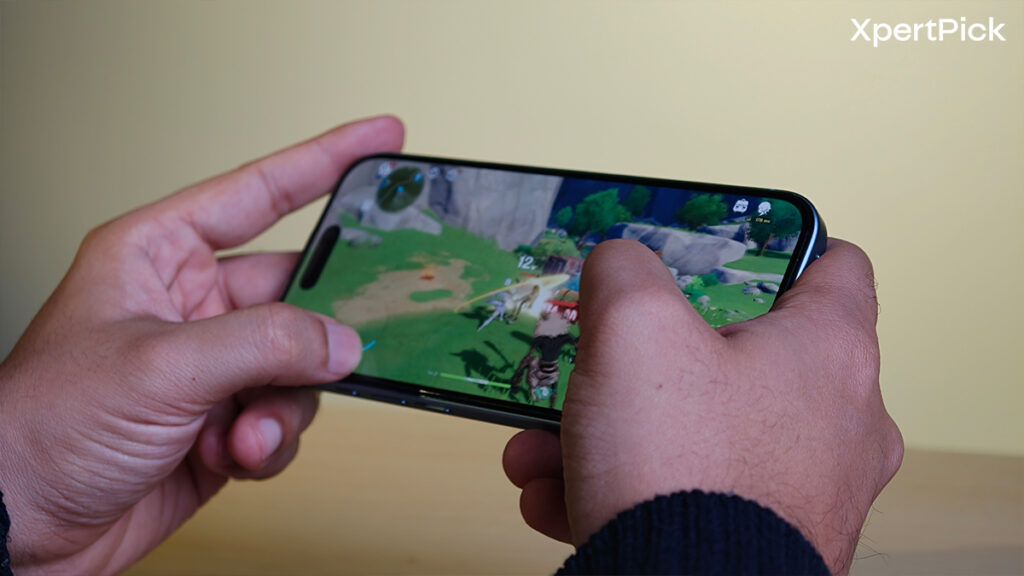
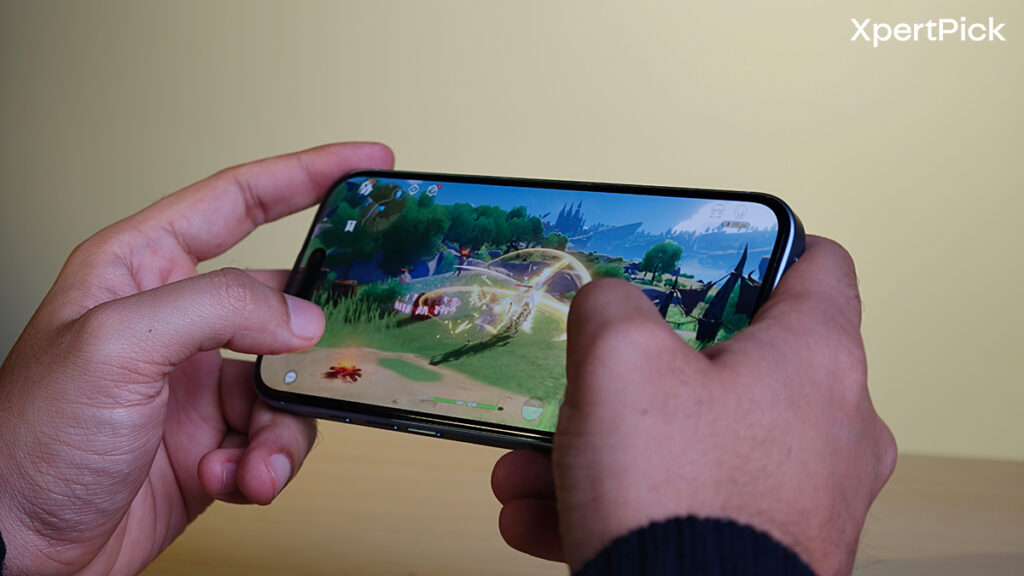
Genshin Impact runs impressively well too. With High graphics and the 60 FPS mode enabled, the iPhone 17 maintains a near-locked 60 FPS, with minimal deviation during combat or traversal.
While synthetic benchmarks rarely tell the full story of how a phone feels in daily use, they do provide a useful reference point for understanding where a device stands within its class and relative to its siblings.
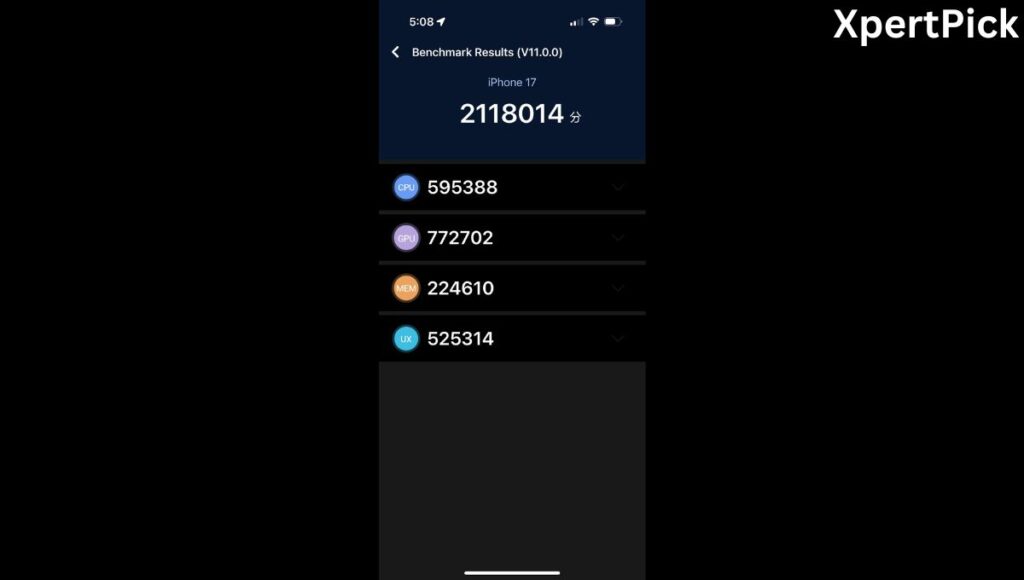
On AnTuTu, the iPhone 17 posts an overall score of 2,118,014, with the CPU contributing 595,388 points and the GPU accounting for a substantial 772,702. These are comfortably flagship-grade numbers, and the GPU performance in particular stands out, placing the iPhone 17 well above most non-Pro devices in raw graphical throughput.
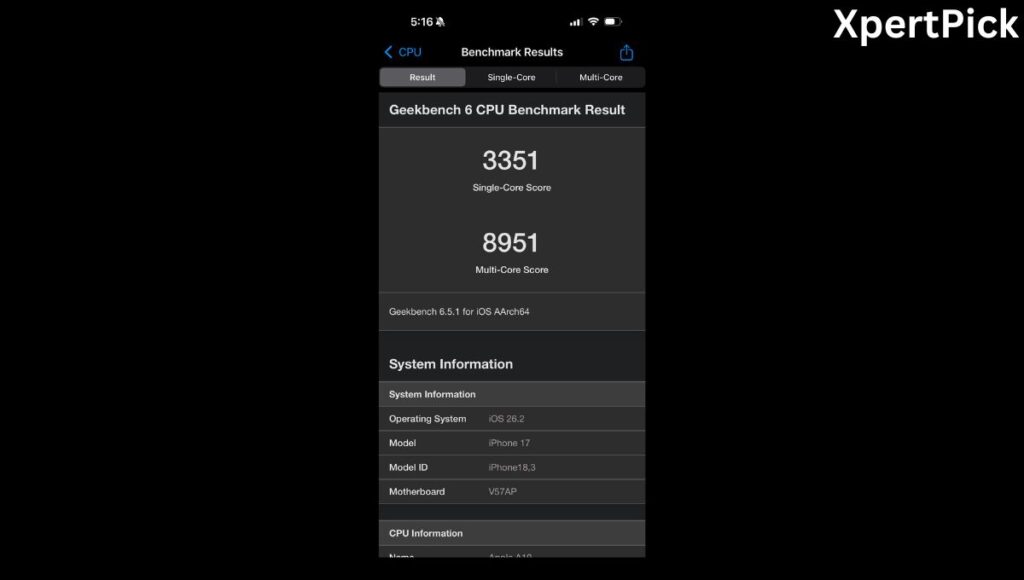
Geekbench paints a similar picture. In version 6.0.1, the iPhone 17 recorded a single-core score of 3,351 and a multi-core score of 8,951, figures that put it surprisingly close to last year’s Pro-level performance. In fact, these numbers land at the higher end of what we typically saw from devices like the iPhone 16 Pro Max, which speaks volumes about how far Apple has pushed its non-Pro silicon this generation.
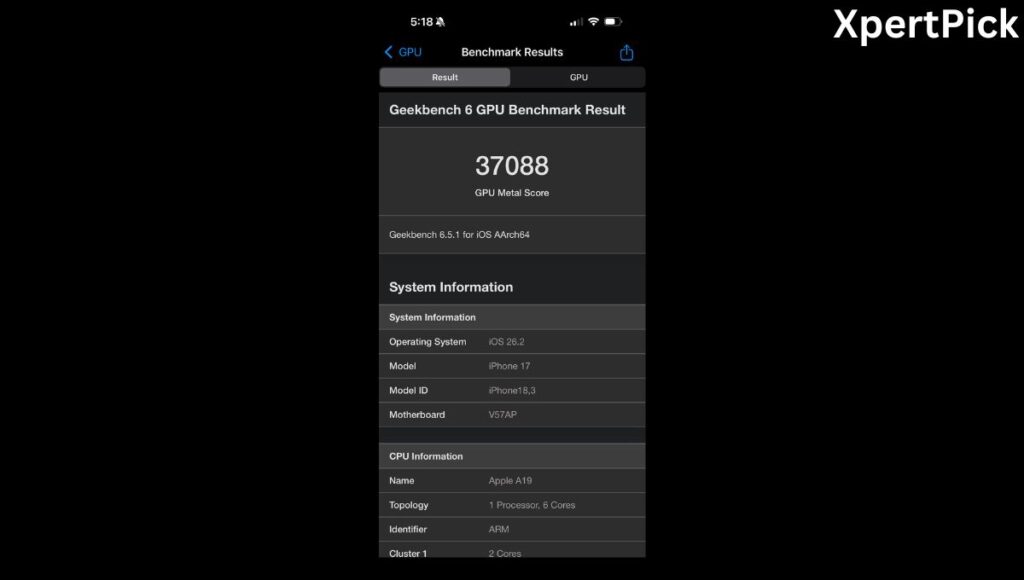
Thermally, the iPhone 17 remains composed even under sustained benchmark loads. During stress testing, the front of the device hovered around 35°C, while the hottest spot on the back, directly above the processor, peaked at approximately 37.5 to 37.6°C. These are well within comfortable limits and never reached a point where the phone felt unpleasant to hold.
Compared to the iPhone Air, which tends to run warmer under similar conditions, the iPhone 17 appears to dissipate heat more efficiently. The aluminium frame likely plays a role here, helping spread thermal load evenly across the chassis rather than concentrating it in one uncomfortable hotspot. That said, the Pro models still maintain a slight edge in sustained thermal dissipation, which is to be expected given their more advanced internal cooling systems.
In everyday use, these figures translate into a phone that feels consistently fast and responsive. Whether switching between apps, using the camera extensively, navigating through Apple CarPlay, or jumping between Wi-Fi and 5G networks, the iPhone 17 maintains its pace without any hiccups. I did encounter the occasional micro-stutter, likely tied to adaptive power management or iOS behaviour rather than hardware limitations, but these were rare and never disruptive to overall usability.
- AnTuTu overall: 2,118,014
- AnTuTu CPU: 595,388
- AnTuTu GPU: 772,702
- Geekbench single-core: 3,351
- Geekbench multi-core: 8,951
Battery Life: Quietly One of the iPhone 17’s Biggest Strengths
Battery life on the iPhone 17 is one of those areas where the improvements do not feel dramatic on paper, yet become immediately noticeable in daily use. Apple has increased the battery capacity from last year’s 3,561 mAh to 3,692 mAh. And although it looks small on paper, the resulting battery life improvement are pretty significant.
Apple claims up to 30 hours of video playback, which is a sizable jump over the iPhone 16. More importantly, this claim does not feel detached from real-world behaviour. In my usage, the iPhone 17 consistently gets me through a full day without any anxiety around topping up mid-way. That includes a mix of web browsing, social media, camera use, music streaming, navigation and Apple CarPlay.
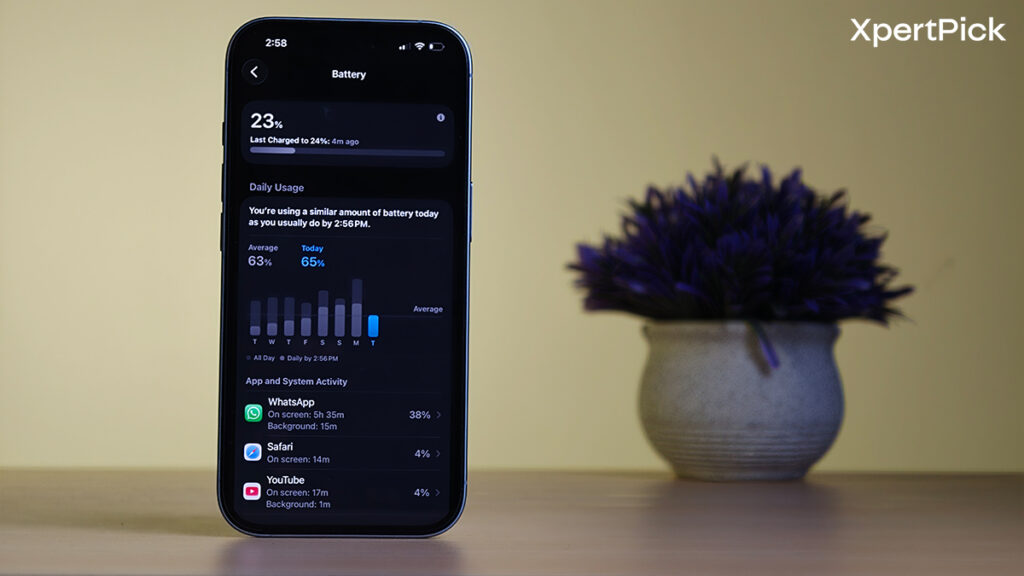
Across a typical workday off the charger, I was seeing close to six hours of active screen time while using around three-quarters of the battery, which is in the same territory as what I experienced with the iPhone 15 Plus. That alone puts the base iPhone 17 in rare company for a non-Plus model.
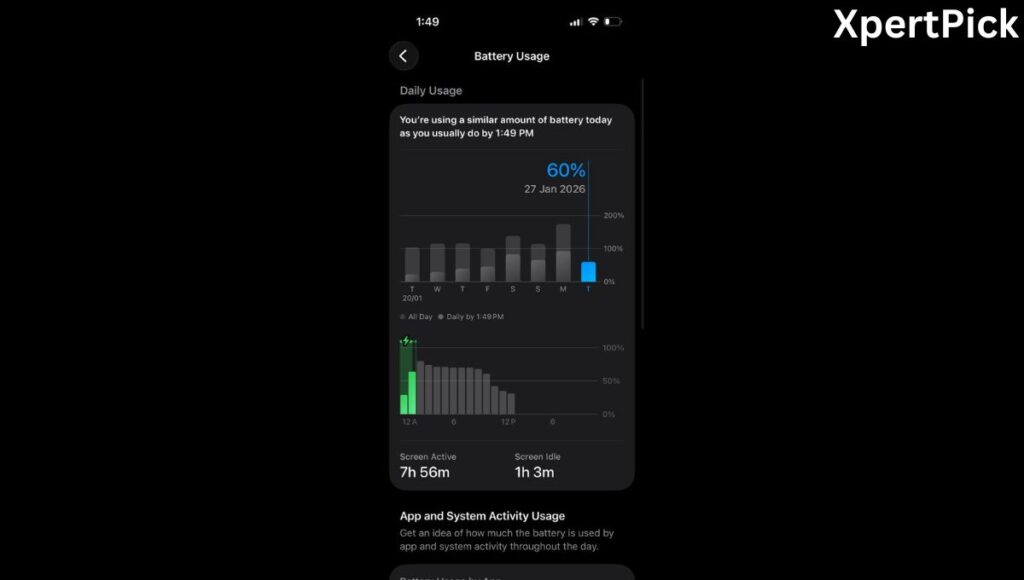
More telling, however, was a particularly revealing day captured in my battery usage stats. By around 1:49 PM, the phone was still sitting at roughly 60 percent charge, despite already logging close to eight hours of active screen time and just over an hour of screen idle. In other words, only about 40 percent of the battery had been consumed for nearly a full workday’s worth of use. If that discharge curve continues in a similar fashion, it comfortably points toward a total screen-on time in the 18 to 20 hour range under comparable conditions, which is an exceptional result for a flagship phone with a high-refresh display and a powerful A-series chip.
Cameras: Finally, No Weak Link in the Base iPhone
Apple’s camera upgrades this year are far more meaningful than they initially appear on paper, especially for the iPhone 17. While the rear cameras look familiar at first glance, the actual shooting experience feels noticeably more complete than before.
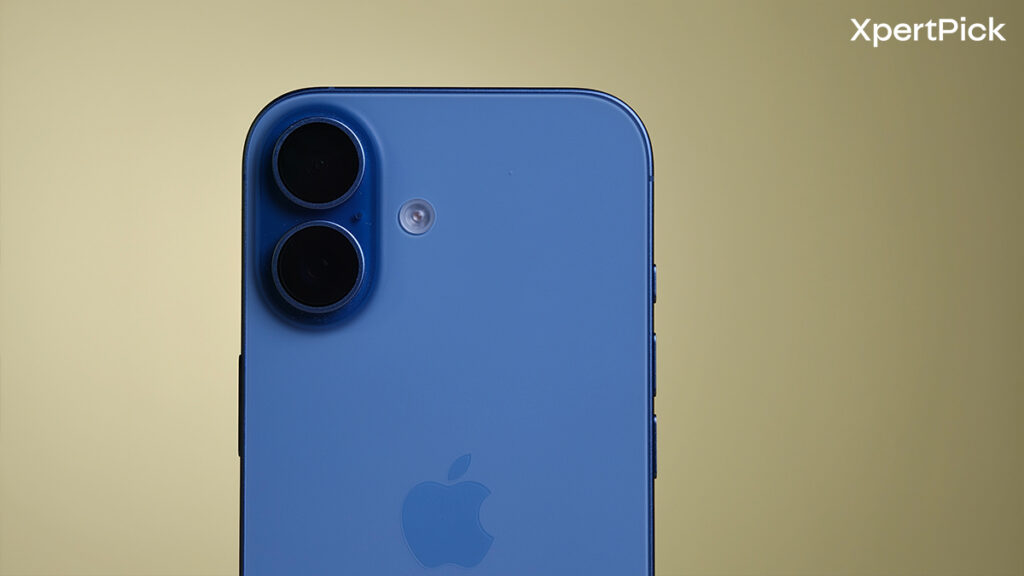
On the back, Apple continues with the 48 MP wide sensor introduced last year, but the major change comes in the form of a new 48 MP ultra-wide camera. With both primary rear cameras now matching in resolution, Apple has effectively removed one of the long-standing asymmetries in the base iPhone’s camera system. Ultra-wide shots no longer feel like a secondary or compromised option. Detail retention, colour consistency, and dynamic range now remain far closer between the two lenses, making lens switching feel far more seamless during real-world use.







In practice, this also means that features like macro photography and wide-angle video benefit substantially. The ultra-wide camera is no longer just for framing convenience, it has become genuinely usable for detail-oriented photography and stabilized video, without that familiar drop in quality that earlier base iPhones exhibited.





However, the most significant camera upgrade on the iPhone 17 is on the front. Apple has introduced an 18 MP “Center Stage” front-facing camera, and it transforms how the phone handles selfies and video recording. Unlike the conventional rectangular sensors used before, this is a square-format sensor that allows Apple to dynamically crop different portions depending on orientation and use case. This enables two key improvements: a more natural landscape shooting option for selfies and video, and greater framing flexibility without sacrificing resolution.





More importantly, this front camera now supports dual recording, allowing you to capture footage from both the front and rear cameras simultaneously. This is a genuinely practical feature for creators, vloggers, and even casual users who want to document reactions while filming what’s in front of them. What makes this particularly notable is that Apple has not reserved this capability for the Pro models. The iPhone 17 uses the same front camera sensor as the iPhone 17 Pro, Pro Max, and even the iPhone Air, which means there is no quality compromise at the hardware level here.
Where the Pro models still differentiate themselves is not through image quality, but through professional video features. The iPhone 17 does not offer ProRes, ProRAW, ProRes RAW, or newer tools like Genlock, all of which remain exclusive to the higher-end models. That said, unless your workflow explicitly depends on these formats, the absence of these features does not meaningfully impact everyday photography or video recording.
iOS 26 and iOS 26.2: When Software Becomes the iPhone 17’s Biggest Weakness
One of the more disappointing aspects of using the iPhone 17 over time has not been the hardware, but the software currently running on it. iOS 26.2, which the phone is presently using, initially appeared to be one of Apple’s more stable updates in recent memory. When it first arrived in mid-December, it delivered smooth performance, no noticeable battery drain, and no overheating issues. In its early days, it felt like a rare update that quietly improved the overall experience.
However, as weeks passed, the behaviour of the update began to change. Over time, iOS 26.2 has gradually become unstable, with a number of issues emerging that significantly affect day-to-day usability. This pattern is particularly frustrating because the update did not launch in a broken state. Instead, it degraded slowly, making the problems harder to immediately attribute to the software.
The most noticeable issue is excessive battery drain, which appears to be directly linked to abnormal heating. The phone frequently becomes warmer than expected, sometimes to the point where it feels uncomfortable in hand, even during relatively light usage. This strongly suggests that the root cause is software-related rather than hardware-specific.
To manage this, Low Power Mode becomes almost a necessity rather than a situational feature. While it does reduce both heat and battery drain by throttling the CPU and GPU, it is clearly not a proper solution for a flagship phone. Adaptive Power Mode, which is meant to intelligently manage power consumption, does not appear to be functioning reliably either, with overheating persisting even when it is enabled.
Storage management has also become less predictable. Earlier builds of iOS 26 kept system data usage well under control, often hovering around 1 GB or lower. With iOS 26.2, system data has expanded to nearly 10 or 12 GB on some devices, which, while not catastrophic, reflects inefficient storage handling and contributes to the perception of a poorly optimised update.
Network reliability is another area where iOS 26.2 has introduced regressions. While Wi-Fi, mobile data, and Bluetooth remain largely stable, call performance has degraded. Calls often take longer to connect, occasional call drops occur mid-conversation, and voice transmission can intermittently cut out.
Call history and messages occasionally appear blank before reloading after several seconds or after toggling between tabs. This issue existed in iOS 26.1 and continues in 26.2. Keyboard lag and erratic text suggestions are also present across both newer and older iPhones, further contributing to the perception of a system that feels unfinished.
At the time of writing, Apple has just released iOS 26.2.1. I have not installed it on my iPhone 17 yet, as it is generally unwise to test or benchmark a smartphone immediately after an update, since the system requires some time to complete background processes such as indexing.
However, at least for now, a phone as capable as the iPhone 17 feels held back by iOS 26.2, which currently stands out as the weakest link in an otherwise very strong product.
Verdict: Possibly the best smartphone bogged down by buggy software
It is frustrating to see how close Apple is to perfection with the iPhone 17. The almost perfect form factor, display, and battery life followed by a decent camera, an exceptional video camera, and a rock solid reliability makes the iPhone 17 the most easy recommendation of 2026.
However, after personally using the notoriously buggy iOS 26 and its subsequent updates, much of what makes the iPhone 17 so compelling ends up being overshadowed by regular call drops, frequent typing errors, and persistent overheating.
The particular iPhone 17 I reviewed is my personal unit, and even after months of ownership, my love-hate relationship with it continues. That is likely to remain the case until Apple becomes more serious about fixing its software and writing the kind of code that truly does justice to the excellent hardware it has built so painstakingly.
Until then, I will continue recommending the iPhone 17 as a strong piece of hardware, but not as a complete smartphone experience.
Pros
- Excellent display with 120Hz ProMotion, Always-On, and class-leading brightness on a base model
- Strong real-world battery life with highly efficient power management
- Consistent flagship-level performance for daily use, gaming, and multitasking
- Upgraded 48MP dual-camera setup with a notably improved front camera
- Familiar, premium design with solid build quality and good in-hand feel
Cons
- iOS 26 remains unstable and undermines an otherwise strong hardware experience
- USB 2.0 port limits data transfer speeds compared to Pro models
- Lacks Pro-grade camera features like ProRAW, ProRes, and advanced video controls
- Thermal performance is good but still trails the Pro models under sustained loads
- Incremental design changes offer little visual differentiation from the previous generation