Apple has long been the benchmark in the premium smartphone segment. Even among tech enthusiasts who aren’t necessarily fans of the iPhone, there’s a shared appreciation for the polish, attention to detail, and overall refinement that define Apple’s top-tier devices. But in recent years, Android flagships have steadily closed that gap, not just in raw power, but in overall experience.
The Find X9 Pro is a prime example of that ambition. It checks every box with advanced cameras, cutting-edge hardware, polished software, and premium construction. But that alone doesn’t make it stand out in a sea of Android flagships. But in a market where nearly every brand offers similar specs, here’s how the Find X9 Pro differentiates itself.
Elegant, Sleek,& iPhone-y
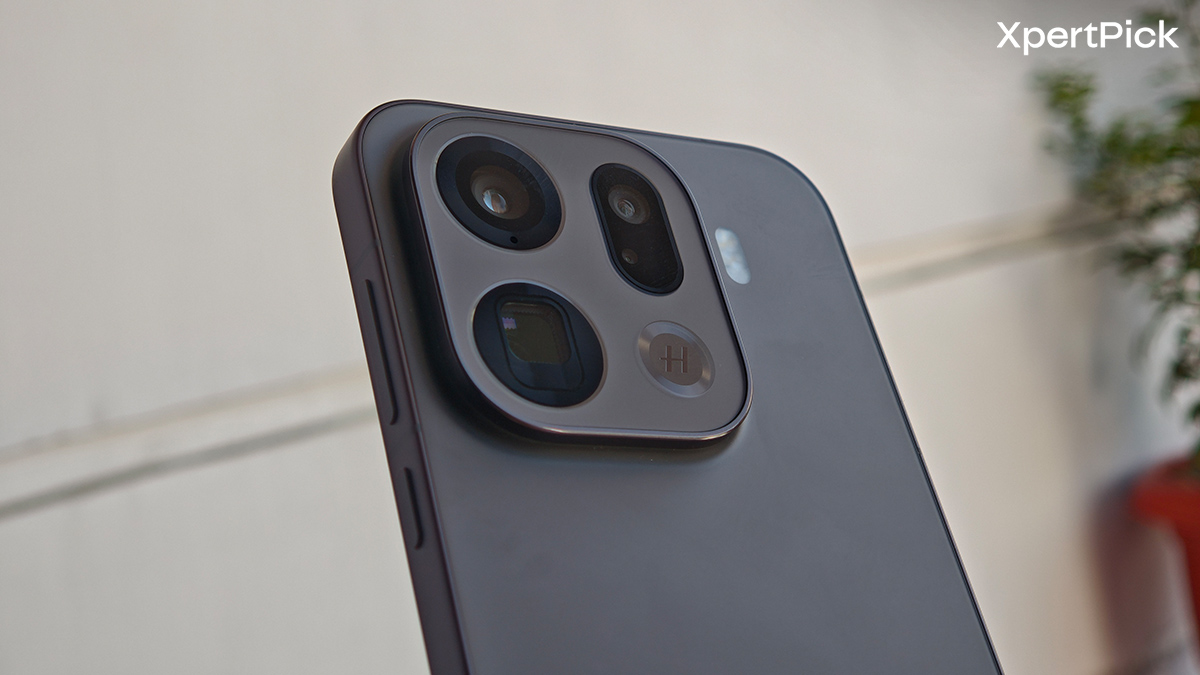
Close your eyes and hold the Find X9 Pro, and the resemblance to modern iPhones is uncanny. Flat front and back, squared metal edges, glass sandwich construction, and now even a programmable side button. The familiarity is immediate. But Oppo has kept the visual identity distinct with the new design overhaul.
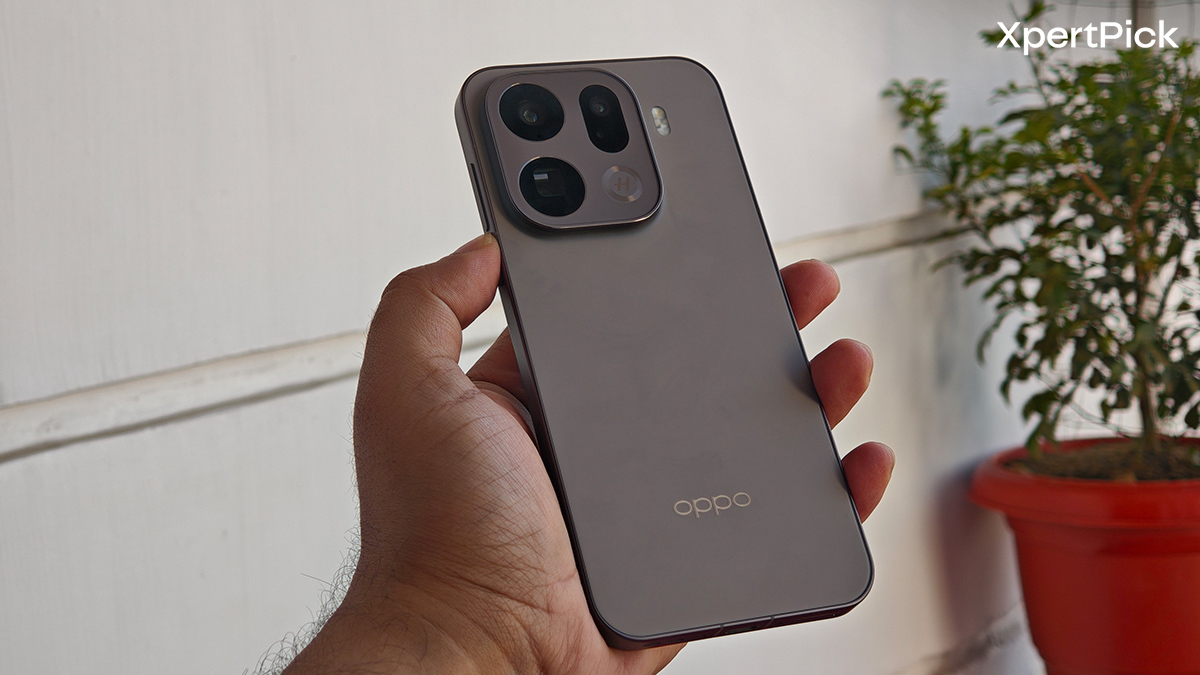
The massive circular camera island is gone, replaced by a more compact squircle module. It’s a design language first seen on OnePlus flagships (like the OnePlus 15), but Oppo adds its own refinements. Dropping the second telephoto sensor has helped shrink the module, which also carries the subtle Hasselblad branding.
Corning’s Gorilla Glass Victus 2 protects the rear and front glass, and you also get an IP68 + IP69 rating for water and dust resistance. I can’t get enough of the Titanium Charcoal version I received, which looks absolutely stunning with an understated but premium look. I do have some gripes, but they are far and few in between.
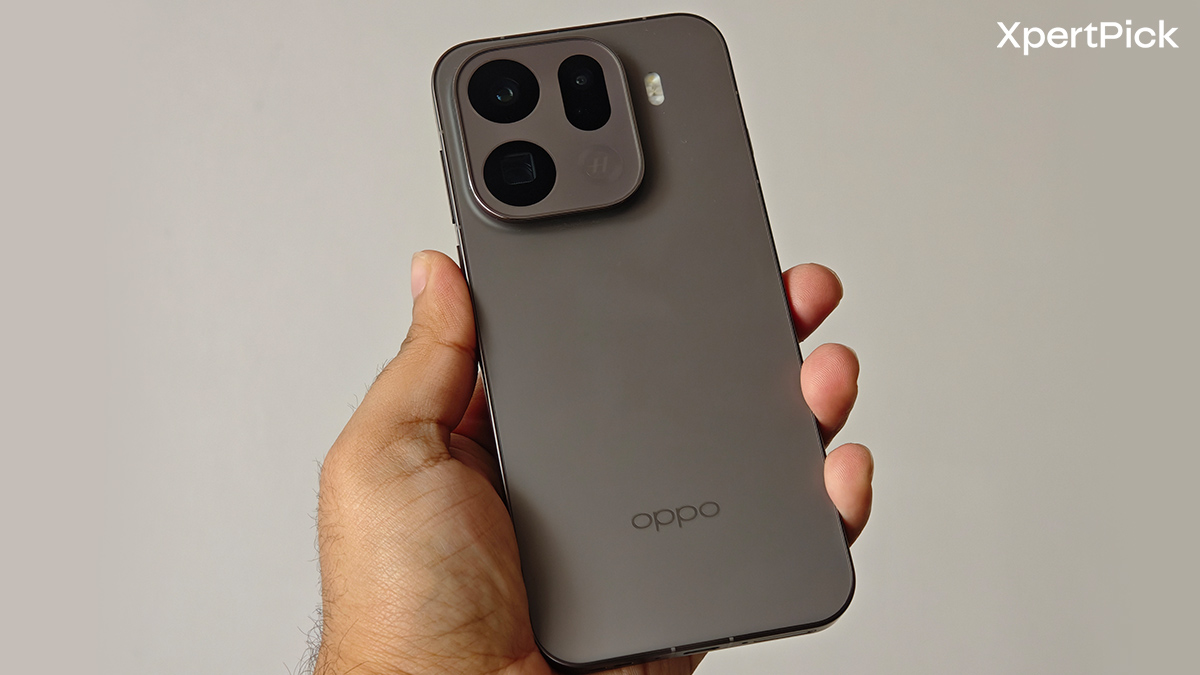
Holding it for extended periods can feel tiring, and without a case, it’s slippery. I’m all for the “free the phone” movement, but this feels like a polished art piece that could slip at any moment. In fact, my Find X9 Pro review unit once slid off a bedside table because vibration nudged it across the surface. That sleek, flat design isn’t the easiest to grip.
The 6.78-inch LTPO AMOLED display is top-tier. Add a 1.5K resolution, a 1-120Hz variable refresh rate, and up to 3,600 nits of peak brightness, and you get a vibrant, responsive, and smooth viewing experience. Be it harsh sunlight or a dark room, you can manually adjust the brightness from 1 to 1800 nits.
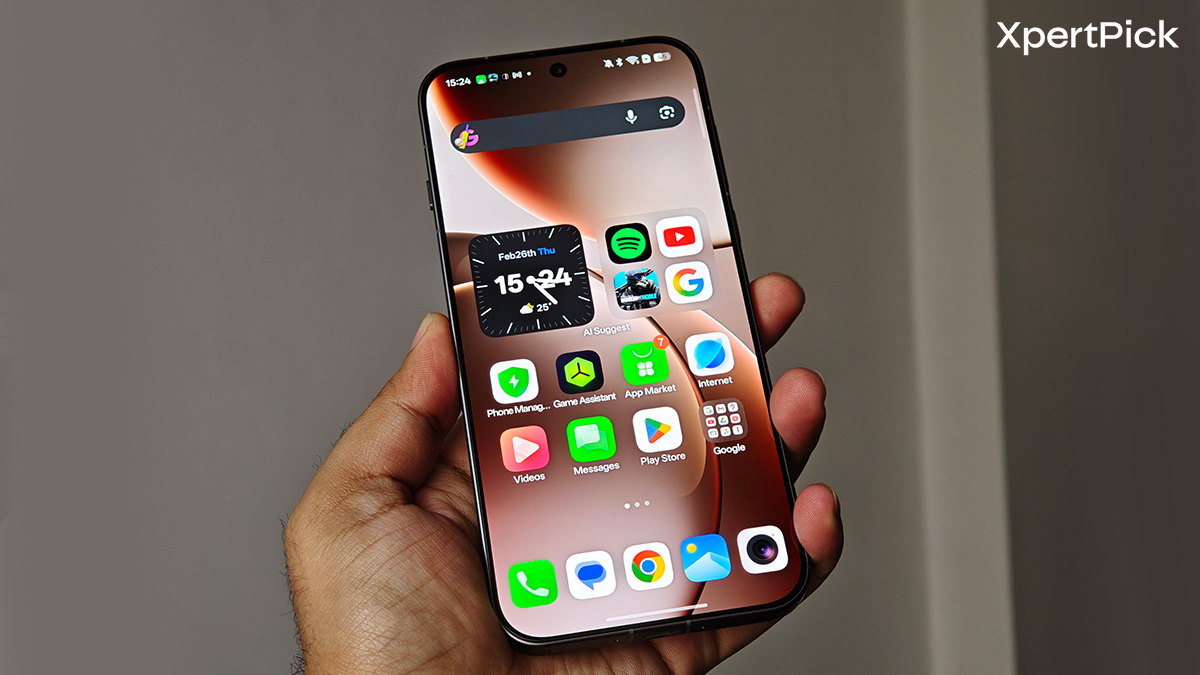
So you get great visibility outdoors and a comfortable viewing experience at night. The uniform 1.15mm bezels add to the premium look, offering an unintrusive viewing experience. This display competes with the very best, and watching any HDR-supported content is a treat.
A Beauty and A Beast
The Oppo Find X9 Pro is not just about the looks and versatile cameras. It also strikes a great balance between endurance and power. Underneath the gorgeous chassis is MediaTek’s latest and greatest Dimensity 9500 SoC, which is coupled with 16GB of LPDDR5X RAM and 512GB of UFS 4.1 storage. So, performance here is flagship-tier, allowing the device to rank among the fastest phones on the market right now. From gaming to everyday use, performance remained reliable and smooth. Here’s a look at its synthetic benchmark results:
- AnTuTu – 2,891,046
- AnTuTu (CPU) – 506,460
- AnTuTu (GPU) – 1,339,254
- Geekbench: 3,203 (single) / 9,348 (multi)
The gameplay experience was solid, with competitive games like BGMI and COD Mobile easily hitting a stable 120fps. High-fidelity titles like Genshin Impact and Wuthering Waves didn’t hit triple-digit frame rates, but managed to stick around the 60fps mark. Thermal throttling doesn’t appear within the first 30 minutes, though extended sessions do cause minor dips. Commendably, Oppo offers quite an effective heat-dissipation solution for stability and quick cooldowns.
Battery life is one of the biggest upgrades. The jump to a 7,500mAh cell is massive. We are seeing even larger capacities hitting the market now, but this battery size is still nothing short of impressive. In moderate use, it easily stretches into two days. Realistically, most users will charge after a day and a half.
That said, optimisation still needs refinement. On some days, battery drain felt inconsistent. This could improve with a few software updates. Charging the monstrous battery takes around an hour with the included 80W charging adapter. Oppo also offers 50W wireless fast charging and 10W reverse wireless charging support. This feature actually came in handy on the go.
Starting to See a Frame in Everything
A mark of a great smartphone camera is that it makes you want to shoot more, and the Find X9 Pro does exactly that. With more ways to quickly launch the camera, you are always a second away from a photoshoot. Blending advanced camera hardware, clever software, and some Hasselblad touches, you get a fun and versatile experience. The company has made some notable changes to the Find X9 Pro’s image sensors, so let’s check it out:
- 50MP 1/1.28″ Sony LYT828 main sensor (f/1.5 aperture, OIS, PDAF)
- 50MP 1/2.76” ISOCELL JN5 ultra wide angle lens (f/2.0, PDAF, Macro)
- 200MP 1/1.56” ISOCELL HP5 periscope telephoto shooter (f/2.1, 3x optical zoom, OIS)
- 2MP monochrome sensor
- 50MP 1/2.76” ISOCELL JN5 selfie camera (f/2.0, PDAF)
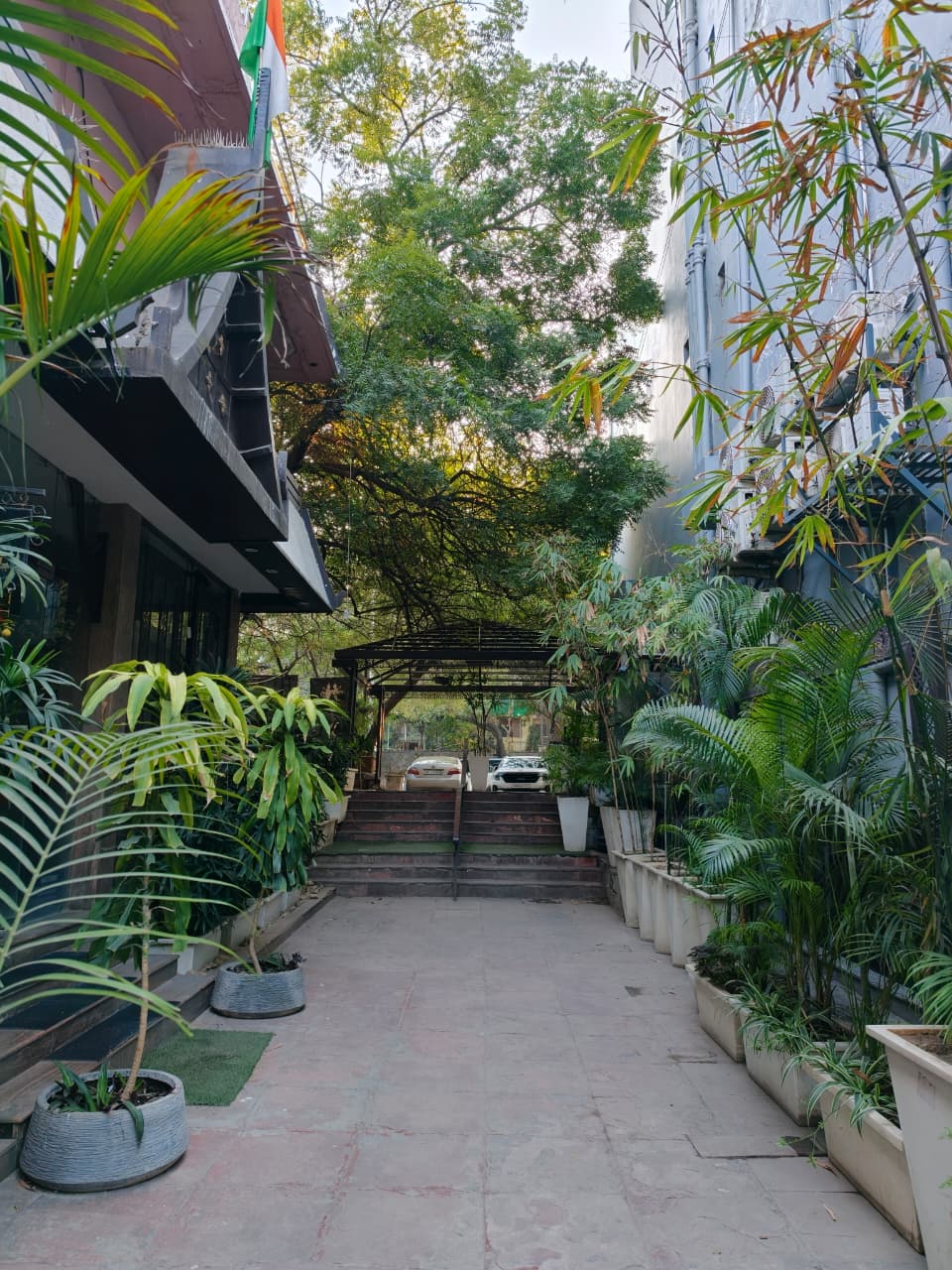
Shooting with the main camera is almost always reliable. Pictures in the day pack great details, and accurate colours. Even in high dynamic scenes, highlights are well preserved, and subjects don’t get overexposed. Compared to the Motorola Signature with an identical sensor, HDR scenes here are a step above. Oppo made a notable upgrade to the main sensor, which mainly shows in dim lighting.
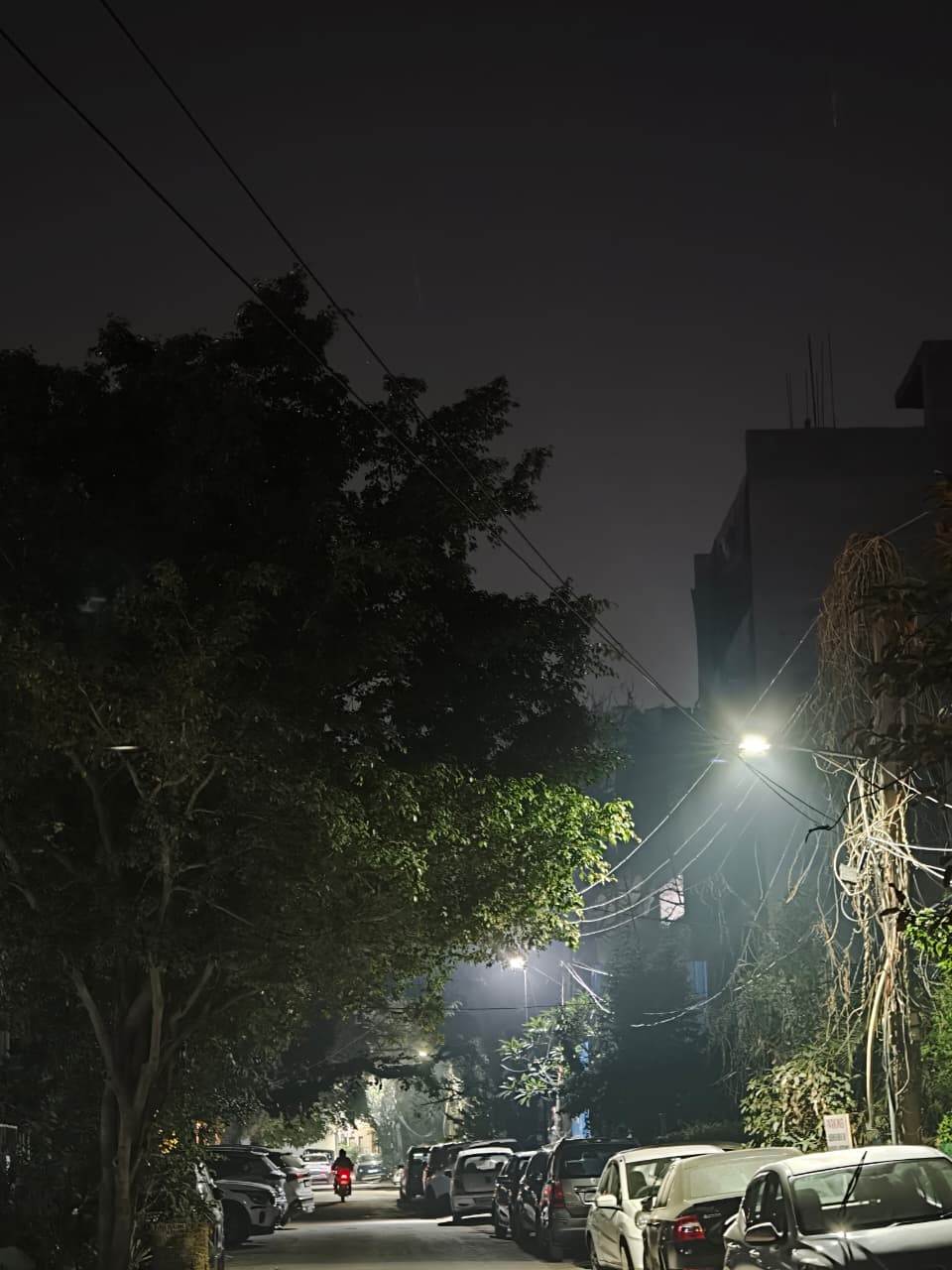
At night, the larger sensor and wide aperture retain details with minimal noise or washed-out colours. Even under bright artificial lighting, the pictures look sharp and vibrant. The only issue here was with its autofocus, which also affected its telephoto shooter. Occasionally, the phone fails to focus properly on the subject, although this only occurs once in every 10 or so shots. Apart from this, you’re getting a proper flagship-level experience here with solid performance in various lighting conditions.
The shift to a single 200MP telephoto instead of dual telephotos prioritises sensor size over focal flexibility. You lose native longer zoom, but gain better low-light performance. While I still prefer the Vivo X300 Pro’s periscope, the camera here offers great zoom photography.
















The natural compression with Hasselblad’s iconic texture makes for some great shots. In the day, 10x digital crop pictures are fairly usable, but the quality quickly drops in night photography. There is visible noise in dim lighting, and zooming past 6x brings in aggressive sharpening to help retain details. But this tends to make the images look unnatural. For the most part, you won’t miss the 6x telephoto on its predecessor, since the 200MP allows for improved digital crop-in. However, it doesn’t match the quality of that longer native focal length.
The ultra-wide lens is the smallest of the bunch, and it still performs admirably. Images are solid in daylight with consistent colour tones and good details. Sharpness of the pictures takes a hit at night, with unavoidable lens distortions and soft edges.
All three cameras bring similar colour tones, which is greatly appreciated, and offer 4K60fps video recording. The odd autofocusing issue returns here, and it’s quite frustrating considering how well the Find X9 Pro performs in capturing videos. To put this phone to the test, I’ve even used some footage from this phone for professional shoots that showcased impressive stabilisation, good details, and vibrant colours.





















Portraits mode on the Find X9 Pro is just as great, if not a step above, the Vivo X300 Pro. It delivers sharp subject separation and accurate edge detection, even with hair detail. There are a bunch of filters available, and these can genuinely elevate the shooting experience.
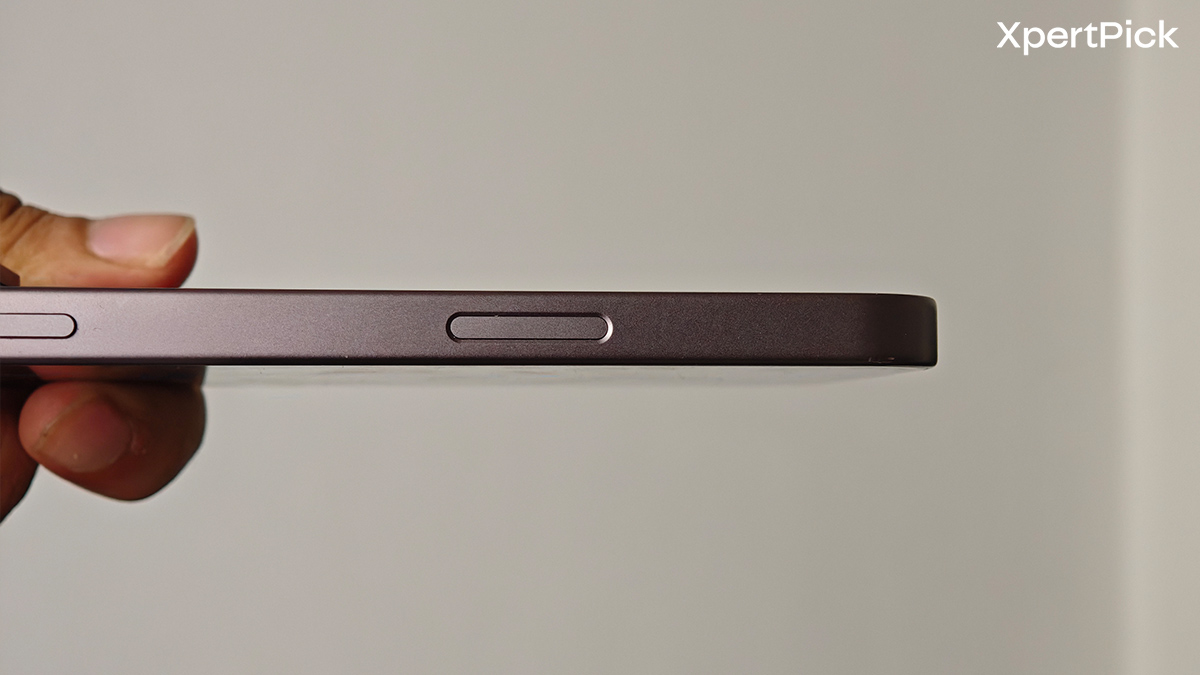
The Quick button on the side makes a return. Just like the Find X8 Pro, it mimics Apple’s camera control key. Double-tapping this key lets you quickly launch the camera app, and sliding your finger lets you zoom in and out. To avoid accidental inputs when using the cameras in portrait orientation, the button only accepts the sliding input in landscape orientation. It’s functional, not transformative. While it is handy to have another shooting method that simulates the feel of hitting a real shutter button, the controls on the display are generally more intuitive.
Subbing in for iOS
ColorOS feels like a hybrid of Android flexibility and iOS polish. My review of the Find X9 talked about the ‘iOS-ification’ of the Android skin, which was also evident in the OnePlus 15 & OnePlus 15R reviews. There is a clear shift in the software with these brands, and it kind of makes sense. Oppo and its subsidiaries are looking to poach iPhone users with this familiar look, especially in China.
And this has been quite effective. I had a long-time iOS user try out this device for a couple of days, and they were quite impressed with the customisability and the recognisable look and feel. O+ Connect helped bridge the gap with Macs and iPads for file transfers, and aside from the few janks, the experience allowed for smooth file transfer.
Now I’m not saying you should go out there to replace your iPhones, but the foundation here seems solid. Overall, the UI experience is fluid, and the AI-powered tools are handy (like AI Writer, AI VoiceScribe, & More). The in-depth customisation is still on offer, and thankfully, the light bloatware is removable.
Verdict
The Oppo Find X9 Pro isn’t just another Android flagship trying to out-spec the competition. Instead, it focuses on refinement with premium design, reliable cameras, powerful internals, and software that feels intentional. More importantly, it positions itself as a comfortable landing spot for iPhone users who want Android flexibility without sacrificing familiarity.
It isn’t flawless. The weight, occasional autofocus hiccups, and battery optimisation quirks hold it back from absolute perfection. But taken as a complete package, the Find X9 Pro feels like one of the most cohesive Android flagships available right now. For Rs 1,09,999, the Find X9 Pro is a worthy competitor in the premium smartphone segment, easily rivalling the likes of the Vivo X300 Pro and the latest iPhones.
Pros
- Premium design and build
- Flagship-level performance
- Massive 7,500mAh battery
- Fast wired and wireless charging
- Excellent cameras
- Apple ecosystem compatibility with O+ Connect
Cons
- Slippery and heavy design
- Occasional autofocus inconsistency
- Quick Button feels gimmicky
- Battery optimisation needs refinement