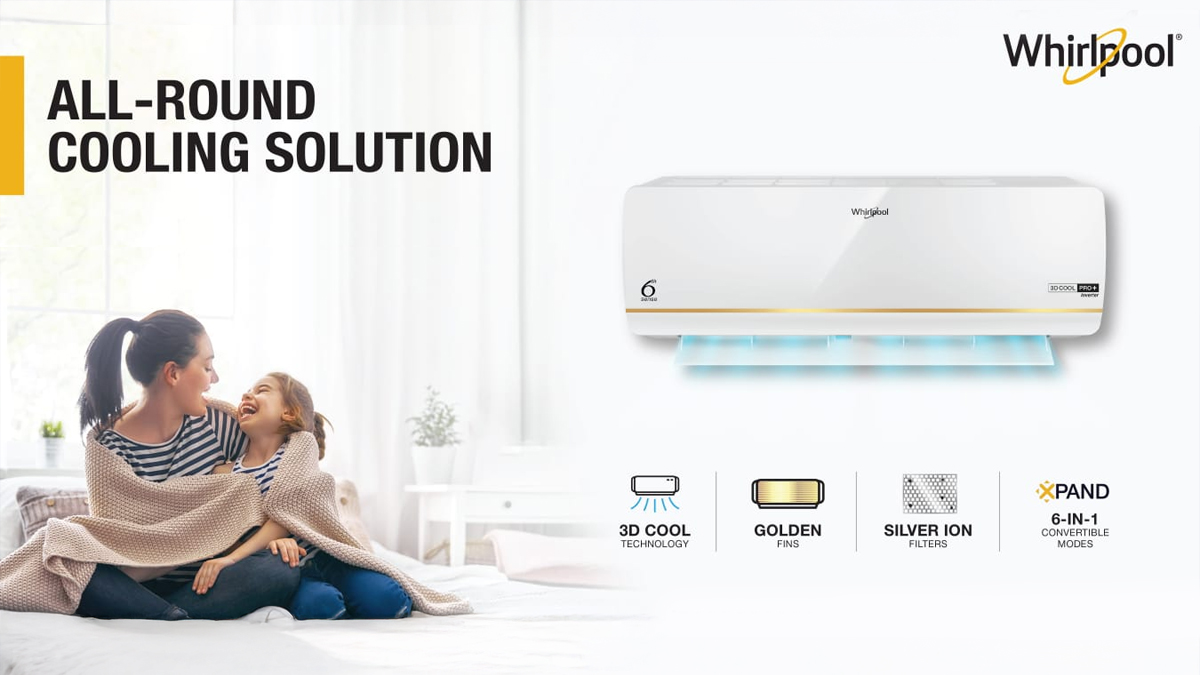
Indian summers are no longer about short bursts of heat. Longer heatwaves, higher ambient temperatures, and extended daily AC usage have changed what buyers expect from air conditioners. Cooling speed still matters, but sustained comfort, airflow consistency, and power efficiency over long hours matter more. Whirlpool’s new 3D Cool Pro+ AC range is designed around these evolving realities, at least on paper.
The company claims the new range is engineered to deliver uniform cooling even when outdoor temperatures reach 56 degrees Celsius, while also addressing common complaints such as uneven airflow, harsh drafts, and rising electricity bills. The question that we have been grappling with is not whether it can cool, but how predictably it can do so across different room sizes and usage patterns.
What “Cooling at 56 Degrees” Actually Signals
Whirlpool says the 3D Cool Pro+ range is tested to operate effectively at ambient temperatures as high as 56 degrees Celsius. In practical terms, most users will not encounter such extremes daily. However, high ambient ratings usually indicate stronger compressors, more stable heat exchange, and better tolerance to voltage and thermal stress.
For XP readers, this is best interpreted as a durability and reliability signal rather than a literal daily use scenario. The real-world question is whether the AC can maintain stable indoor temperatures during prolonged heat spells without frequent cycling, noise spikes, or efficiency drops.
A headline feature of the 3D Cool Pro+ range is its claimed air throw of up to 60 feet. On paper, this suggests suitability for large living rooms and open layouts, which are increasingly common in urban Indian homes.
In real use, airflow effectiveness depends on ceiling height, room geometry, furniture placement, and vent direction. We have plans to extensively test a few air conditions, and in our XP testing, we would focus on whether this long air throw translates into even temperature distribution or simply stronger airflow in a narrow path. Eliminating hot spots matters more than sheer throw distance.
Fast Cooling Versus Comfortable Cooling
The Turbo Chill mode promises to bring the room temperature down to 24 degrees Celsius in about 60 seconds. Quick pull-down performance is useful when entering a heat-soaked room, but it often comes with trade-offs such as higher noise levels and uneven airflow.
For XP readers, we would like to remind that sustained comfort is more important than momentary speed. Key evaluation points will be how quickly the AC stabilises after Turbo mode, whether it avoids overshooting temperatures, and how quiet it remains during prolonged operation.
Airflow Modes and Sleep Comfort
Whirlpool includes three airflow profiles through its 3D Air System: Focused, Diffused, and Sweep modes. Focused mode targets rapid relief, while Diffused mode is intended to reduce harsh drafts, particularly during sleep. Sweep mode uses a four-way swing to distribute air more evenly.
In practice, many ACs offer similar airflow adjustments, but execution varies widely. XP testing would examine whether Diffused mode genuinely softens airflow or merely reduces fan speed, and whether Sweep mode improves uniform cooling or simply increases air movement.
Air Quality Claims Need Clear Framing
The inclusion of Silver Ion Filters positions the 3D Cool Pro+ range as a healthier indoor cooling option. These filters help reduce bacteria and allergens, which is beneficial during long AC usage hours.
However, it is worth noting that this is not equivalent to air purification. Silver-ion filtration improves hygiene in circulating air but does not replace dedicated air purifiers. The value here lies in incremental improvement, not comprehensive air cleaning.
Energy Flexibility and Long-Hour Usage
Whirlpool’s 6-in-1 Xpand Technology allows users to scale cooling capacity based on usage needs, from lower power operation to a 110 per cent performance mode. This feature is particularly relevant for households that run ACs for long hours but do not always need maximum cooling.
The real benefit will depend on how intuitive these modes are and whether users can easily identify the right setting for different times of day. XP evaluation would focus on actual power draw differences and whether energy savings are meaningful in day-to-day usage.
Build Quality and Maintenance Considerations
Durability features such as Golden Fin coating, 100 percent copper condensers, and ODU Self Clean are practical inclusions for Indian conditions. Coastal humidity, dust, and difficult outdoor unit access remain genuine concerns for AC owners.
These features are less about innovation and more about long-term ownership experience. Their effectiveness becomes clear only after months of usage, particularly in demanding environments.
Who This AC Appears Suited For
Based on specifications and positioning, the Whirlpool 3D Cool Pro+ range appears best suited for medium to large rooms, households with long daily AC usage, and buyers prioritising uniform cooling over headline cooling speed alone. The availability of 1-ton, 1.5-ton, and 2-ton options with both 3-star and 5-star ratings gives it broad applicability.
Before recommending this range, XP would want to closely evaluate airflow distribution, noise levels across modes, real-world power consumption under different Xpand settings, and temperature stability during prolonged operation. Claims around extreme heat performance and rapid cooling are promising, but consistency will determine real value.
Whirlpool has mentioned that the pricing for the 3D Cool Pro+ range starts at Rs 35,000. The models are available across major retail stores and online platforms in India.