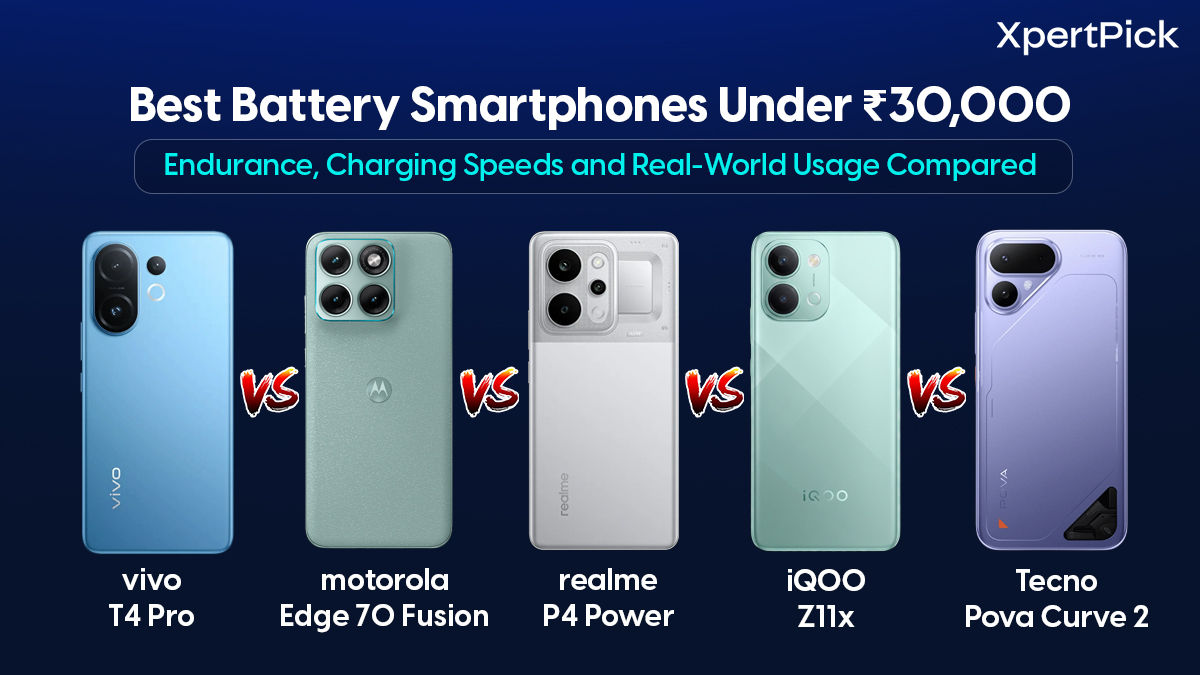
If you’re looking for the best battery smartphones under ₹30,000 in 2026, the segment has evolved far beyond basic endurance. This is no longer just about getting through a day; it’s about multi-day usage, sustained workloads, and charging systems that can quickly refill large batteries.
This comparison focuses on five battery-centric smartphones that take very different approaches. The Realme P4 Power pushes boundaries with a 10,001mAh silicon-carbon battery. The Tecno Pova Curve 2 pairs a large cell with an unusually slim design. The vivo T4 Pro takes a balanced route with faster charging and performance tuning. The iQOO Z11x targets value-focused buyers with strong endurance at a lower price. The Motorola Edge 70 Fusion focuses on efficiency and system optimization rather than brute capacity.
Battery Capacity And Hardware Overview
| Attribute | Realme P4 Power | Tecno Pova Curve 2 | vivo T4 Pro | iQOO Z11x | Motorola Edge 70 Fusion |
| Battery Capacity | 10,001mAh | 8,000mAh | 6,500mAh | 7,200mAh | 7,000mAh |
| Charging Speed | 80W | 45W | 90W | 44W | 68W |
| Processor | Dimensity 7400 Ultra | Dimensity 7100 | Snapdragon 7 Gen 4 | Dimensity 7400 Turbo | Snapdragon 7s Gen 4 |
| RAM Options | 8GB / 12GB | 8GB | 8GB / 12GB | 6GB / 8GB | 8GB / 12GB |
| Storage Options | 128GB / 256GB | 128GB / 256GB | 128GB / 256GB | 128GB / 256GB | 128GB / 256GB |
| Display | AMOLED, 144Hz | AMOLED, 144Hz | AMOLED, 120Hz | LCD, 120Hz | AMOLED, 144Hz |
On paper, the Realme P4 Power completely changes expectations in this segment. A 10,001mAh battery in a sub-10mm chassis is a significant engineering step. But capacity alone doesn’t define real-world performance, which is where efficiency and tuning come into play.
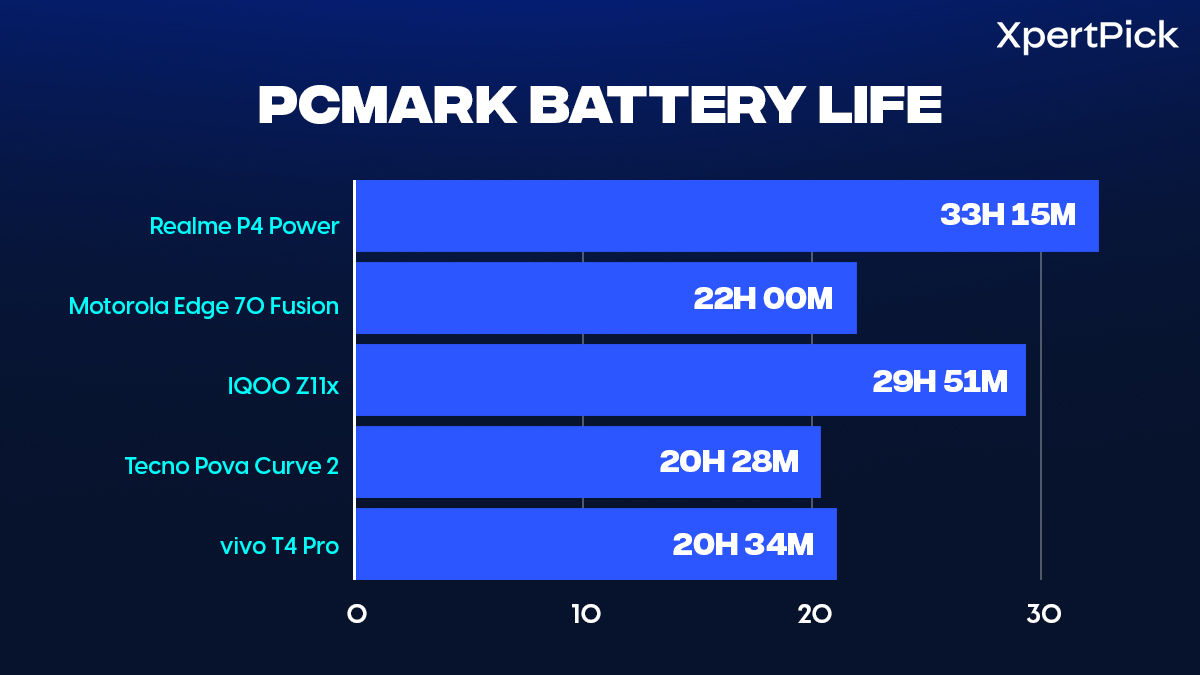
Battery Life: Realme P4 Power Sets the Endurance Benchmark
| Smartphone | PCMark Battery Life |
| Realme P4 Power | 33h 15m |
| Motorola Edge 70 Fusion | 22h 00m |
| iQOO Z11x | 29h 51m |
| Tecno Pova Curve 2 | 20h 28m |
| vivo T4 Pro | 20h 34m |
The Realme P4 Power sets a completely different benchmark here, stretching all the way to 33 hours and 15 minutes. That’s not just a lead, it’s a gap large enough to put it in its own category. In practical terms, this is the kind of phone that comfortably pushes into two-day usage without needing to be managed.
The iQOO Z11x comes next at 29 hours and 51 minutes, and it holds its ground surprisingly well. While it doesn’t quite reach the same extreme as the Realme, it still sits firmly in that high-endurance tier where battery anxiety basically disappears from daily use.
The Motorola Edge 70 Fusion drops to 22 hours flat, which marks a clear shift into a different bracket. It’s still strong for a full day and beyond, but the difference compared to the top two is noticeable, especially for heavier users.
The vivo T4 Pro and Tecno Pova Curve 2 sit very close to each other at just over 20 hours. Both deliver dependable all-day usage, but they don’t stretch much further than that, indicating a more balanced tuning rather than a focus on maximum endurance.
Looking at the overall spread, this isn’t a tightly contested lineup. There’s a clear separation between extreme endurance devices and the rest. And within that top tier, the Realme P4 Power stands out decisively, emerging as the longest-lasting device in this comparison.
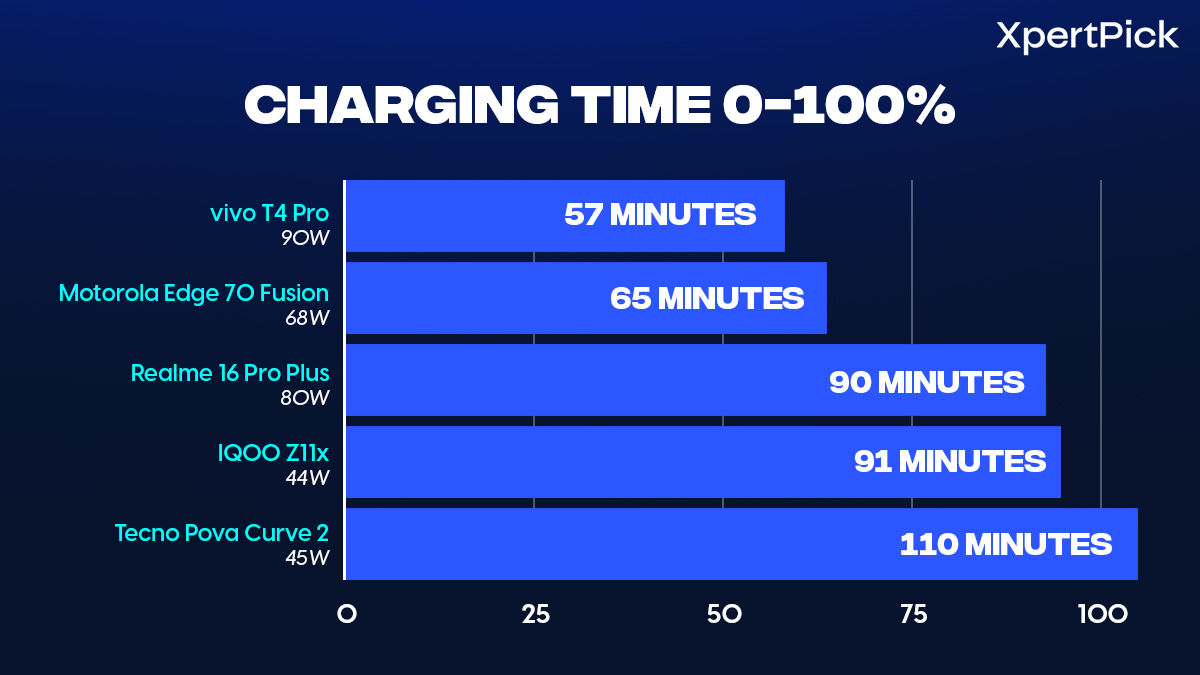
Charging Speed: vivo T4 Pro Charges Fastest, Motorola Edge 70 Fusion Follows Closely
| Smartphone | Charging Speed | 0–100% Time |
| vivo T4 Pro | 90W | 57 minutes |
| Motorola Edge 70 Fusion | 68W | 65 minutes |
| Realme P4 Power | 80W | 90 minutes |
| iQOO Z11x | 44W | 91 minutes |
| Tecno Pova Curve 2 | 45W | 110 minutes |
The vivo T4 Pro sets the pace here, completing a full charge in 57 minutes. With 90W charging, this is the kind of speed that fits neatly into everyday use, plug it in for a short while and you’re comfortably set for the rest of the day.
The Motorola Edge 70 Fusion follows at 65 minutes with a 68W charger. It’s not chasing peak numbers, but the result is practical and consistent, especially for users who prefer predictable charging over aggressive speed.
The Realme 16 Pro Plus stretches to 90 minutes despite offering 80W charging. That gap between rated speed and actual time suggests a more conservative charging curve, likely tuned to manage heat and long-term battery health rather than pushing maximum output throughout.
The iQOO Z11x lands almost identically at 91 minutes with 44W charging. Given the lower wattage, the result isn’t surprising, but it does place it firmly in the slower half of this lineup when it comes to full charge times.
The Tecno Pova Curve 2 takes the longest at 110 minutes. Even with a 45W charger, this is clearly a slower approach, and it leans more toward steady, gradual charging rather than quick turnaround.
Looking at the full picture, there’s a clear divide between fast, everyday-friendly charging and more relaxed implementations. At the top, the vivo T4 Pro stands out as the quickest to charge, with the Motorola Edge 70 Fusion not too far behind.
Efficiency: Realme P4 Power Leads on Endurance, iQOO Z11x Wins on Value
This is where the real differences show up. The Realme P4 Power is in a league of its own for endurance. Heavy users, travellers, and anyone who genuinely cannot afford downtime will find it transformative. It is less a smartphone with a good battery and more a power bank that happens to make calls.
The iQOO Z11x is the value standout and the efficiency champion. Its Dimensity 7400 Turbo chip is conservative by nature, and that works massively in its favour for battery life. For buyers who can live with an LCD panel and slower charging, the endurance-to-price ratio here is unbeatable in this segment.
The Motorola Edge 70 Fusion stands out as one of the most efficient devices in this comparison. Its silicon-carbon battery and measured system behaviour mean it consistently extracts more runtime per milliamp-hour than any other phone here except the iQOO. It is the phone that balances the equation most intelligently with good endurance, practical charging speed, and predictable daily behaviour.
The vivo T4 Pro is the least battery-focused phone in this group, but it is also the most complete overall. Its periscope telephoto camera, slim profile, and fast charging make it a strong daily driver for users who don’t need two-day battery life but want to stay competitive on every other spec. It is doing a different job from the others.
The Tecno Pova Curve 2 feels designed around a specific use case: the buyer who wants a slim phone with a large battery and an attractive curved screen. The endurance is decent in moderate daily use, but it struggles under heavier sustained workloads, which is where the less-efficient Dimensity 7100 platform shows its limits.
Battery and Charging Balance: vivo T4 Pro Feels the Most Practical Overall
The Realme P4 Power is built around sheer endurance, and it shows. With over 33 hours in the PCMark test, it sits comfortably ahead of everything else here. But that advantage comes with a trade-off. Charging doesn’t quite keep up with that massive battery, so while it lasts the longest, getting it back to 100 percent takes noticeably more time.
The iQOO Z11x follows a similar pattern, delivering close to 30 hours of runtime. It’s firmly in that “charge once, forget about it” category. But again, the slower 44W charging means you’re waiting longer when you do need to plug in, which slightly limits its flexibility.
The Motorola Edge 70 Fusion takes a more balanced route. At 22 hours of runtime, it doesn’t compete with the endurance leaders, but it holds up well for a full day and beyond. More importantly, its 65-minute charging time keeps things practical, making it easier to quickly recover battery when needed.
The vivo T4 Pro shifts the focus even further toward usability. Its runtime sits just above 20 hours, which is solid but not exceptional. Where it stands out is charging. At just 57 minutes for a full cycle, it’s the quickest here, and that changes how the phone feels in everyday use. Short charging windows actually become useful rather than something you plan around.
The Tecno Pova Curve 2 ends up in a tougher spot. Its runtime is similar to the vivo, but with the slowest charging time in the group at 110 minutes, it lacks the advantage on either side of the equation.
When you look at both sides together, the picture becomes clearer. Phones like the Realme P4 Power and iQOO Z11x dominate on endurance, but they demand more patience when charging. On the other hand, the vivo T4 Pro may not last the longest, but it recovers the fastest. And when you combine how long a phone lasts with how quickly it gets back up, the vivo T4 Pro stands out as the most well-rounded option in this lineup.
Battery Value: iQOO Z11x Offers the Strongest Endurance for the Money
| Phone | Price (₹) | PCMark Battery Life | Charging Time (0–100%) | Battery Positioning | Value Take |
|---|---|---|---|---|---|
| iQOO Z11x | 24,999 | 29h 51m | 91 minutes | High endurance, slow charging | Best balance of price and battery life |
| Motorola Edge 60 Fusion | 26,499 | 22h 00m | 65 minutes | Balanced endurance + charging | Most practical everyday option |
| vivo T4 Pro | 27,464 | 20h 34m | 57 minutes | Faster charging, moderate endurance | Best for quick top-ups |
| Realme P4 Power | 28,999 | 33h 15m | ~90 minutes | Maximum endurance focus | Best for longest usage per charge |
| Tecno Pova Curve 2 | 31,999 | 20h 28m | 110 minutes | Average endurance, slow charging | Weakest value in this group |
The iQOO Z11x sets the baseline here at ₹24,999, and it does it with a clear focus, maximum endurance for the least money. Pushing close to 30 hours in your testing, it offers one of the strongest battery performances in this lineup. The trade-off is slower charging, but at this price, the sheer runtime carries a lot of weight.
The Motorola Edge 60 Fusion sits slightly higher at ₹26,499 and takes a more balanced approach. It doesn’t chase extreme battery numbers, but 22 hours of runtime paired with a 65-minute full charge makes it far more flexible in everyday use. You’re paying a bit more, but getting a noticeably more rounded experience in return.
The vivo T4 Pro at ₹27,464 leans into practicality. Its runtime is similar to the mid-pack, but the 57-minute charging time is the fastest here, and that changes how usable the phone feels day to day. It may not last the longest, but it wastes the least time when plugged in.
The Realme P4 Power, priced at ₹28,999, is all about endurance. At over 33 hours, it comfortably leads the chart. But that comes with slower charging, which means you’re trading convenience for longevity. Whether that works depends entirely on how you use your phone.
The Tecno Pova Curve 2 is the most expensive here at ₹31,999, but it struggles to justify that position. Its battery life sits alongside the mid-tier devices, and with the slowest charging time in the group, it doesn’t offer a clear advantage in either direction.
Looking at price against what you actually get, the decision becomes clearer. The iQOO Z11x delivers the strongest mix of endurance and affordability, making it the best value-for-money option in this lineup, especially if battery life is your top priority.