In the under ₹60,000 segment, gaming and performance phones promise a lot on paper, but real-world usage tells a very different story. Once you move beyond benchmark numbers and actually push these devices with sustained gaming and heavy workloads, clear differences begin to emerge.
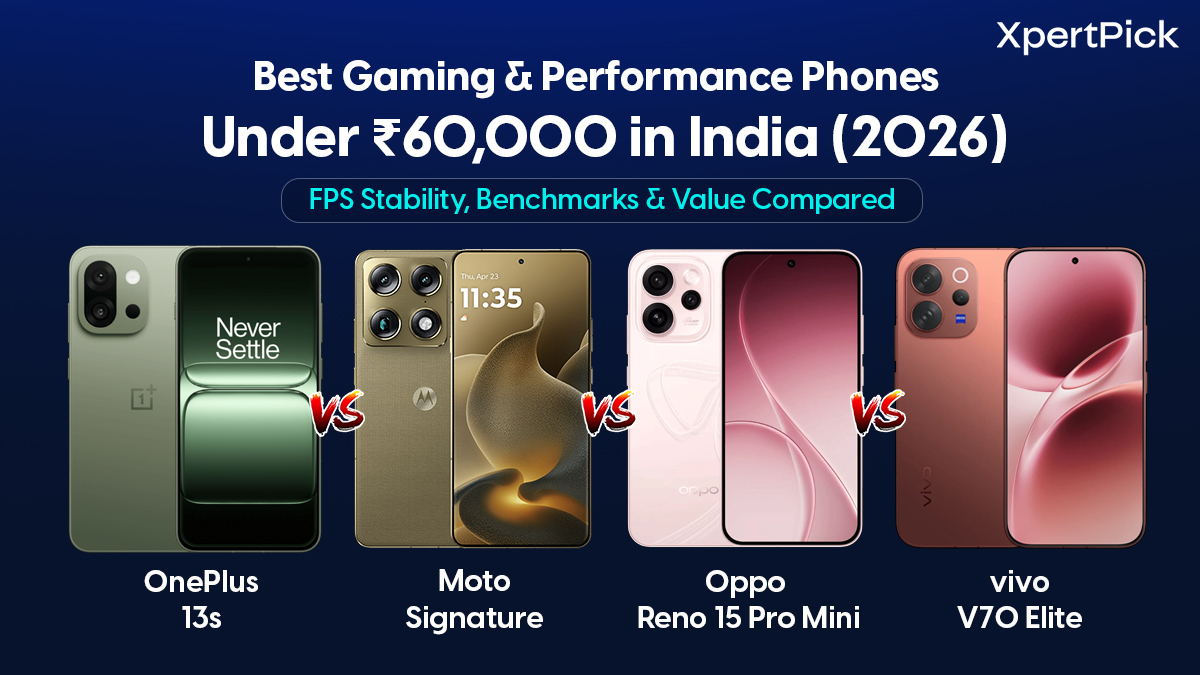
Some chase peak performance, others focus on stability, and a few try to balance both. This comparison looks at how these phones behave where it actually matters, under pressure, over time, and in scenarios that go beyond just raw numbers. To understand this balance, we are looking at four primary contenders: the Moto Signature (₹58,990) powered by the Snapdragon 8 Gen 5, the OnePlus 13s (₹52,999) featuring the Snapdragon 8 Elite, the Oppo Reno 15 Pro mini (₹59,999) with the MediaTek Dimensity 8450, and the Vivo V70 Elite (₹59,999) equipped with the Snapdragon 8s Gen 3.
Our tests highlighted different strengths across these phones. To ensure that we have the best phones we tested them on CPU and GPU performance, FPS stability, thermal management, and battery efficiency. Each parament played a major role in deciding which phones maintained their performance during longer gaming sessions. While some devices pulled ahead in raw performance and gaming numbers, others stood out for consistency, efficiency, and longer sessions. This helped us identify clear winners depending on what users prioritise the most.
Test Results: Our Top Recommendations
| Category | Winner | Why We Picked It |
|---|---|---|
| Best Gaming Performance | Moto Signature | Delivered the strongest gaming performance with the best FPS output and overall power in our tests |
| Best Benchmark Performance | Moto Signature | Posted the strongest overall performance results, with OnePlus 13s staying close in CPU-focused tests |
| Best Sustained Performance | Vivo V70 Elite | Achieved the highest stability score, maintaining performance more consistently during extended workloads |
Performance: Moto Signature Leads Clearly, OnePlus 13s Stays Close on CPU
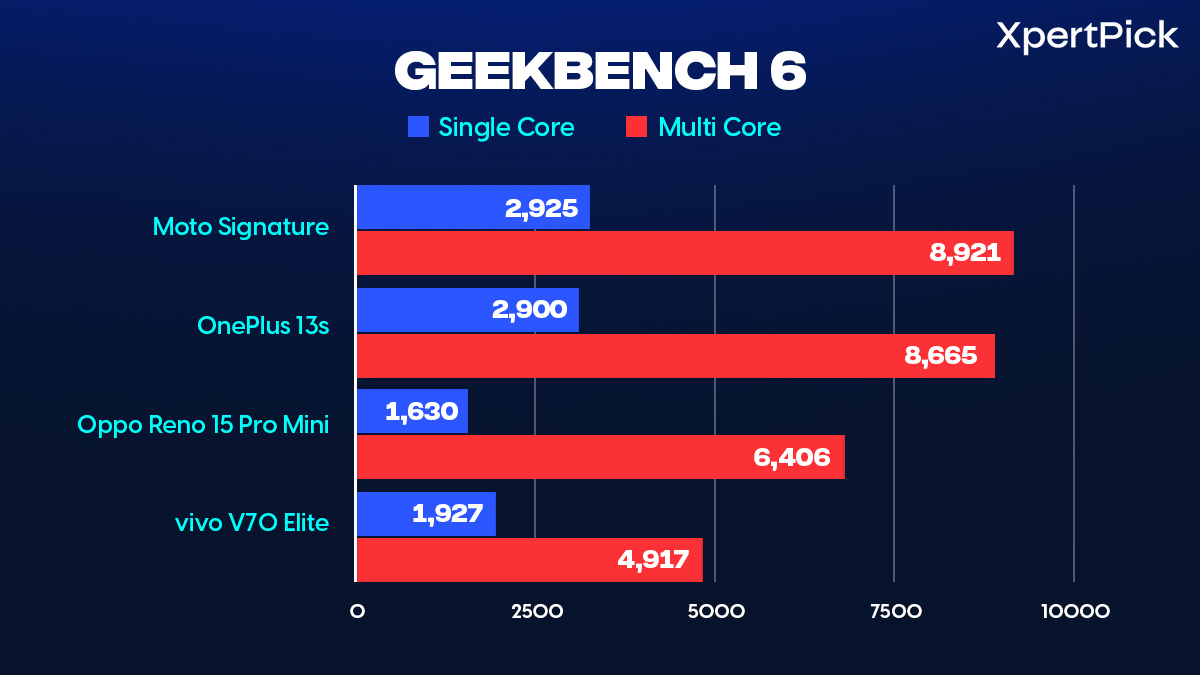
| Device | Single Core Score | Multi-Core Score |
| Moto Signature | 2,925 | 8,921 |
| OnePlus 13s | 2,900 | 8,665 |
| Oppo Reno 15 Pro mini | 1,630 | 6,406 |
| Vivo V70 Elite | 1,927 | 4,917 |
The Moto Signature sits right at the top of this table, and it shows in both numbers and intent. With 2,925 in single-core and 8,921 in multi-core, it’s clearly tuned for peak performance while still holding consistency under load. This is the kind of chipset that feels fast everywhere, whether it’s quick app launches or heavier multitasking.
The OnePlus 13s is right behind it, almost matching the Moto step for step. Its 2,900 single-core and 8,665 multi-core scores keep it firmly in flagship territory. In actual usage, the difference between the two is marginal, so this still delivers a top-tier, fluid experience across the board.
The Oppo Reno 15 Pro mini drops into a different performance bracket. With 1,630 single-core and 6,406 multi-core, it’s clearly not chasing peak numbers. Instead, it leans toward a more balanced approach, where everyday tasks remain smooth but there’s a noticeable gap in responsiveness compared to the top two.
The Vivo V70 Elite takes a slightly different route. Its single-core score of 1,927 suggests decent responsiveness for lighter tasks, but the multi-core score of 4,917 limits it under sustained workloads. It’s usable for daily use, but it’s not built for heavier performance demands.
Overall, the Moto Signature comes out as the best performer here, with the OnePlus 13s extremely close behind. The other two simply operate in a lower performance tier.
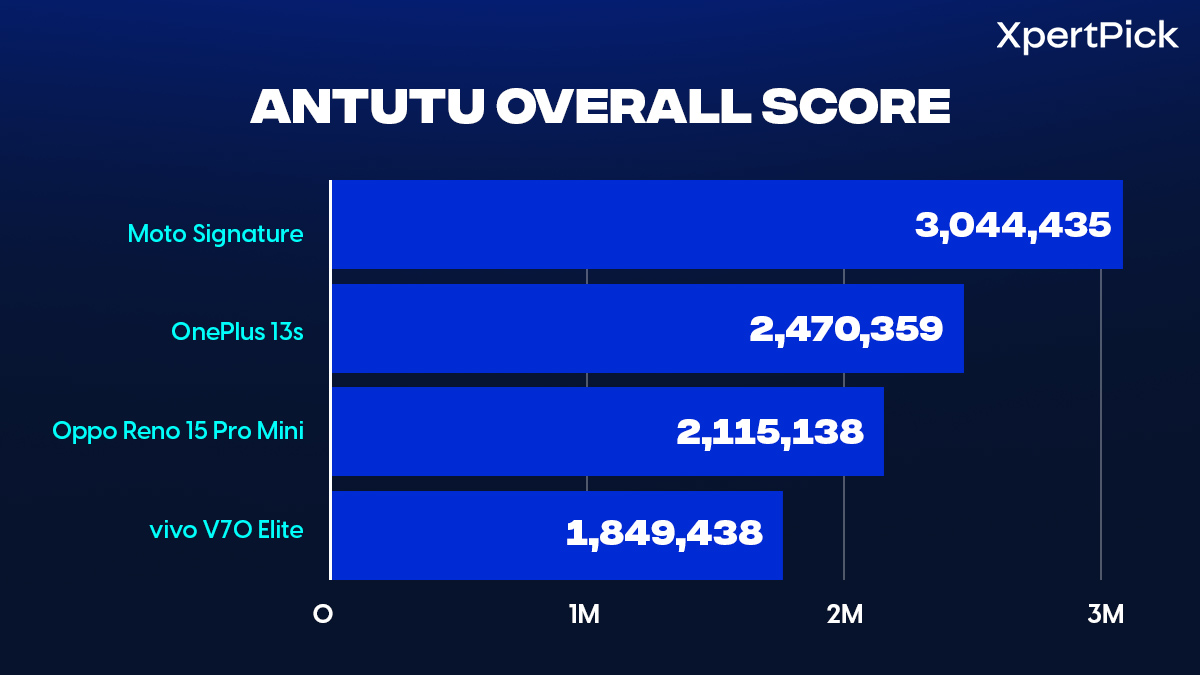
| Device | AnTuTu Overall Score |
| Moto Signature | 3,044,435 |
| OnePlus 13s | 2,470,359 |
| Oppo Reno 15 Pro mini | 2,115,138 |
| Vivo V70 Elite | 1,849,438 |
The Moto Signature completely pulls away here with an AnTuTu score of 3,044,435. That’s not just a lead, it’s a clear statement of intent. This kind of number reflects a device that’s pushing both CPU and GPU aggressively, and it shows up in real usage through faster load times, smoother gaming, and better sustained performance.
The OnePlus 13s comes in at 2,470,359, which is still firmly in flagship territory, but the gap from the Moto is now much more visible. It’s a strong performer on its own, but here you can see that it’s tuned a bit more conservatively compared to the outright top score.
The Oppo Reno 15 Pro mini posts 2,115,138, which keeps it competitive within the upper mid-range space. It’s not chasing peak performance, but it still delivers enough power for demanding apps and games without feeling underpowered in everyday use.
The Vivo V70 Elite lands at 1,849,438, placing it at the bottom of this comparison. It’s still a capable score for general usage, but the gap compared to the others becomes quite noticeable, especially when you start pushing the device with heavier workloads or gaming.
Overall, the Moto Signature is the clear winner here. It’s not just leading, it’s operating on a different level, with the OnePlus 13s following as a solid but slightly restrained alternative.
Sustained Performance: OnePlus 13s Balances GPU Power Better, Vivo V70 Elite Holds CPU Stability Longer
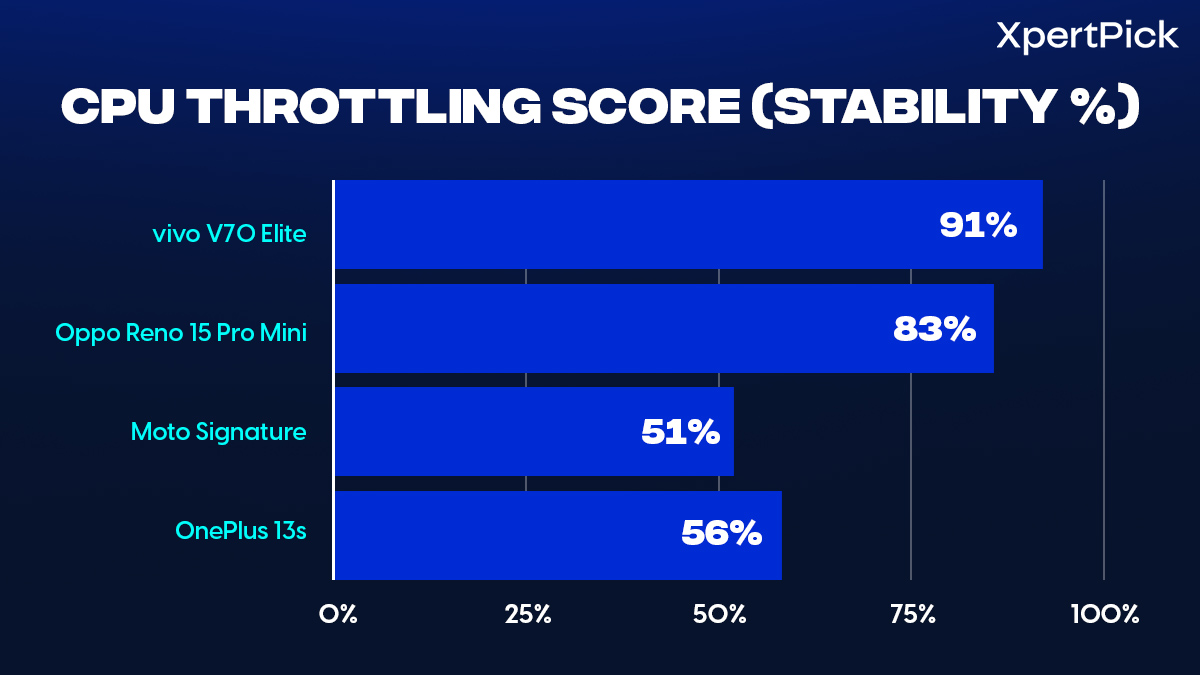
| Device | CPU Throttling Score (Stability %) |
| Vivo V70 Elite | 91% |
| Oppo Reno 15 Pro mini | 83% |
| Moto Signature | 51% |
| OnePlus 13s | 56% |
The Vivo V70 Elite stands out here with a 91% stability score, which is excellent. This suggests the phone is highly consistent under sustained workloads, holding performance without major drops. It may not be the fastest device overall, but it’s clearly the most reliable when it comes to maintaining performance over time.
The Oppo Reno 15 Pro mini follows with 83%, which is still a strong result. It strikes a good balance between performance and thermal control, meaning it can handle longer sessions without aggressive throttling, even if it isn’t pushing the highest peak numbers.
The Moto Signature drops sharply to 51%, and this tells a very different story compared to its benchmark dominance. It’s clearly pushing for maximum performance, but it cannot sustain that level for long. Expect strong bursts initially, followed by noticeable drops once thermals kick in.
The OnePlus 13s sits slightly better at 56%, but the behaviour is similar to the Moto. It delivers high peak performance, but struggles to maintain it over extended periods, especially under heavy workloads like gaming or stress tests.
Overall, the Vivo V70 Elite is the best performer here in terms of sustained stability, followed by the Oppo Reno 15 Pro mini. The Moto Signature and OnePlus 13s prioritise peak performance, but clearly compromise on consistency under load.
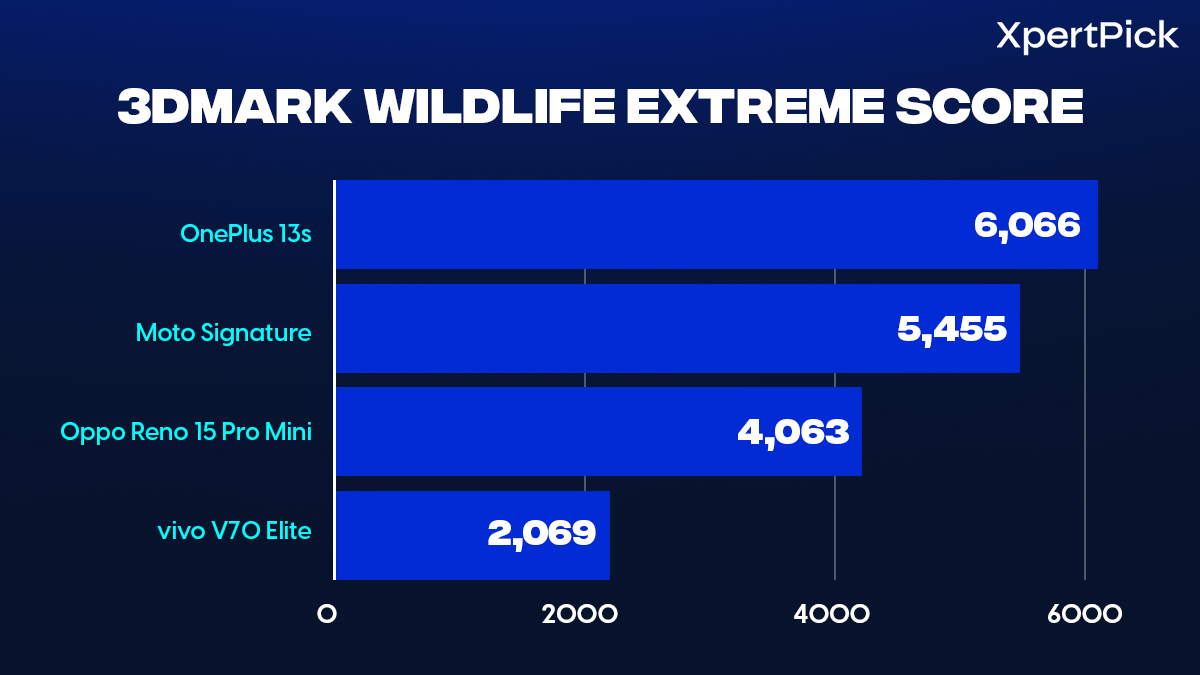
| Device | 3DMark WildLife Extreme Score | Stability (Throttling Percentage) |
| OnePlus 13s | 6,066 | 68.1% |
| Moto Signature | 5,455 | 67% |
| Oppo Reno 15 Pro mini | 4,063 | 46.5% |
| Vivo V70 Elite | 2,069 | 79% |
The OnePlus 13s comes out on top here with a 3DMark Wild Life Extreme score of 6,066, paired with 68.1% stability. What makes this interesting isn’t just the top score, but the balance it maintains. It delivers the highest peak GPU performance in this test while still keeping throttling under reasonable control, which translates to strong and relatively consistent gaming output.
The Moto Signature follows closely with a score of 5,455 and 67% stability. The gap in performance isn’t massive, but it reinforces a familiar pattern. The Moto pushes hard for peak output, but its stability remains slightly behind the OnePlus.
In practice, this means it can feel just as fast initially, but may show slightly more fluctuation over longer sessions.
The Oppo Reno 15 Pro mini drops to 4,063 with 46.5% stability, and this is where things start to fall off. Not only is the peak performance lower, but the stability is also significantly weaker. That combination suggests noticeable throttling under load, leading to inconsistent performance in demanding gaming scenarios.
The Vivo V70 Elite sits at the bottom in terms of raw GPU score at 2,069, but its 79% stability stands out. This is clearly a device tuned for consistency rather than performance. It won’t deliver high frame rates, but it will hold its limited performance more reliably over time without aggressive drops.
Overall, the OnePlus 13s is the best performer in this test, offering the strongest balance between peak GPU performance and sustained stability.
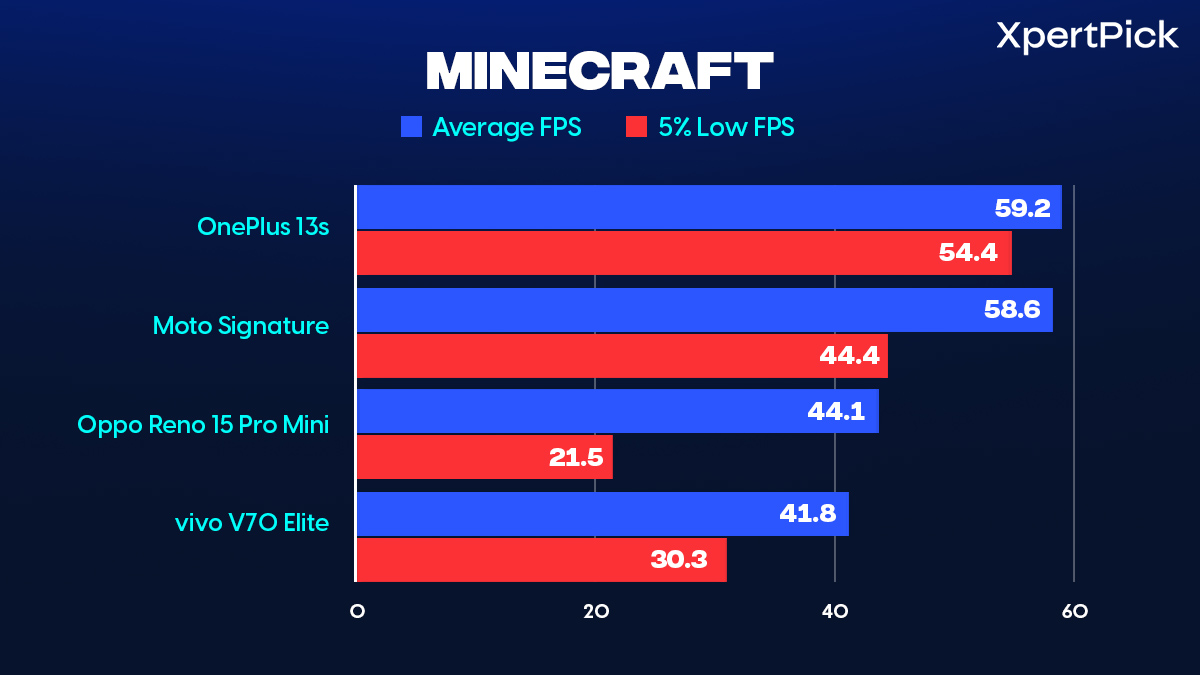
Gaming Performance: Moto Signature Dominates BGMI, OnePlus 13s Is Smoother in Minecraft
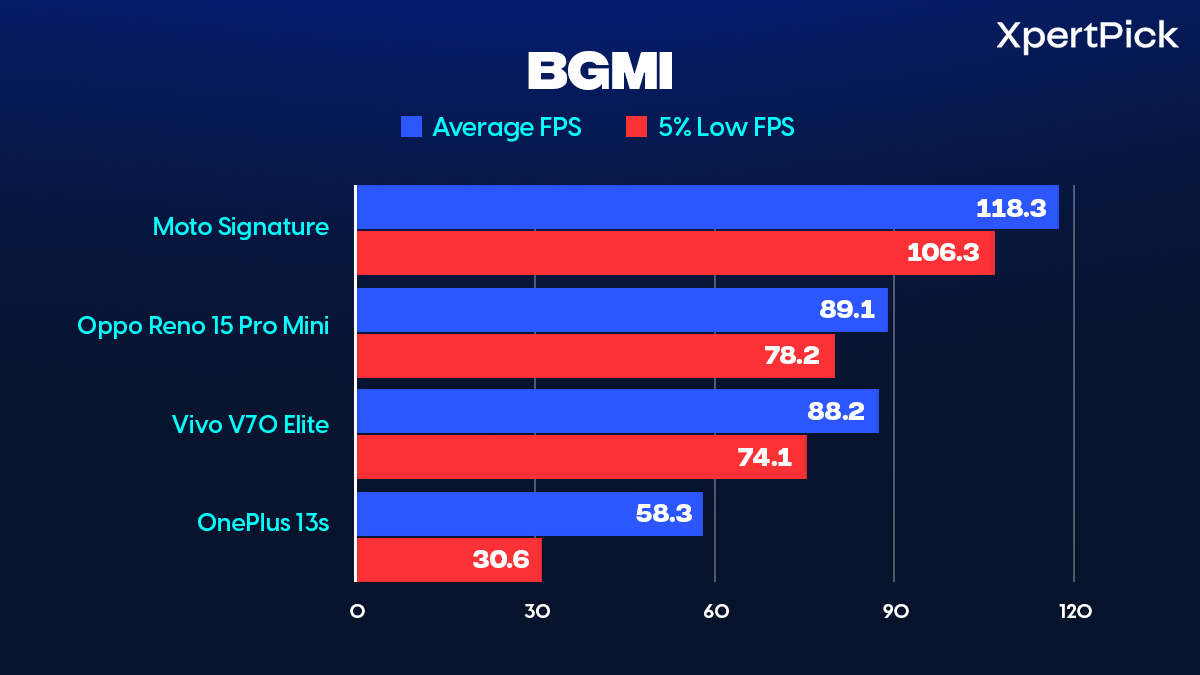
| Device tested for BGMI | Average FPS | 5% Low FPS |
| Moto Signature | 118.3 | 106.3 |
| Oppo Reno 15 Pro mini | 89.1 | 78.2 |
| Vivo V70 Elite | 88.2 | 74.1 |
| OnePlus 13s | 58.3 | 30.6 |