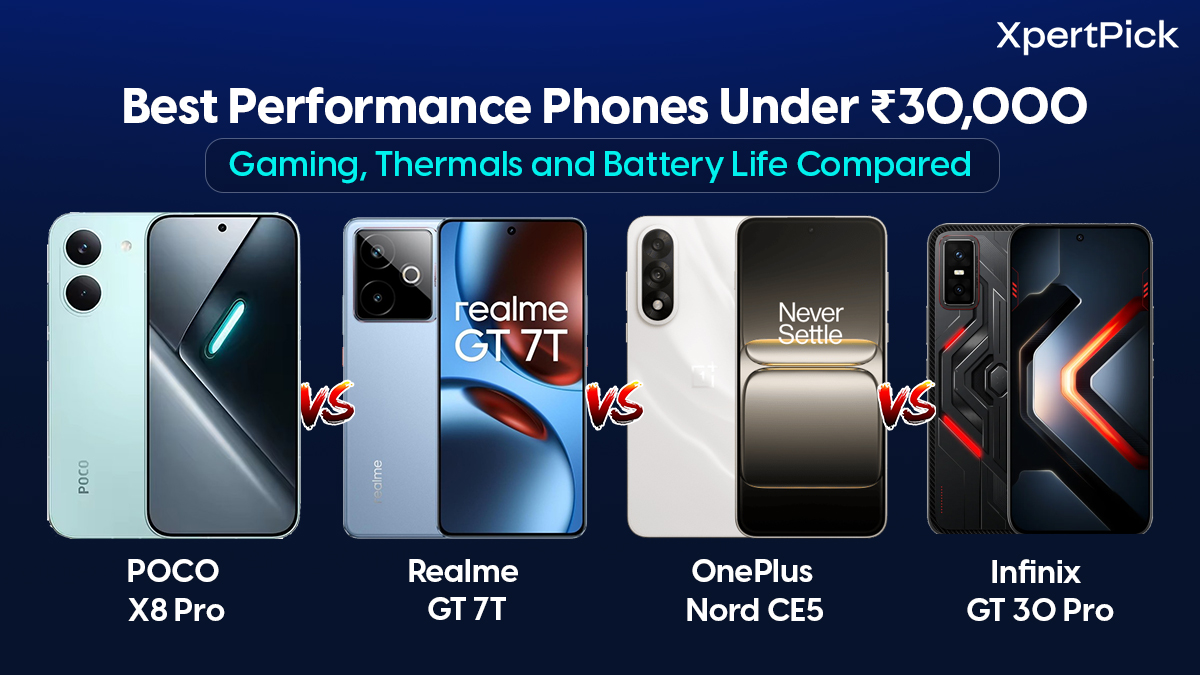
If you’re searching for the list of the top performance smartphones under Rs 30,000 in 2026, then you’re in luck. Because even though device component shortage has hit the global market quite harshly, smartphone brands are doing their best to launch high performance smartphones with good gaming performance in the budget to mid-range price category.
In this article, we are going to take a look at four popular performance-focused smartphones under Rs 30,000. Starting with the most affordable one, the OnePlus Nord CE5, which is selling for Rs 24,250 on Flipkart. The second smartphone in terms of price is the Infinix GT 30 Pro 5G, which costs Rs 27,999, again on Flipkart. The third high-performance smartphone on this list is the Realme GT 7T, which costs Rs 31,995. Lastly, the most expensive smartphone on this list is the POCO X8 Pro, which costs Rs 32,999.
Also, do remember that the prices for all the smartphones mentioned here are at the time of writing and are subject to change in the future.
Performance Winners From Our Tests
| Test Category | Winner |
|---|---|
| Overall Performance | POCO X8 Pro |
| Benchmark Performance | POCO X8 Pro |
| Gaming Performance | POCO X8 Pro |
| Sustained Performance | POCO X8 Pro |
| Battery and Charging | Realme GT 7T |
Performance: POCO X8 Pro Leads Across CPU, AnTuTu, and GPU Tests
Starting with synthetic benchmarks, for instance in Geekbench 6, the OnePlus Nord CE5 scores 1,309 in single-core and 3,884 in multi-core.
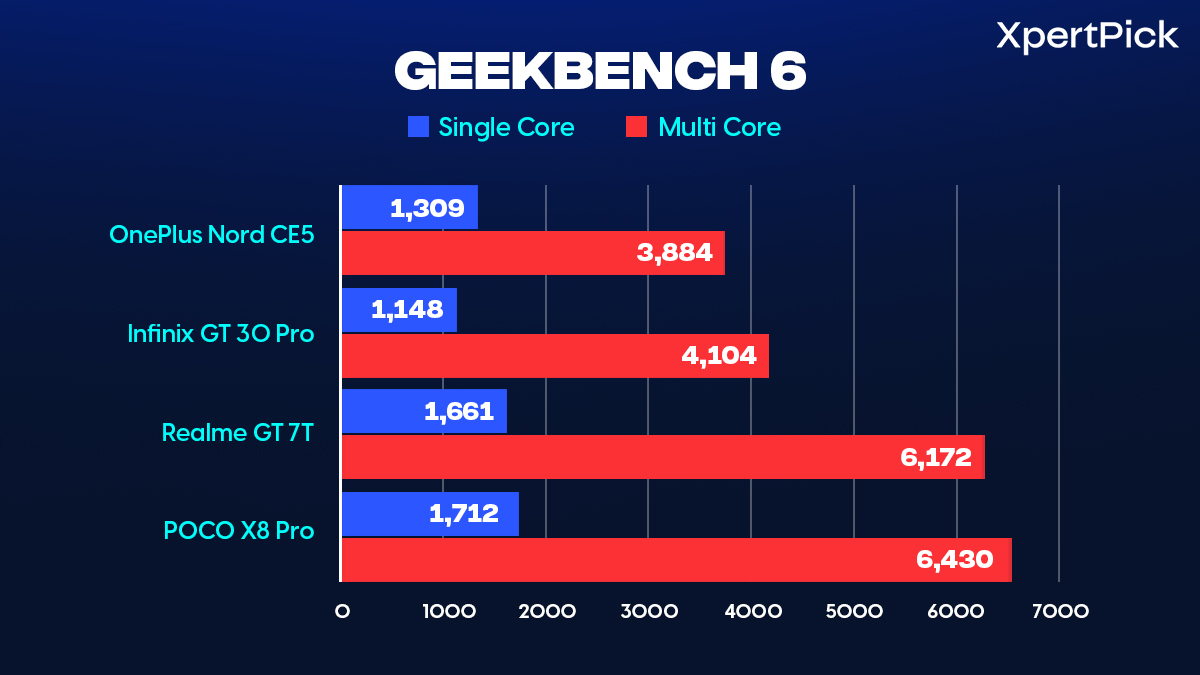
The Infinix GT 30 Pro 5G posts a slightly lower single-core score of 1,148 but a stronger multi-core score of 4,104, which makes sense given that both phones run variants of the same core chipset, the Nord CE5 utilizes the Dimensity 8350 Apex, while the Infinix GT 30 Pro runs on the Dimensity 8350 Ultimate.
| Smartphone | Chipset | Geekbench 6 (Single-Core) | Geekbench 6 (Multi-Core) | AnTuTu Score | 3DMark Wildlife Extreme |
| OnePlus Nord CE5 | Dimensity 8350 Apex | 1,309 | 3,884 | 13,90,121 | 3,033 |
| Infinix GT 30 Pro 5G | Dimensity 8350 Ultimate | 1,148 | 4,104 | 1,349,476 | 2,845 |
| Realme GT 7T | MediaTek Dimensity 8400-Max | 1,661 | 6,172 | 17,27,642 | 4,015 |
| POCO X8 Pro | MediaTek Dimensity 8500-Ultra | 1,712 | 6,430 | 21,03,560 | 4,296 |
The gap widens considerably when we move to the Realme GT 7T. Powered by the MediaTek Dimensity 8400-Max, it posts a Geekbench 6 single-core score of 1,661 and a multi-core score of 6,172. That’s a massive jump in multi-core performance, roughly 50% higher than the Infinix GT 30 Pro. The POCO X8 Pro, equipped with the MediaTek Dimensity 8500-Ultra, sits in a similar performance tier and manages a Geekbench 6 single-core score of 1,712 and a multi-core score of 6,430, making it the highest scorer in this comparison for CPU-bound tasks.
In AnTuTu, the rankings largely stay the same. The OnePlus Nord CE5 scores 13,90,121, the Infinix GT 30 Pro scores 1,349,476, the Realme GT 7T scores 17,27,642, and the POCO X8 Pro leads the pack with a score of 21,03,560. The POCO X8 Pro’s higher AnTuTu score can be attributed to its stronger GPU and memory subsystem performance.
For GPU-focused benchmarks, I ran 3DMark Wildlife Extreme. The OnePlus Nord CE5 scored 3,033, while the Infinix GT 30 Pro scored 2,845. The Realme GT 7T pulled ahead with a score of 4,015, and the POCO X8 Pro topped the chart again with a score of 4,296. So in terms of raw GPU power, the POCO X8 Pro and the Realme GT 7T are clearly the better options.
Sustained Performance: POCO X8 Pro Holds Its Power Better Under Load
Thermal management is where things get interesting, because higher performance doesn’t always mean better sustained performance. I tested CPU throttling on all four smartphones using a 15-minute CPU Throttling Test.The POCO X8 Pro retained the most performance at 83%, making it the best in this lineup for sustained workloads.
| Phone | Chipset | Performance Retained | Throttling Behaviour | Observations |
|---|---|---|---|---|
| POCO X8 Pro | Dimensity 8500 Ultra | 83% | Lowest throttling | Best sustained performance in the lineup |
| OnePlus Nord CE5 | Dimensity 8350 | 79% | Moderate throttling | Good balance between performance and thermals |
| Infinix GT 30 Pro | Dimensity 8350 | 77% | Moderate throttling | Similar behaviour to Nord CE5, slightly less stable |
| Realme GT 7T | Dimensity 8400-Max | 63% | Aggressive throttling | Prioritises thermals over sustained peak performance |
The OnePlus Nord CE5 came in second at 79%, followed closely by the Infinix GT 30 Pro at 77%, both Dimensity 8350-based phones throttle to a similar extent. The Realme GT 7T, despite housing the more powerful Dimensity 8400-Max, showed the most aggressive throttling at just 63%, meaning the phone prioritises keeping temperatures in check at the cost of sustained CPU speed.
Gaming Performance: POCO X8 Pro Leads in BGMI, Realme GT 7T Edges Ahead in Genshin Impact
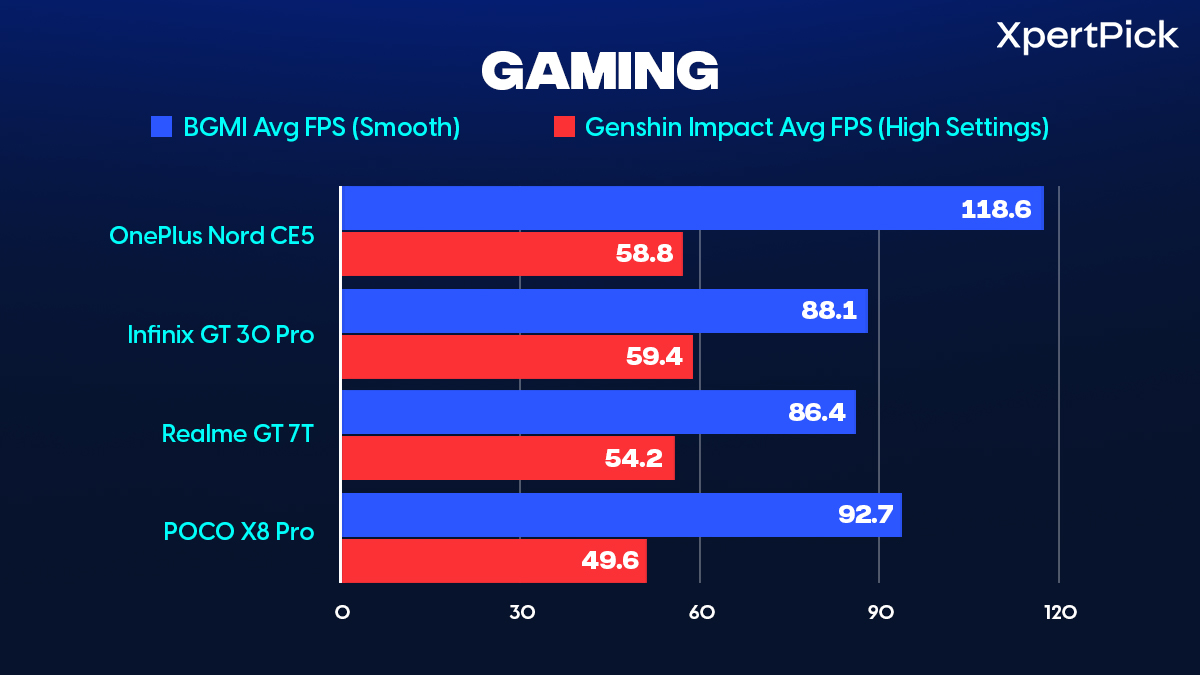
In BGMI at smooth settings, the POCO X8 Pro recorded the highest average frame rate at 118.6 FPS, followed by the Infinix GT 30 Pro at 92.7 FPS, the Realme GT 7T at 88.1 FPS, and the OnePlus Nord CE5 at 86.4 FPS.
| Smartphone | BGMI Avg FPS(Smooth) | Genshin Impact Avg FPS(High Settings) |
| POCO X8 Pro | 118.6 | 58.8 |
| Realme GT 7T | 88.1 | 59.4 |
| OnePlus Nord CE5 | 86.4 | 54.2 |
| Infinix GT 30 Pro | 92.7 | 49.6 |
In Genshin Impact at high settings, the Realme GT 7T led with an average of 59.4 FPS, closely followed by the POCO X8 Pro at 58.8 FPS. The OnePlus Nord CE5 delivered 54.2 FPS, while the Infinix GT 30 Pro recorded the lowest at 49.6 FPS.
Battery and Charging: Realme GT 7T Delivers the Strongest Overall Balance
The battery comparison shows a clear split between endurance and charging speed. The OnePlus Nord CE5 leads in sheer capacity with a 7,100mAh battery and delivers a strong 17 hours and 34 minutes in the PCMark test, though its 0–100% charging time of around 1 hour and 23 minutes is the slowest here.
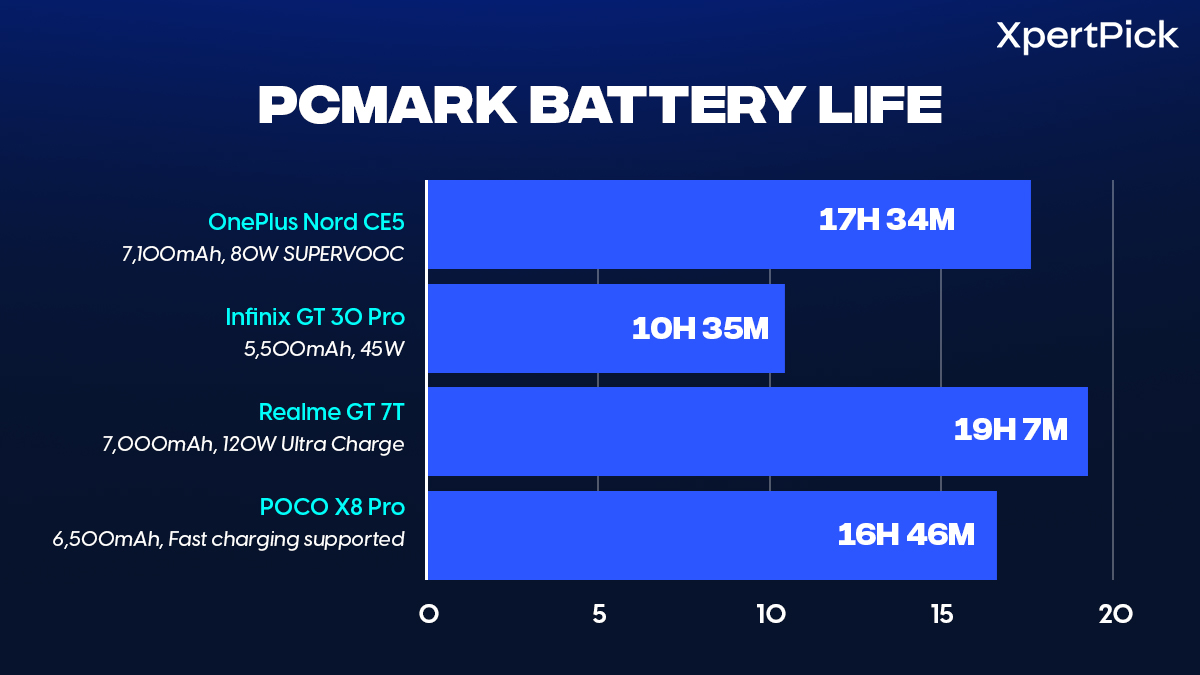
The Realme GT 7T strikes the most aggressive balance, pairing a 7,000mAh battery with the fastest 120W charging, reaching full charge in just 47 minutes while also topping the chart with 19 hours and 7 minutes of battery life. The POCO X8 Pro sits in the middle with a 6,500mAh battery, offering a respectable 16 hours and 46 minutes of endurance and a quick 49-minute full charge. Meanwhile, the Infinix GT 30 Pro, with its smaller 5,500mAh battery, trails behind at 10 hours and 35 minutes, with a charging time of about 1 hour and 8 minutes.
| Smartphone | Battery Capacity | Charging Speed | PCMark Battery Life | 0–100% Charging Time |
|---|---|---|---|---|
| OnePlus Nord CE5 | 7,100mAh | 80W SUPERVOOC | 17h 34m | ~1h 23m |
| Infinix GT 30 Pro | 5,500mAh | 45W | 10h 35m | ~1h 8m |
| Realme GT 7T | 7,000mAh | 120W Ultra Charge | 19h 7m | ~47m |
| POCO X8 Pro | 6,500mAh | Fast charging supported | 16h 46m | ~49m |
Overall Verdict: POCO X8 Pro Is the Most Complete Performance Pick
The POCO X8 Pro stands out as the most complete performance-focused smartphone here. It leads in benchmarks, delivers the highest FPS in BGMI, and also maintains the best sustained performance, making it the safest pick if raw power and consistency matter most.
The Realme GT 7T comes very close, especially in GPU-heavy gaming like Genshin Impact, while also offering the best battery life and fastest charging. However, its aggressive CPU throttling means it prioritises thermals over sustained peak performance.
The OnePlus Nord CE5 offers a balanced experience with strong battery life and stable thermals, even if it doesn’t lead in any one area. Meanwhile, the Infinix GT 30 Pro, despite decent peak performance, falls behind in sustained gaming and battery endurance, making it the least compelling option in this comparison.