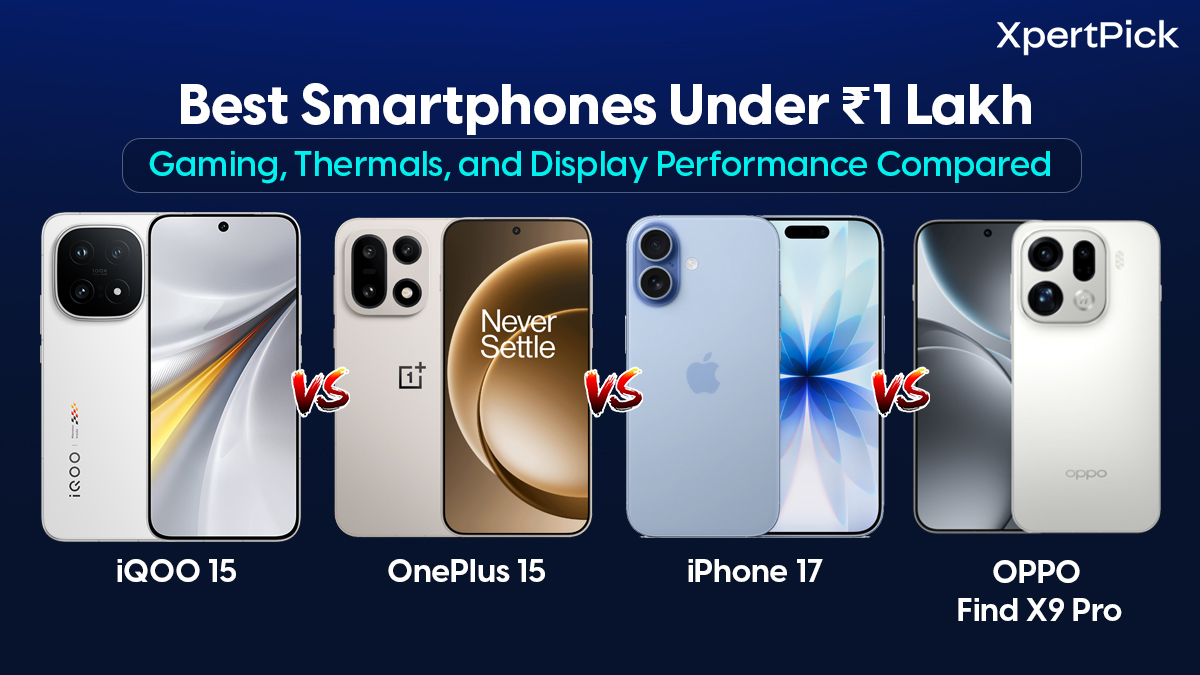
If you’re planning to spend Rs 1 lakh on a smartphone then chances are that you will have high expectations. At this price point, what you can expect from a smartphone completely changes. Not only are you demanding the absolute pinnacle of raw processing power, but you also expect uncompromised thermal stability, ultra-responsive displays, and sustained high frame rates during the most demanding titles.
In this ultra-premium tier, cutting-edge hardware like the Snapdragon 8 Elite Gen 5 found in the iQOO 15 and OnePlus 15, the powerhouse A19 chip in the iPhone 17, and the sustained efficiency of the Find X9 Pro’s Dimensity 9500 are just the baseline. We’re looking for the devices that go above and beyond, leveraging advanced vapor cooling chambers, dedicated gaming chips, and 120Hz ProMotion displays, to deliver a truly flawless, throttle-free experience. Here are the ultimate gaming smartphones that actually justify that Rs 1 lakh price tag.
At this price point, every phone comes with top-tier hardware, so the differences are rarely visible from specifications alone. What separates them is how well they bring everything together, from gaming and display quality to heat management and everyday consistency. Our tests look at where each flagship actually pulls ahead rather than just which one has the biggest numbers.
At the time of writing, these are the approximate prices of the all the smartphones in this comparison:
| Smartphone | Starting Price (Approx.) | Base Configuration |
| iQOO 15 | ₹72,999 | 12GB + 256GB |
| OnePlus 15 | ₹72,999 | 12GB + 256GB |
| iPhone 17 | ₹82,900 | 256GB |
| OPPO Find X9 Pro | ₹1,09,999 | 16GB + 512GB |
Our Flagship Picks Based on Testing
| Category | Winner | Why We Picked It |
|---|---|---|
| Best Overall Flagship Phone | OnePlus 15 | Best balance of gaming performance, thermals, display, and battery life |
| Best Gaming Performance | iQOO 15 | Delivered the strongest gaming numbers and FPS stability |
| Best Display Experience | OPPO Find X9 Pro | Strong combination of brightness, colours, and viewing experience |
| Best Sustained Performance | OnePlus 15 | Maintained better consistency during longer workloads |
| Best Camera + Performance Balance | Vivo X300 Pro | Combines flagship performance with stronger camera capabilities |
How We Test Smartphones
We are very thorough with our testing process and evaluate flagship smartphones across synthetic benchmarks, real-world gaming, FPS stability, thermal behavior, display performance, and battery efficiency. Benchmark numbers help measure peak performance, but our final recommendations also consider how consistently each phone performs during extended use.
Performance: OnePlus 15 Leads Overall, iPhone 17 Dominates GPU Compute
Looking at the numbers, the Realme GT 7T leads in AnTuTu with a score of 21,27,058, followed closely by the POCO X8 Pro at 20,83,072. The OnePlus Nord 5 sits significantly lower at 14,18,888, while the Infinix GT 30 trails behind at 9,75,961.
In Geekbench 6 single-core performance, the OnePlus Nord 5 actually comes out on top with a score of 1,973, followed by the POCO X8 Pro at 1,740 and the Realme GT 7T at 1,595, while the Infinix GT 30 again ranks last at 1,069.
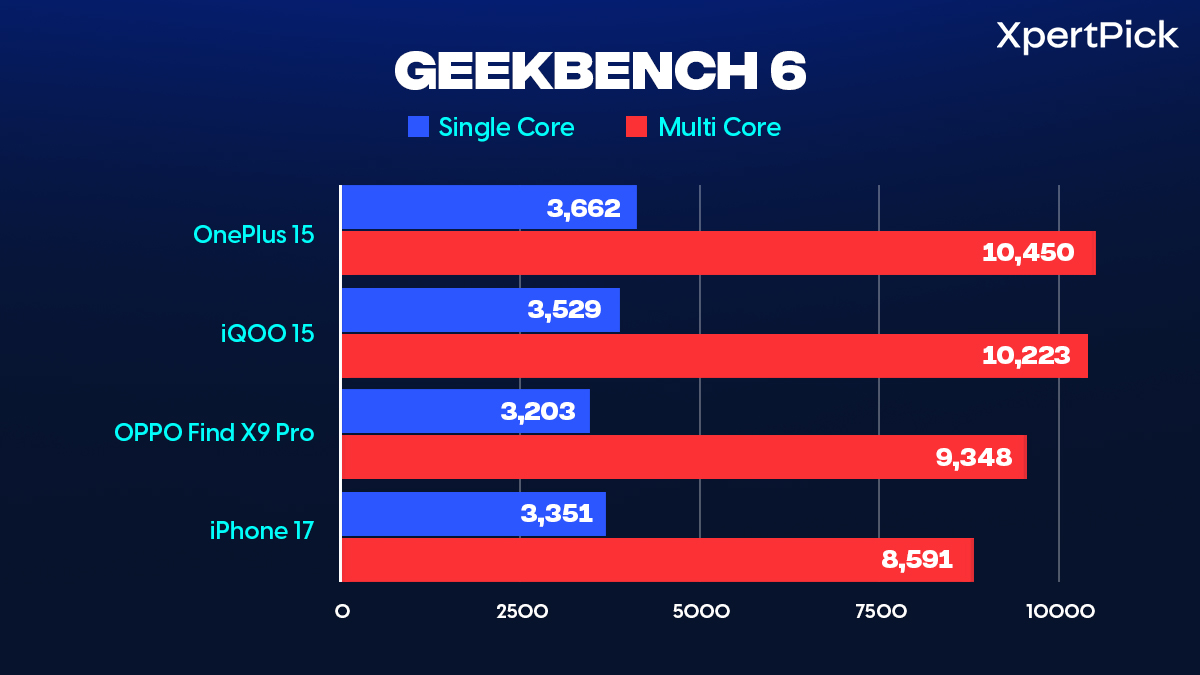
For multi-core performance, the POCO X8 Pro takes the lead with 6,705, followed by the Realme GT 7T at 6,248, then the OnePlus Nord 5 at 5,361, and finally the Infinix GT 30 at 3,159.
| Smartphone | AnTuTu Score | Geekbench 6 (Single-Core) | Geekbench 6 (Multi-Core) |
| OnePlus 15 | 39,32,097 | 3,662 | 10,450 |
| iQOO 15 | 3,891,344 | 3,529 | 10,223 |
| OPPO Find X9 Pro | 2,891,046 | 3,203 | 9,348 |
| iPhone 17 | 2,118,014 | 3,351 | 8,591 |
The iPhone 17 scored 37,088 and dominates the flagship tier with a 55% lead over the OnePlus 15 at 23,923, underscoring Apple’s superior GPU compute power.
| Smartphone | Geekbench GPU Score |
| iPhone 17 | 37,088 |
| OnePlus 15 | 23,923 |
| iQOO 15 | 23,573 |
| OPPO Find X9 Pro | 19,722 |
In terms of GPU performance, the gap here is quite noticeable. The iPhone 17 sits comfortably at the top with a Geekbench GPU score of 37,088, well ahead of the competition.
The OnePlus 15 and iQOO 15 follow next with scores of 23,923 and 23,573 respectively, making them nearly identical in performance. The OPPO Find X9 Pro comes in last at 19,722, placing it clearly behind the other three in this test.
Sustained Performance: iPhone 17 Holds Performance Best, OnePlus 15 Is the Balanced Android Pick
In terms of CPU throttling stability, the iPhone 17 leads comfortably with 83.9%, maintaining the highest level of performance under sustained load. The OPPO Find X9 Pro comes next at 66.0%, followed by the OnePlus 15 at 61.0%. The iQOO 15 ranks last at 58.0%, showing the most aggressive throttling among the four.
| Smartphone | CPU Throttling Stability |
| iPhone 17 | 83.9% |
| OPPO Find X9 Pro | 66.0% |
| OnePlus 15 | 61.0% |
| iQOO 15 | 58.0% |
The data illustrates a clear trade-off between raw “burst” performance and long-term gaming consistency across the flagship tier. The OPPO Find X9 Pro and iQOO 15 are the undisputed sprinters, posting massive peak scores above 7,100 that showcase superior immediate graphical muscle, yet they struggle with aggressive thermal throttling that sees their performance drop to nearly half, 50.3% and 58.3% respectively, as they heat up.
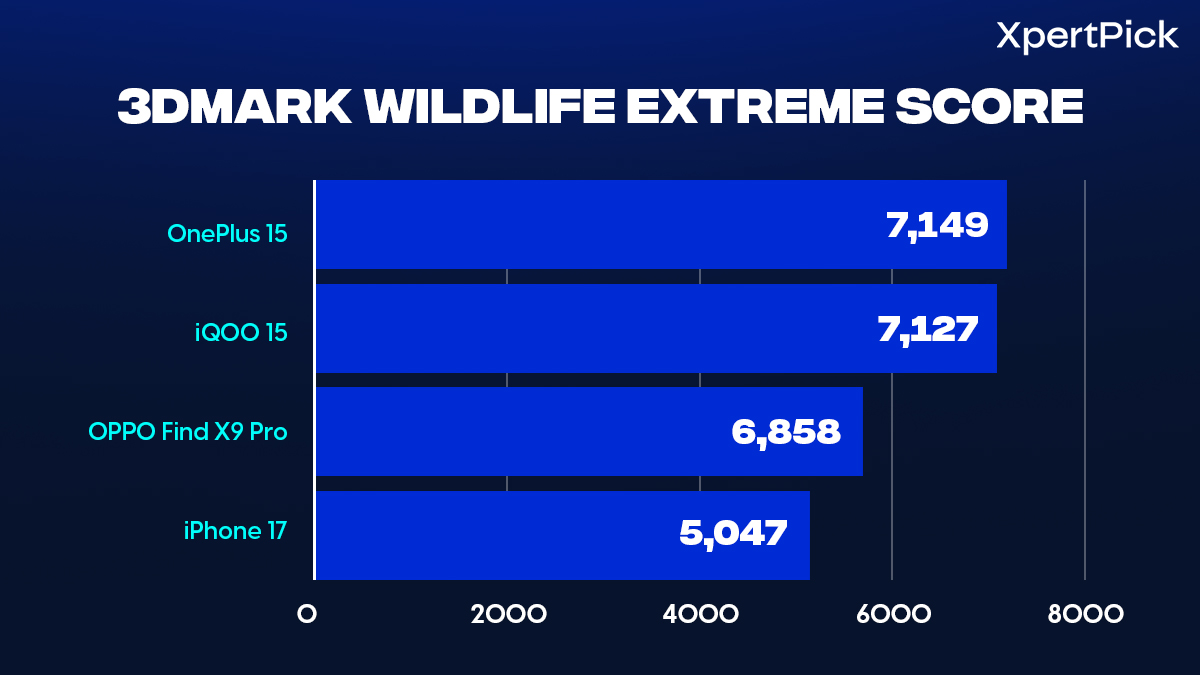
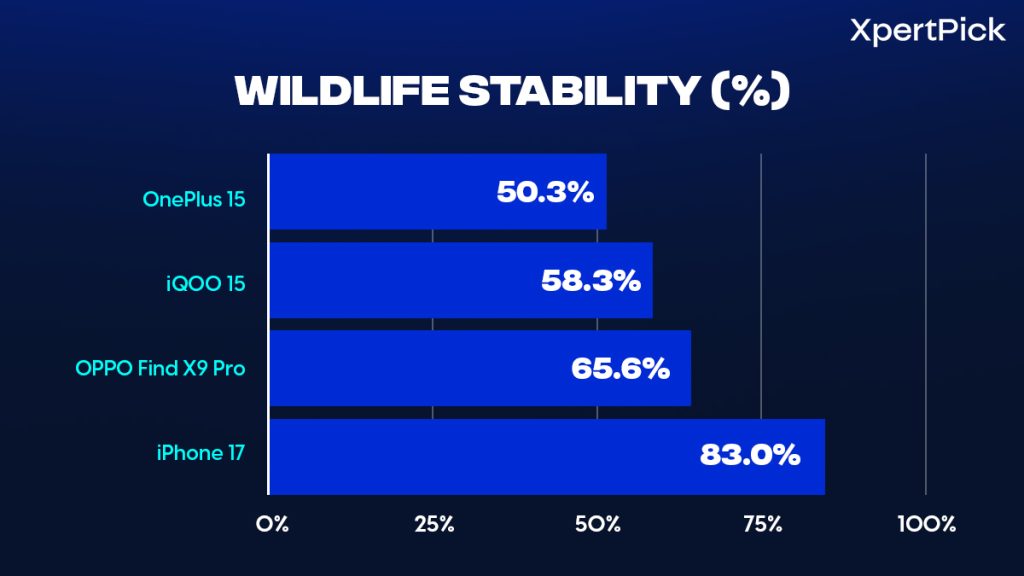
Conversely, the iPhone 17 acts as the marathon runner of the group. While its peak score of 5,047 is significantly lower than its Android rivals, its class-leading 83% stability ensures a much more predictable and stutter-free experience during extended gameplay.
| Smartphone | 3DMark WildLife Extreme Score | WildLife Stability (%) |
| OPPO Find X9 Pro | 7,149 | 50.3% |
| iQOO 15 | 7,127 | 58.3% |
| OnePlus 15 | 6,858 | 65.6% |
| iPhone 17 | 5,047 | 83.0% |
Meanwhile, the OnePlus 15 emerges as the most balanced Android contender, offering a high-performance ceiling of 6,858 while maintaining a more respectable 65.6% stability, effectively splitting the difference between raw power and thermal endurance.
When it comes to refresh rate, the iQOO 15 stands out with a 144Hz panel, offering the highest refresh rate in this group. The OnePlus 15, iPhone 17, and OPPO Find X9 Pro all feature 120Hz displays, placing them on the same level in this regard.
| Smartphone | Auto Max Brightness (Tested) |
| iPhone 17 | 3,000 nits |
| iQOO 15 | 2,760 nits |
| OPPO Find X9 Pro | 2,660 nits |
| OnePlus 15 | 2,480 nits |
Brightness is where the separation becomes clearer. The iPhone 17 takes the top spot with an auto max brightness of 3,000 nits.
The iQOO 15 follows at 2,760 nits, with the OPPO Find X9 Pro slightly behind at 2,660 nits. The OnePlus 15 comes in last at 2,480 nits.
| Smartphone | Display Size | Display Tech / Panel Type | Resolution | PPI |
|---|---|---|---|---|
| iQOO 15 | 6.85-inch | LTPO AMOLED | 3168 x 1440 | 508 |
| OnePlus 15 | 6.78-inch | LTPO AMOLED | 2772 x 1272 | 450 |
| OPPO Find X9 Pro | 6.78-inch | LTPO AMOLED | 2772 x 1272 | 450 |
| iPhone 17 | 6.3-inch | LTPO OLED | 2622 x 1206 | 460 |
From a spec standpoint, there’s a clear hierarchy here. The iQOO 15 sits at the top with the largest 6.85-inch display and the highest resolution of 3168 x 1440, resulting in a sharp 508 PPI, making it the most detailed panel in this comparison.
The OnePlus 15 and OPPO Find X9 Pro follow with identical configurations, both offering 6.78-inch LTPO AMOLED panels with a resolution of 2772 x 1272 and a pixel density of 450 PPI, placing them right in the middle in terms of size and clarity.
The iPhone 17 takes a different approach with a smaller 6.3-inch OLED display. Despite its lower resolution of 2622 x 1206, it still achieves a respectable 460 PPI, meaning it remains quite sharp even if it doesn’t match the outright detail of the iQOO 15.
Gaming Performance: OnePlus 15 Offers the Strongest Overall Game Output
The difference between these phones becomes clearer once you look at how they behave across different games. In BGMI, the performance is extremely close at the top, with the iQOO 15 and OnePlus 15 delivering 119.6 FPS and 119.4 FPS respectively.
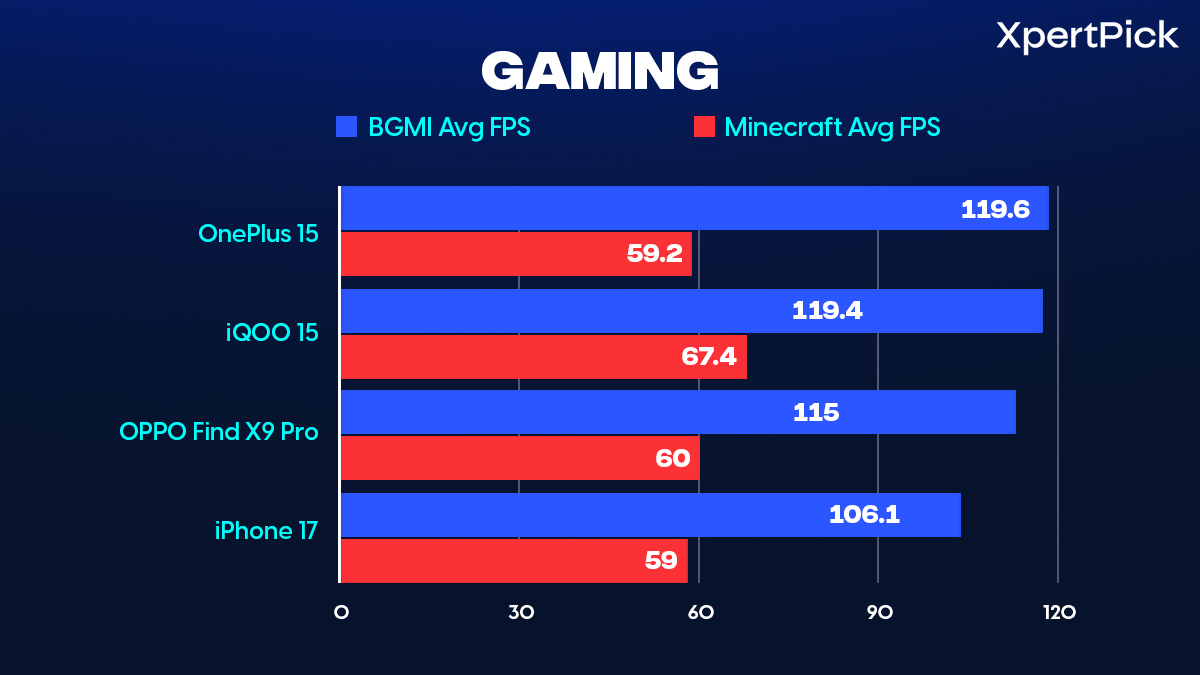
The iPhone 17 follows at 115 FPS, while the OPPO Find X9 Pro sits slightly behind at 106.1 FPS.
| Smartphone | BGMI Avg FPS | Minecraft Avg FPS |
|---|---|---|
| iQOO 15 | 119.6 | 59.2 |
| OnePlus 15 | 119.4 | 67.4 |
| iPhone 17 | 115 | 60 |
| OPPO Find X9 Pro | 106.1 | 59 |
In Minecraft, however, the gap widens a bit. The OnePlus 15 takes the lead with 67.4 FPS, while the iPhone 17 comes next at 60 FPS. The iQOO 15 and OPPO Find X9 Pro are very close to each other at 59.2 FPS and 59 FPS, respectively, effectively placing them in the same performance tier.
Overall Flagship Winner: OnePlus 15 Delivers the Strongest All-Round Package
Each of these phones leans into a different kind of user. The iPhone 17 feels like the pro choice, built for those who value long, stutter-free sessions, with the best thermal stability, strongest GPU compute performance, and excellent outdoor visibility. The iQOO 15, on the other hand, is clearly the speed-focused option, ideal for competitive BGMI players who want the fastest 144Hz refresh rate and the highest resolution at a relatively lower price in this bracket.
The OnePlus 15 sits right in the middle as the balanced flagship. It delivers the highest raw AnTuTu scores among the Android options here while also managing thermals better than the iQOO, making it a strong everyday performer. Meanwhile, the OPPO Find X9 Pro positions itself as the luxury powerhouse, appealing to users who want a premium 512GB setup and strong burst performance for short, intensive workloads.
Based on the testing data and performance analysis provided, here are the answers to your questions formatted as an FAQ section.
Frequently Asked Questions (FAQ’s)
What Are the Top 3 Best Phones Under Rs 1 Lakh?
Based on the test results, the top three recommendations that fall completely under the ₹1 lakh mark are:
-
OnePlus 15 (₹72,999): The best overall flagship. It strikes an excellent balance between raw performance, effective thermal management with 65.6% stability, and consistently strong gaming performance across a wide range of titles.
-
iPhone 17 (₹82,900): The most stable and predictable performer. It features the brightest display in its class, rated at 3,000 nits, and is powered by the A19 chip, which delivers class-leading thermal stability of 83.9% for consistently smooth performance during extended workloads.
-
iQOO 15 (₹72,999): The ultimate performance-focused device. It features the sharpest display in this segment, with a pixel density of 508 PPI, along with the fastest refresh rate of 144Hz, making it particularly well suited for fluid gaming and fast-paced content.
What Is the Best Gaming Phone Under Rs 1 Lakh?
The right choice depends entirely on your gaming style:
-
For competitive, short-burst gamers: The iQOO 15 is the winner. It is built with performance in mind, featuring a 144Hz display and delivering exceptionally high frame rates in games such as BGMI, where it achieved 119.6 FPS in our testing.
-
For marathon gamers: The OnePlus 15 is the better overall choice. The data shows that the iQOO 15 experiences more aggressive thermal throttling over time, with stability dropping to 58.3% under sustained workloads. In comparison, the OnePlus 15 maintains better thermal performance and delivers more consistent results across different gaming engines, making it the stronger option for longer gaming sessions and extended heavy use.
Should You Buy an Android Flagship or an iPhone Under Rs 1 Lakh?
The data illustrates a clear divide between “burst” performance and long-term consistency.
-
Choose an Android (OnePlus 15 / iQOO 15) if: You want the highest raw multi-core CPU benchmark scores, larger displays, and faster refresh rates of up to 144Hz. Android smartphones in this segment behave more like sprinters, delivering exceptional burst performance and impressive graphical power right from the outset.
-
Choose the iPhone 17 if: You prioritise sustained, throttle-free performance. While it behaves more like a marathon runner, with lower peak CPU scores than some Android rivals, Apple’s GPU performance remains exceptionally strong. Its 83.9% thermal stability means you are less likely to encounter sudden frame rate drops or stuttering during prolonged gaming sessions or other demanding workloads.
Should You Consider a Foldable Phone if Your Budget Is Rs 1 Lakh?
Based on the performance metrics prioritised in this comparison, no. The analysis specifically looks for devices that can deliver uncompromised thermal stability, sustained high frame rates, and advanced vapour cooling systems.
Because foldable phones must divide their internal space to accommodate hinges and dual displays, they inherently lack the thermal capacity and larger cooling solutions found in traditional slab-style flagship smartphones. If you are spending ₹1 lakh and are primarily seeking the absolute best raw performance with minimal throttling, conventional flagships such as the OnePlus 15 or the iPhone 17 are generally better equipped to manage heat and sustain peak performance over longer periods.