So, Asus has updated its Zenbook S 14 lineup, the same series whose AMD-powered 16-inch version I reviewed recently, with Intel’s Panther Lake lineup. The laptop is less of a redesign and more of a refresh, with a new coat of paint and a few small design changes here and there.
What is really interesting is the price Asus is charging for it. At the time of writing this article, the Asus Zenbook S 14 is priced at ₹2,49,990. To put that into context, the 16-inch Samsung Galaxy Book6 Pro, which I also tested recently, will set you back around ₹2,24,990 for a similar configuration. Meanwhile, even the 14-inch MacBook Pro with the M5 chip, 32GB RAM, and 1TB SSD costs around ₹2,29,000.
So, is the Asus Zenbook S 14 OLED (2026) worth it? Here’s my answer.
Design and Build: Same Premium Chassis, Small Visual Tweaks, and One Practical Compromise
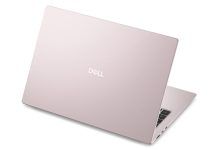
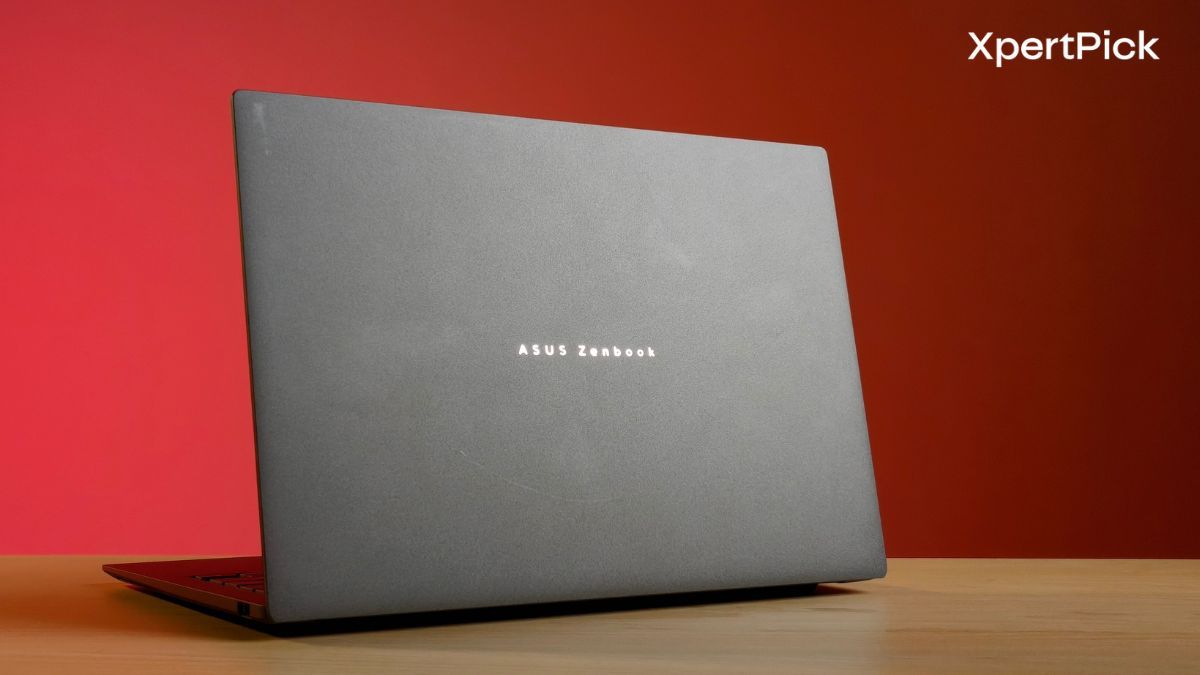
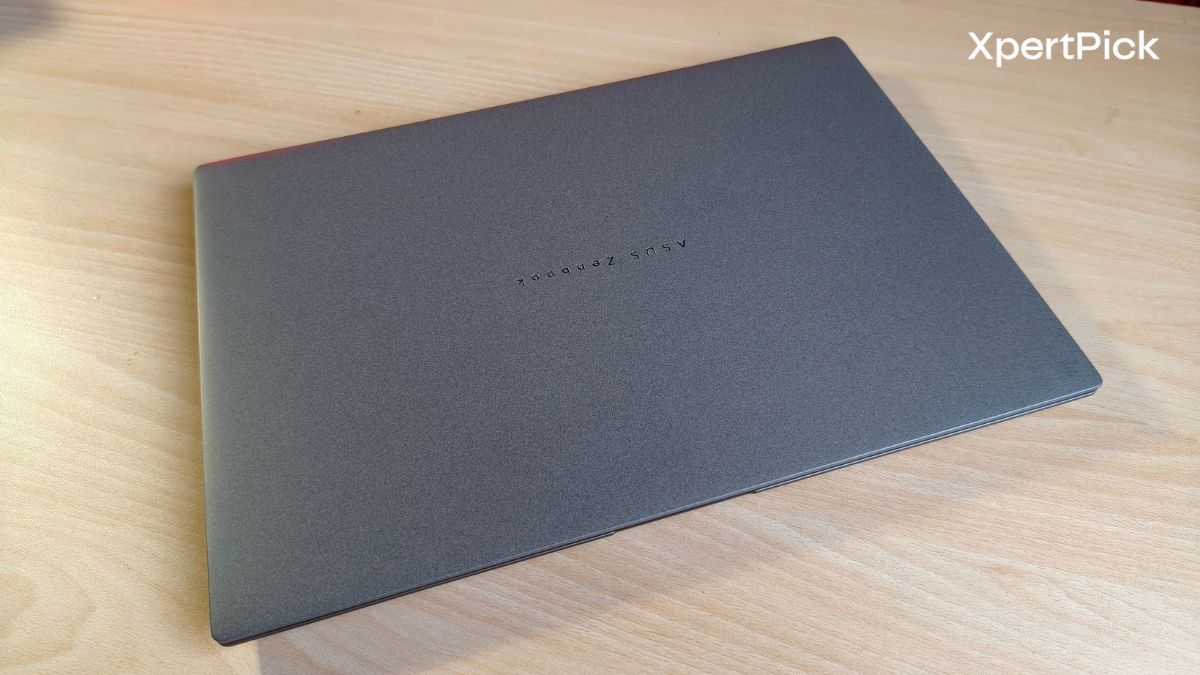
The 2026 iteration of the Asus Zenbook S 14 OLED (UX5406 series), remains similar to the its previous generation. The main change here is in the form of a redesigned lid which now bears the Asus Zenbook logo in a very minimalist fashion. It continues to use the same proprietary “Ceraluminum” construction.
When first introduced, it was an industry-first material that blended the lightness of aluminium with the hardness and wear resistance of ceramic. It replaced the traditional anodised finishes seen on older Zenbook models. This coating is highly resistant to micro-abrasions, scratches, and daily wear. It also resists fingerprint smudges well, though oily fingers can still leave visible marks on the surface.
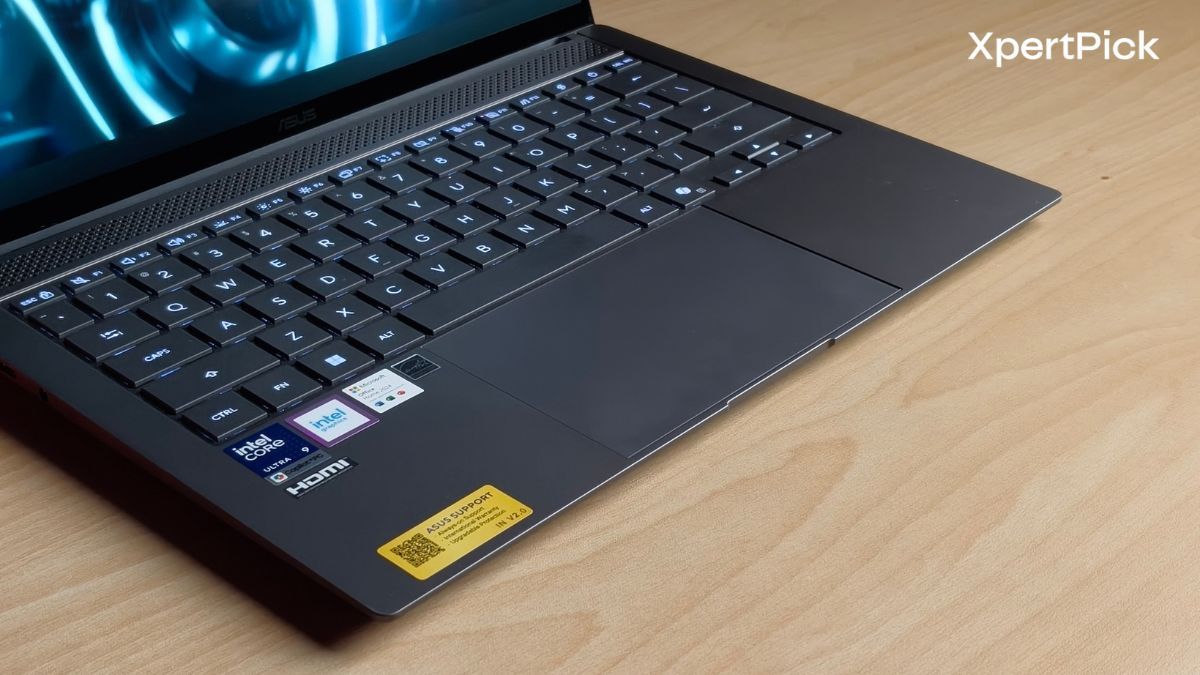
Beyond its surface finish, the chassis holds a MIL-STD 810H military-grade certification. The CNC-milled frame is strong and has minimal flex across both the keyboard deck and the display lid.
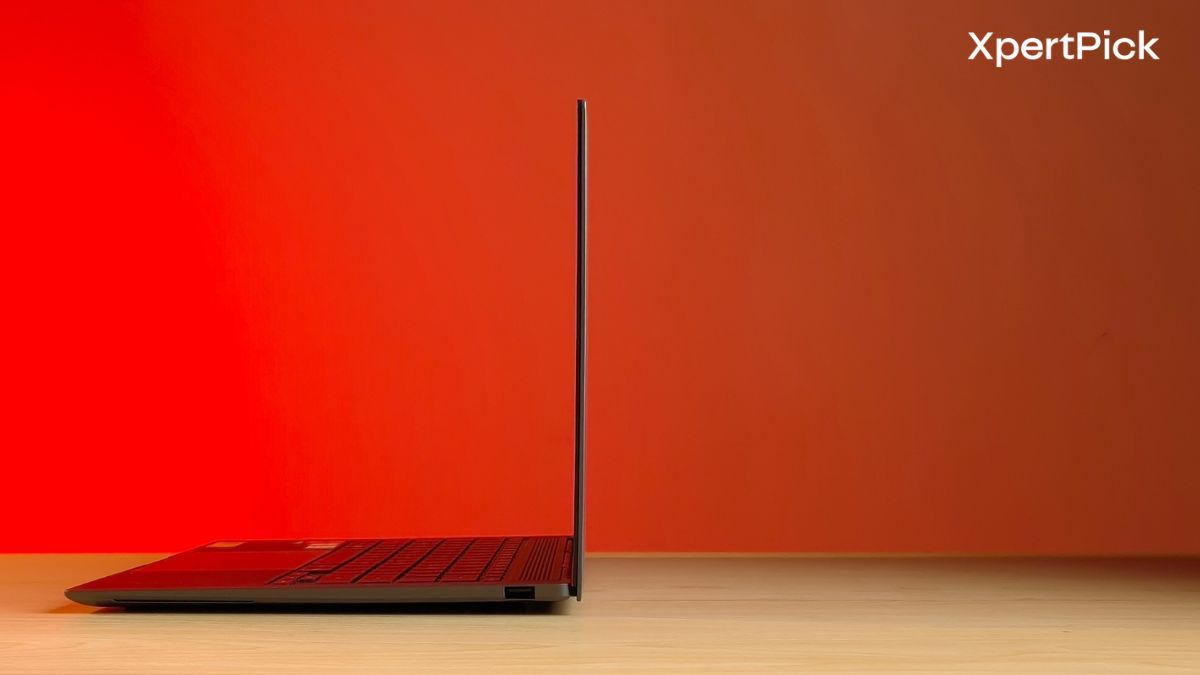
In terms of dimensions, the laptop continues to measure an ultra-thin 1.1 cm, or 11.9 mm, and weighs almost 1.2 kg.
This multi hole grille acts as the primary air intake for the dual-fan, 3D vapour chamber cooling system. How effectively it works in reality is something we will examine later in the performance section.
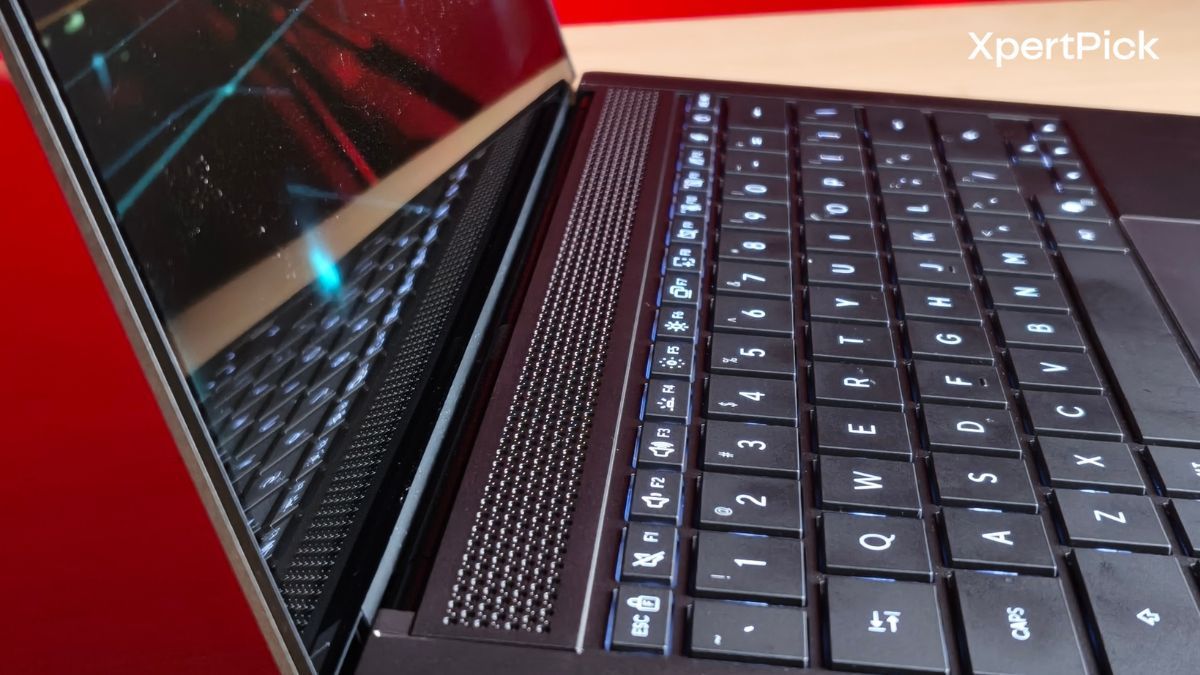
However, a notable design compromise related to this thermal layout is the hinge mechanism. Because the cooling exhausts are routed through the rear edge of the chassis, the display lid is restricted to a maximum opening angle of approximately 130 degrees and cannot lay flat like many other Asus laptops.
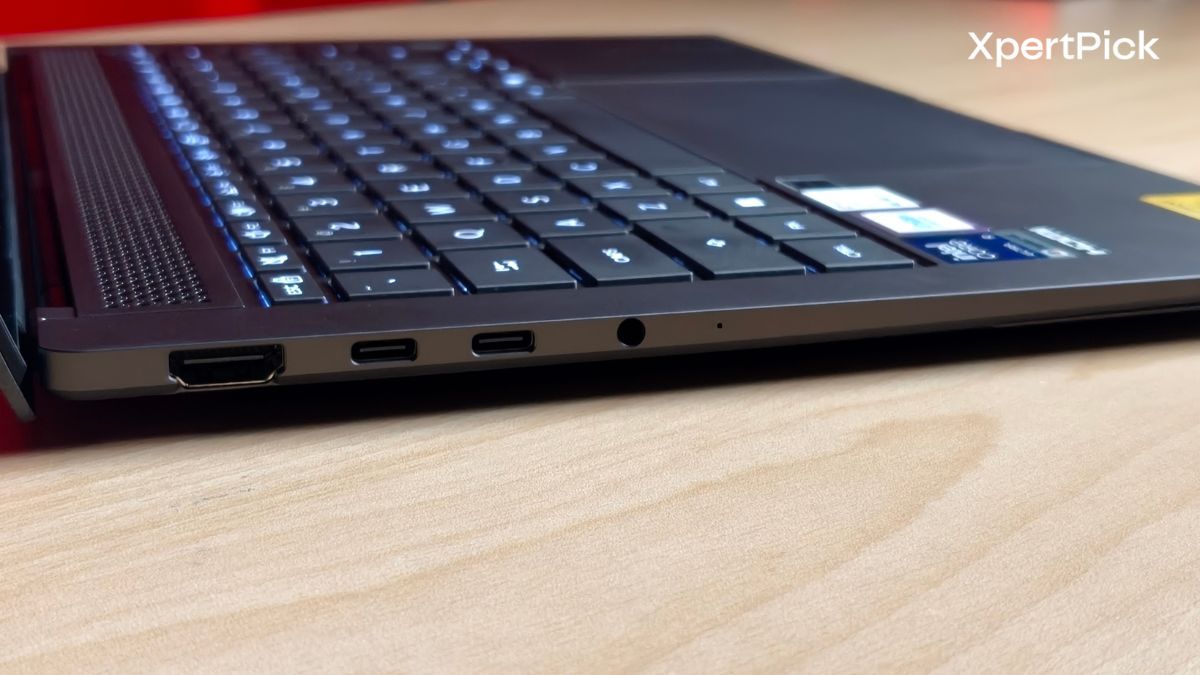
Despite the extreme thinness, Asus has avoided the minimal-port trend and retained a highly functional I/O layout that is useful for peripheral connectivity and external displays. The left edge houses a full-sized HDMI 2.1 port, an audio combo jack, and two Thunderbolt 4 Type-C ports, while the right edge features a single USB 3.2 Gen 2 Type-A port.
The laptop also continues to feature a spacious 16:10 glass trackpad that supports smart gestures, which is kind of a bummer because other laptops in this price range, including the Samsung Galaxy Book6 Pro and the 14-inch M5 MacBook Pro feature a haptic touchpad.
Meanwhile, the keyboard uses a durable Excimer coating on the keycaps to prevent the shine that typically develops over time due to finger oils. I cannot objectively comment on this yet, because it would take months before even a regular keyboard would begin to lose the coating on its keys.
Largely, this year’s Asus ZenBook S 14 has the same design as before, with a few minor visual tweaks.
Display and Speakers: A Gorgeous 1,100-Nit OLED Panel Paired With Merely Good Audio
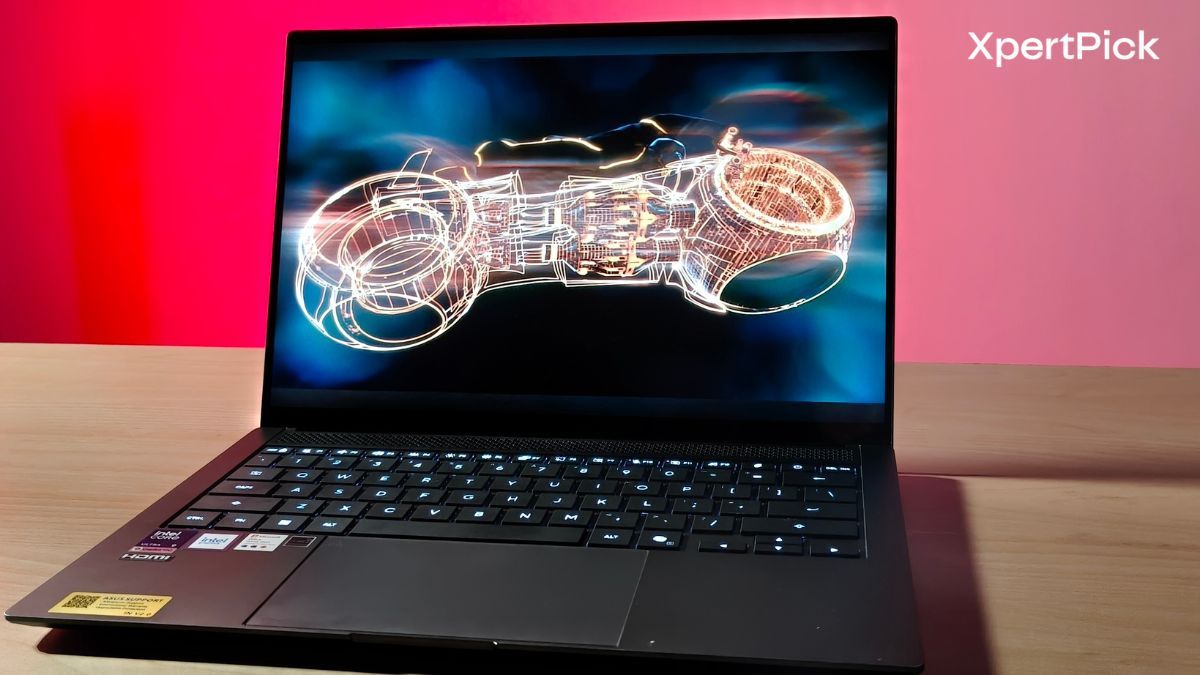
If there’s one area where the Asus Zenbook S14 (UX5406AA) demands your attention, it’s the display. Asus has outfitted this year’s model with a 14-inch, 3K (2880 x 1800) Lumina OLED panel in a productivity-first 16:10 aspect ratio. But the real headline is the peak brightness.
While everyday SDR tasks operate at a very comfortable 500 nits, the panel now boasts an impressive 1,100-nit HDR peak brightness. The same kind of upgrade we also saw in the 16-inch Samsung Galaxy Book6 Pro.
This massive headroom shatters the 500-to-600-nit ceiling of older models, delivering true VESA Certified DisplayHDR True Black 1000 performance. The result is explosive contrast and bottomless blacks when you are viewing or editing high-dynamic-range media.
The display also has a 120Hz refresh rate with a near-instant 0.2ms response time and for color-critical work, the panel covers 100% of the DCI-P3 colour gamut and arrives Pantone Validated right out of the box to guarantee strict color accuracy.
In terms of audio, Asus has packed a capable four-speaker setup into the Zenbook S 14, with two tweeters and two woofers. Tuned by the Asus Golden Ear team and certified by Harman Kardon, it delivers rich depth, loud volume, and decent surround effects for its size. Dolby Atmos support also helps with spatial separation and clarity.
The quad-speaker setup is also found on the Samsung Galaxy Book6 Pro. However, the slightly more expensive Galaxy Book6 Ultra, priced at Rs 2,42,990, features a much better six-speaker audio system, while the 14-inch MacBook Pro also offers a louder and better six-speaker setup.
This means both the Asus ZenBook S 14 and the Samsung Galaxy Book6 Pro sit on the lower end of audio capabilities in the Rs 2.50 lakh price range.
Performance: Strong Efficiency and Stability, but GPU and AI Scores Fall Behind
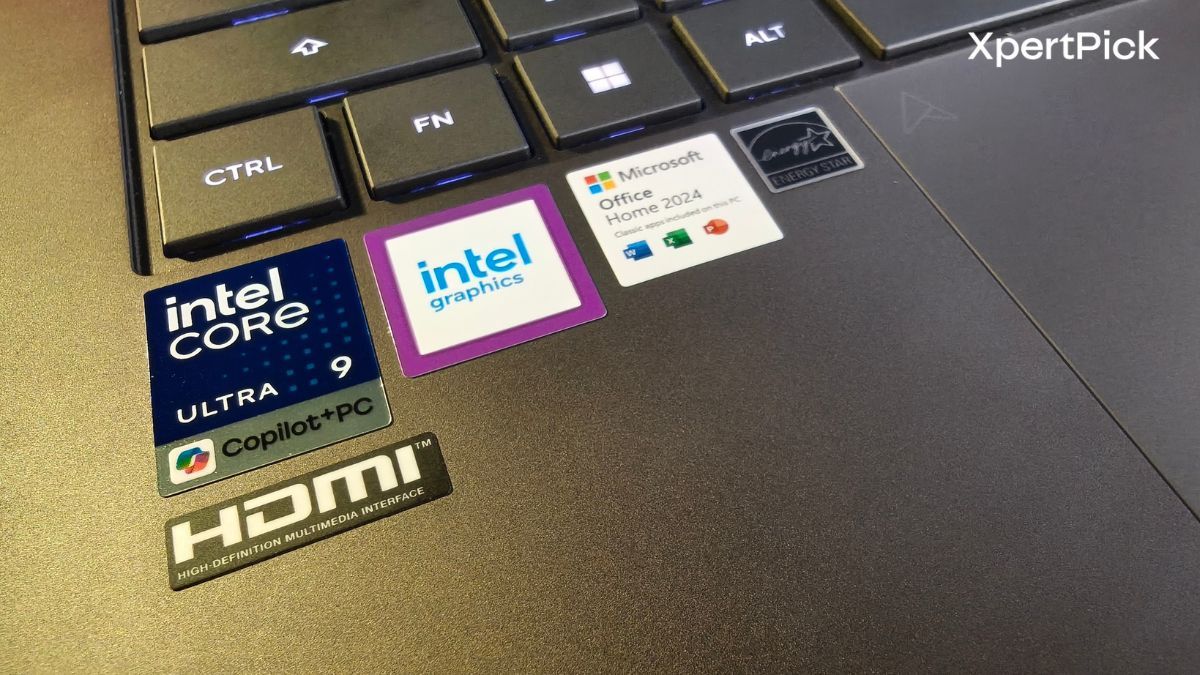
In terms of performance, the biggest change in this year’s Asus ZenBook S 14 is the move to Intel’s latest Panther Lake platform. The laptop features the Core Ultra 9 386H, a 16-core, 16-thread processor. However, there is an important distinction between this chip and some of the other Panther Lake processors on the market.
Intel’s Panther Lake line-up is divided into X and non-X variants. The X-branded chips, such as the Core Ultra X7 and X9, come with Intel’s newer and more powerful integrated GPU. Meanwhile, the non-X chips get the less powerful Intel integrated graphics solution.
This matters because one of the biggest selling points of the Panther Lake series is the integrated Intel Arc B390 GPU, which comes with 12 Xe cores. This iGPU is found on the X7 and X9 chipsets, and in our Panther Lake chip test, it delivered nearly twice the performance of the Lunar Lake iGPU, which already was amongst the most powerful iGPUs of the last generation and was featured in handhelds like the MSI Claw 8 AI+.
In terms of actual numbers, the Intel Core Ultra 9 386H scored 23,232 in the Geekbench 6 GPU test, while the Intel Core Ultra X7 358H in the Samsung Galaxy Book6 Pro scored 56,308.
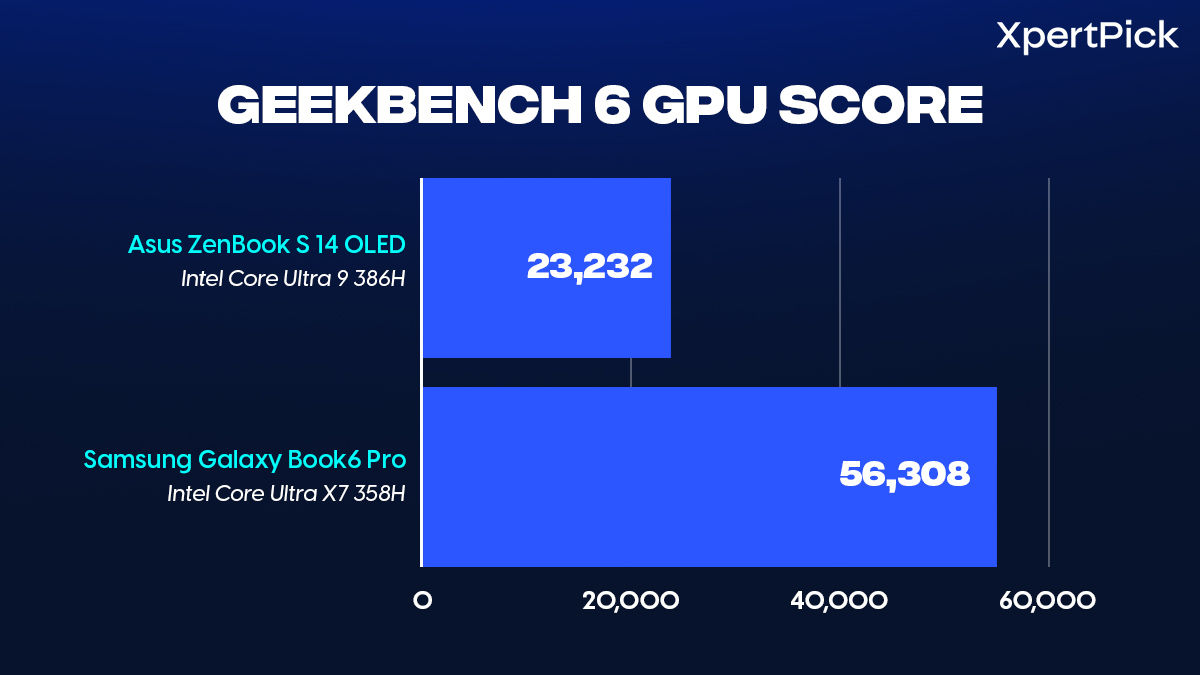
| Laptop | Processor | Geekbench 6 GPU score |
|---|---|---|
| Asus ZenBook S 14 OLED | Intel Core Ultra 9 386H | 23,232 |
| Samsung Galaxy Book6 Pro | Intel Core Ultra X7 358H | 56,308 |
Similarly, in 3DMark Wild Life Extreme, which tests real-time graphics performance, the Samsung Galaxy Book6 Pro scored 11,536 points. That is more than double the 4,086 points scored by the Asus ZenBook S 14.
This just goes to show how much more powerful the iGPU in the Core Ultra X7 358H is.
However, one area where the Asus ZenBook S 14 performed well is thermal stability. The laptop scored 96.1% frame stability in the 3DMark Wild Life Extreme stress test, while the Samsung Galaxy Book6 Pro scored 90.4%. That said, neither laptop reached the 97% mark required to pass the test.
| Laptop | Processor | 3DMark Wild Life Extreme score | Wild Life Extreme stress test stability | Lowest loop score |
|---|---|---|---|---|
| Asus ZenBook S 14 OLED | Intel Core Ultra 9 386H | 4,086 | 96.1% | 3,931 |
| Samsung Galaxy Book6 Pro | Intel Core Ultra X7 358H | 11,536 | 90.4% | 10,431 |
Even so, the Samsung Galaxy Book6 Pro still had a much higher lowest loop score after the stress test. It recorded 10,431 points, compared to 3,931 points on the Asus ZenBook S 14. This means that despite throttling more, the Galaxy Book6 Pro still has enough performance headroom to stay well ahead.
However, this improved thermal performance also makes the ZenBook S 14 a slightly noisier laptop compared to the Samsung Galaxy Book6 Pro, which remains almost silent throughout operation.
Another area where the ZenBook fares a bit better is in terms of efficiency. The Intel Core Ultra 9 386H uses 29 W at a stable max capability, while only consuming around 8 W during normal streaming and browsing tasks. The Core Ultra X7 358H, meanwhile, consumes over 45 W under stress and around 10 W during normal tasks.
In terms of CPU performance in the Geekbench 6.6 test, both chips are very similar in single-core performance. The Core Ultra 9 386H scores slightly higher with 2,905 points, compared to 2,890 points for the Core Ultra X7 358H. However, the X7 358H surprisingly pulls ahead in the multi-core test, scoring 17,108 points compared to 16,659 points on the Core Ultra 9 386H.
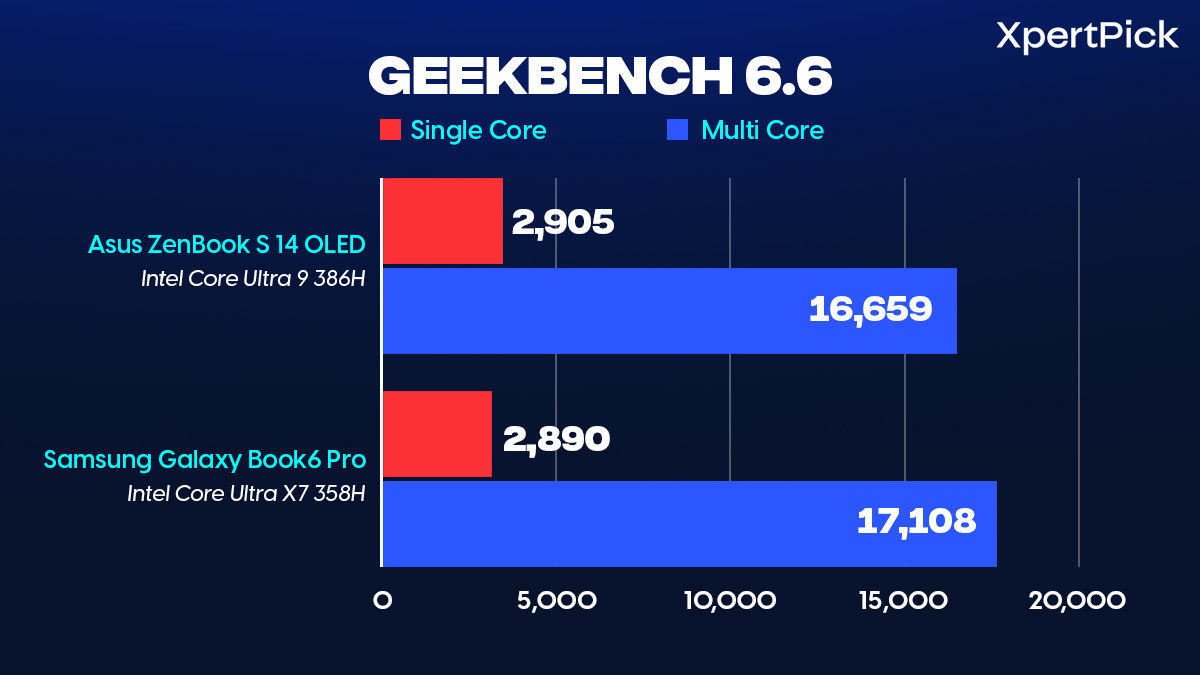
| Laptop | Processor | Geekbench 6.6 single-core | Geekbench 6.6 multi-core |
|---|---|---|---|
| Asus ZenBook S 14 OLED | Intel Core Ultra 9 386H | 2,905 | 16,659 |
| Samsung Galaxy Book6 Pro | Intel Core Ultra X7 358H | 2,890 | 17,108 |
That said, CPU-focused tasks should largely feel similar on both chips in real-world use.
For instance, in the UL Procyon Office Productivity test, the Samsung Galaxy Book6 Pro scored 295,000, while the Asus ZenBook S 14 scored 298,000. Lastly, AI performance in the UL Procyon AI Image Generation benchmark is not as strong on the Core Ultra 9 386H.
| Laptop | Processor | UL Procyon Office Productivity score | UL Procyon AI Image Generation score |
|---|---|---|---|
| Asus ZenBook S 14 OLED | Intel Core Ultra 9 386H | 298,000 | 253 |
| Samsung Galaxy Book6 Pro | Intel Core Ultra X7 358H | 295,000 | 669 |
It scored 253 points, compared to 669 points on the Core Ultra X7 358H. This difference largely comes down to the stronger GPU on the X7 358H.
Battery Life: The ZenBook S 14’s Efficiency Advantage Shows Clearly
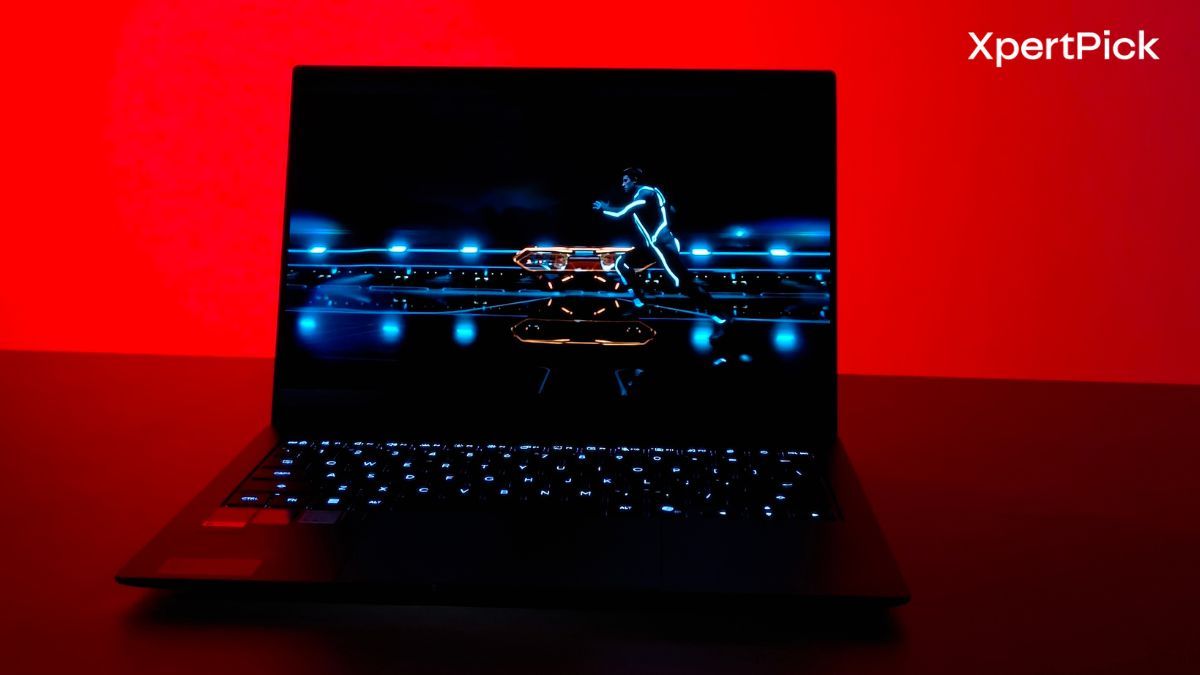
In our UL Procyon battery consumption benchmark, the ZenBook S 14 won with flying colours largely due to the high efficiency of the Intel Core Ultra 9 386H by scoring a run time of 667 minutes.
Meanwhile, the Samsung Galaxy Book6 Pro managed a relatively low run time of 469 minutes, due to the Intel Core Ultra X7 358H being more power hungry, on account of being more powerful as well.
Both laptops also have a similar battery size as well, the ZenBook S 14 2026 variant comes with a 77Wh battery while the 16-inch Samsung Galaxy Book6 Pro comes with a 78.07 Wh battery.
Verdict: A Lovely Ultrabook That Makes Less Sense at This Price
The Asus ZenBook S 14 OLED (2026) is a very good laptop in isolation, but a slightly difficult one to recommend at ₹2,49,990. It still gets the fundamentals right: the build is excellent, the 1.2 kg chassis is genuinely portable, the OLED display is bright and colour-accurate, the port selection is practical, and battery life is clearly one of its biggest strengths. If your priority is a thin, premium Windows laptop for writing, browsing, office work, media consumption, travel, and long unplugged usage, the ZenBook S 14 delivers a polished experience.
However, the pricing changes the conversation. At this price, the ZenBook S 14 is competing against machines that either offer more graphics performance, better audio, a haptic touchpad, or a stronger overall performance-per-rupee equation. The Intel Core Ultra 9 386H is efficient and performs well in CPU-heavy everyday tasks, but the lack of the more powerful Arc B390 iGPU hurts it badly in GPU and AI workloads. This becomes especially clear when compared to the Samsung Galaxy Book6 Pro with the Core Ultra X7 358H, which pulls far ahead in graphics benchmarks despite offering lower battery endurance.
That’s not to mention that, at the price point of the Asus ZenBook S 14, you can also get the Samsung Galaxy Book6 Ultra, which comes with all the bells and whistles of the Book6 Pro. In addition, it also gets a slightly bigger battery, better thermals, a six-speaker system, and likely even quieter operation, considering its chassis is thicker than the Book6 Pro’s.
And if you only want a 14-inch thin-and-light laptop, the 14-inch Samsung Galaxy Book6 Pro is also an option. It features the same core specifications as the 16-inch variant, but with a smaller display and a relatively more affordable price tag of Rs 2.14 lakh.
In short, the Asus ZenBook S 14 OLED (2026) is a good laptop, but it currently finds itself at a tough price point. Asus products do tend to become better value a few months after launch, so maybe I can take another look at the laptop sometime in the future. But if you are searching for a laptop in this price range right now, I would suggest looking at other options.
Pros
- Premium, lightweight build with a slim 1.2 kg chassis and practical port selection.
- Excellent 3K OLED display with 1,100-nit HDR brightness, 100% DCI-P3 coverage, and Pantone validation.
- Strong battery life, lasting 667 minutes in the benchmark.
- Efficient CPU performance for office work, writing, browsing, multitasking, and everyday productivity.
- Good keyboard feel, with Excimer-coated keycaps designed to resist long-term shine.
Cons
- Expensive at ₹2,49,990, especially against stronger alternatives in the same range.
- GPU and AI performance fall well behind the Samsung Galaxy Book6 Pro with Intel Arc B390.
- Regular mechanical touchpad feels less premium than the haptic touchpads on rivals.