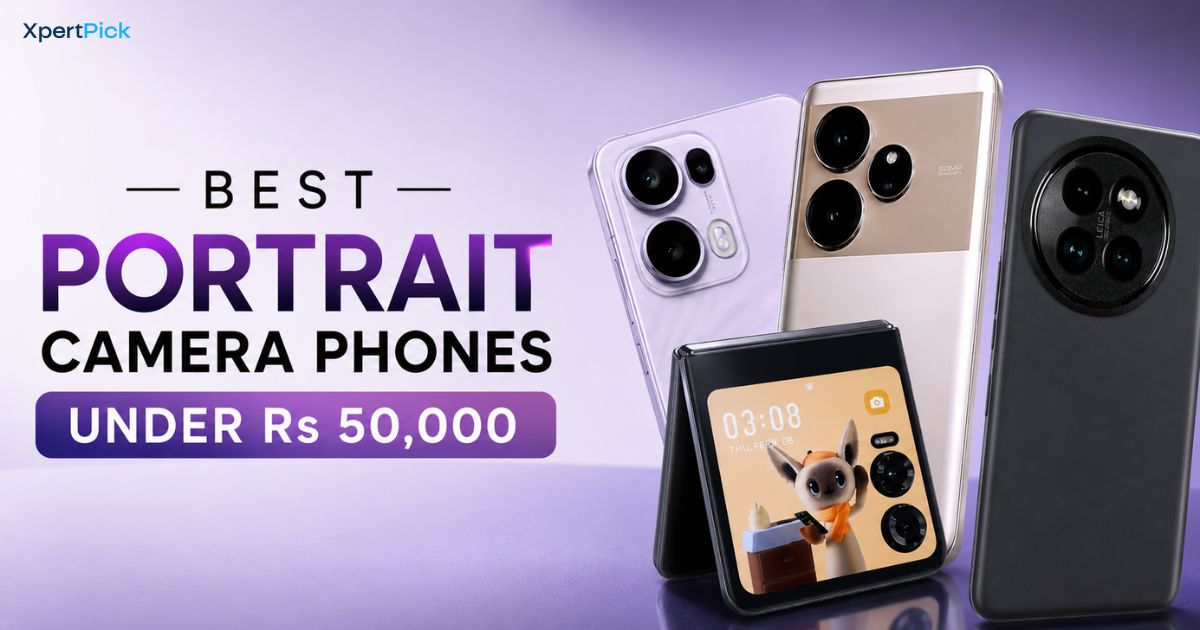
Infinix Zero Flip: Best for Selfie Portraits Under Rs 50,000
Why We Picked It
The Infinix Zero Flip is our best pick for selfie portraits under Rs 50,000 because its flip-style form factor allows users shoot selfies through the 50MP rear cameras, a sensor advantage no conventional front camera in this segment can replicate.
When folded, the Zero Flip uses its 50MP rear cameras for selfies via the external display, and the result is visibly better than the 32MP front shooters on the Reno 13 Pro, Realme GT 6, and Xiaomi 14 Civi. The image was sharper, bokeh was more convincing, and skin tone accuracy was closer to the rear camera output. If selfie quality is a priority, the Zero Flip’s form factor gives it a real-world advantage that matters.
On rear-camera portraits, the Zero Flip sits in the middle of the pack. Skin rendering was decent and not overly processed, but the image had a flatter tonal quality overall, the subject’s complexion looked slightly dull compared to the Reno 13 Pro, though it avoided the brightening tricks of the Realme GT 6. Edge work was softer overall; in areas where hair was finer or the transition was gradual, the line between subject and background was blurrier than it should have been. Bokeh was smooth but the algorithm played it safe, blur was present and consistent, but everything in the background looked roughly equally blurred, rather than falling off by distance.
Key Specifications
- 50 MP (upto 10x Digital Zoom) Wide Angle Primary Camera
- 50 MP Ultra-Wide Angle Camera
- 50 MP Front Camera
- Price: Rs 54,999
Test Data
- Selfie portrait: Sharpest of the four; convincing bokeh; accurate skin tones (via rear camera)
- Skin tone rendering (rear): Decent, not overprocessed, but flatter tonal quality
- Edge detection (rear): Softer than competitors; struggles with fine hair transitions
- Bokeh quality (rear): Smooth but uniform; lacks depth differentiation
| Pros |
Cons |
| Rear-camera selfies deliver class-leading sharpness and bokeh |
Priced above the ₹50,000 ceiling at ₹54,999 |
| Flip form factor gives a structural advantage no other phone in this segment can match |
Rear-camera edge detection is the softest of the four phones tested |
| Skin tone rendering avoids artificial brightening |
Background bokeh lacks depth differentiation compared to the Reno 13 Pro |
Realme GT 6: Best Value Portrait Phone Under Rs 50,000
Why We Picked It
The Realme GT 6 is our best value portrait phone under Rs 50,000 because at Rs 34,232 it delivers vibrant, social-media-ready portraits at a significantly lower price than the Reno 13 Pro, Xiaomi 14 Civi, and Infinix Zero Flip.
The GT 6 isn’t the most accurate performer, but it is the most flattering out of the box. On skin tone, it went noticeably warmer and brighter, the subject’s skin looked lighter than it was, and shadow detail around the jawline and collar was reduced. It doesn’t look bad; in fact, most people would probably prefer this output on social media, but it isn’t accurate. On edges, it struggled slightly on the right side of the hair where it transitioned into the bright sky, producing a soft, slightly washed-out edge that’s noticeable on zoom.
On bokeh, the GT 6 applied heavier blur overall, dramatic at first glance, but the transition between sharp and blurred wasn’t well-graduated near the shoulder area, and there were spots where the blur bled into the subject slightly. Its selfie portrait was composed well and the skin tone held up accurately, consistent with what we saw from the rear camera; background blur was visible and the edge around the face and hair was reasonably clean. For buyers who prioritise impact and price over strict accuracy, the GT 6 delivers the best portrait performance per rupee.
Key Specifications
- 50 MP Wide Angle Primary Camera
- 8 MP Ultra-Wide Angle Camera
- 50 MP Telephoto (upto 20x Digital Zoom, upto 2x Optical Zoom) Camera
- 32 MP Front Camera
- Price: Rs 35,900
Test Data
- Skin tone rendering: Warmer and brighter than reality; flattering but inaccurate
- Edge detection: Soft, washed-out edge near hair-to-sky transitions
- Bokeh quality: Heavier blur; uneven transition; occasional bleed into subject
- Selfie portrait: Accurate skin tone; clean edges around face and hair
Xiaomi 14 Civi: Best for Selfie Framing Under Rs 50,000
Why We Picked It
The Xiaomi 14 Civi is our best pick for selfie framing under Rs 50,000 because its dual 32MP front camera setup, one wide, one ultra-wide is specifically designed to improve portrait-style selfie composition.
The dual front camera setup arguably gave the Civi an edge in framing flexibility over the other three phones. Its selfie showed good detail, strong sharpness on the face, and decent background separation. On rear-camera portraits, segmentation was generally sharp and it got the glasses right, but around the top of the head the cutout felt overly aggressive, with a very hard edge that didn’t look entirely natural.
On skin tone, the Civi added punch and contrast, which made the face look sharp but also slightly harsher under direct comparison. Skin tones leaned cooler and the shot had a more “digital” quality to it. On bokeh, the Civi kept the blur tight and controlled, but because the overall image was brighter and more contrasty, the background didn’t feel as separated from the subject as on the Reno 13 Pro. Skin tone accuracy isn’t class-leading, but the overall package, especially the front camera is genuinely good for selfie-first users.
Key Specifications
- 50 MP Wide Angle Primary Camera
- 12 MP Ultra-Wide Angle Camera
- 50 MP Telephoto (upto 20x Digital Zoom, upto 2x Optical Zoom) Camera
- 32 MP + 32 MP Front Cameras
- Price: Rs 43,101
Test Data
- Selfie framing: Best of the four; dual-lens setup adds compositional flexibility
- Skin tone rendering: Cooler, more contrasty, “digital” quality
- Edge detection: Sharp segmentation; glasses preserved; overly hard edge at top of head
- Bokeh quality: Tight and controlled; weaker subject-background separation
| Pros |
Cons |
| Dual front camera setup gives the best selfie framing flexibility in the test |
Skin tones lean cooler and more “digital” than competitors |
| Sharp, detailed rear-camera output |
Edge cutout at the top of the head looks unnaturally hard |
| Accurate glasses rendering in edge detection |
Background-to-subject separation in bokeh is weaker than the Reno 13 Pro |
Portrait Mode Tips: How To Get Cleaner Edges, Better Light, And More Natural Blur
- Background complexity matters: A detailed background, brick walls, foliage with fine leaves, iron grills is much harder for depth estimation algorithms than a plain wall or open sky. When the background is complex, segmentation errors at edges become more visible. If you have control over location, choose simpler backgrounds. If you don’t, stand closer to the subject to reduce the background’s visual weight.
- Light direction: Phones meter for brightness, not directionality. Shooting with the primary light source directly behind the subject creates a backlit situation the phone will struggle with it often either blows out the background or underexposes the face. Side or front lighting consistently produces cleaner results. Golden hour light from the side renders far better than midday overhead light, even if total brightness is lower.
- Shoot multiple frames: The algorithm doesn’t produce identical output every frame. Small movements, a breeze moving hair, or the subject shifting slightly can change what the depth estimator has to work with. Take at least five frames per setup and compare edge quality around hair and shoulders before deciding which to keep.
- Glasses are a red flag: Reflections in glasses confuse depth estimation. After shooting a subject with glasses, zoom in on the frames and the area directly beneath them, that’s where errors most commonly appear. Some phones handle this better than others, but none handle it perfectly.
- Portrait mode isn’t always the best tool: If the subject is moving, if the light is poor, or if you want more control over the final look, shooting in standard mode and using a slight crop can produce more reliable results. Portrait mode’s computational blur is an approximation, on challenging scenes, a well-exposed standard shot with clean subject-background separation often looks better than a portrait mode shot with visible artefacts.
FAQs
Which is the best portrait camera phone under Rs 50,000?
The OPPO Reno 13 Pro is the best portrait camera phone under Rs 50,000. It delivered the most natural skin tones, the cleanest edge detection around hair and glasses, and the most realistic layered background blur in our side-by-side testing.
Which phone has the best selfie camera under Rs 50,000?
The Infinix Zero Flip has the best selfie camera in this segment because its flip form factor allows you to shoot selfies through the 50MP rear cameras, producing sharper detail, more convincing bokeh, and more accurate skin tones than the 32MP front cameras on competing phones.
Which is the best value portrait phone under Rs 50,000?
The Realme GT 6 is the best value portrait phone at Rs 34,232. It doesn’t deliver the most accurate skin tones or cleanest edges, but it produces vibrant, flattering, social-media-ready portraits at a significantly lower price than the Reno 13 Pro, Xiaomi 14 Civi, or Infinix Zero Flip.
Is the OPPO Reno 13 Pro better than the Realme GT 6 for portraits?
Yes, the OPPO Reno 13 Pro is the better portrait camera overall. It handles skin tone more naturally, keeps edge detection cleaner, and produces more convincing background blur.