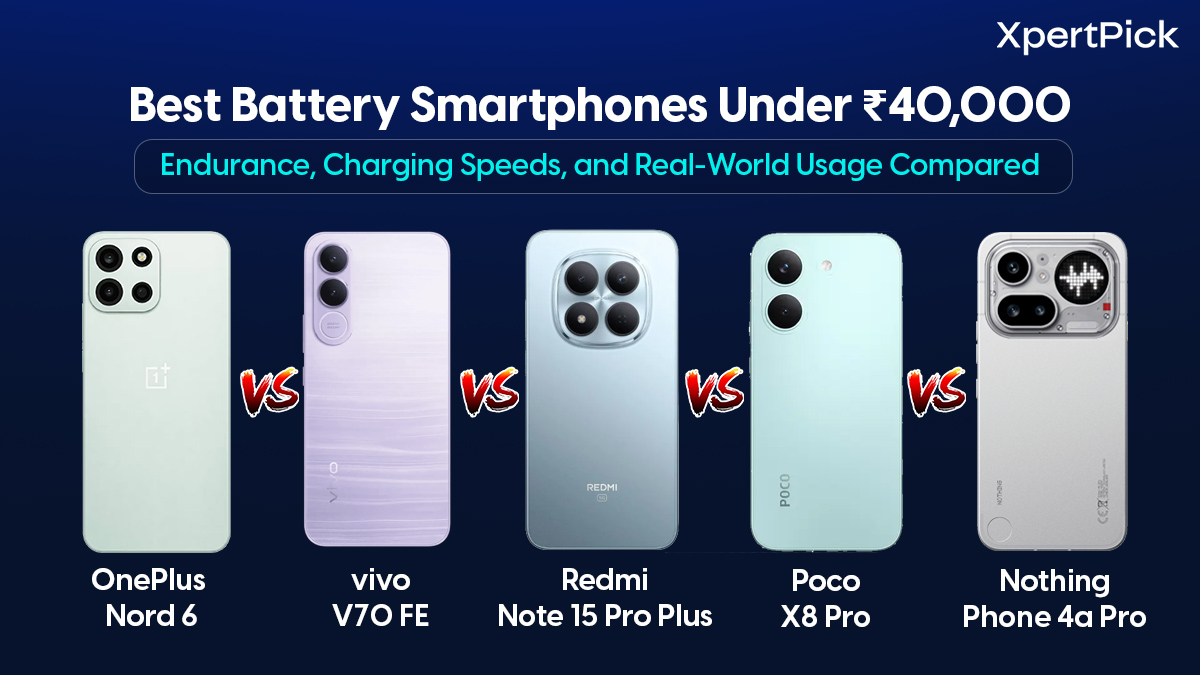
If you’re looking for the best battery smartphones under ₹40,000 in 2026, this segment has evolved dramatically. This is no longer about compromise. Phones in this range now push extreme battery capacities, rivaling or even surpassing what flagships offered just a couple of years ago.
What separates them today is not just battery size. It is how efficiently that power is used, how devices behave under sustained workloads, and how quickly they recover with fast charging.
This comparison covers five key contenders:
- OnePlus Nord 6 (₹38,999) with a massive 9,000mAh silicon-carbon battery
- Nothing Phone 4a Pro (₹39,999) focuses on efficiency and premium design
- Redmi Note 15 Pro Plus (₹37,999) combining 6,500mAh with 100W charging
- vivo V70 FE (₹37,999) offering a 7,000mAh battery with camera focus
- Poco X8 Pro (₹32,999) delivers performance and value
Battery Capacity And Hardware Overview
| Key Specifications | OnePlus Nord 6 | Nothing Phone 4a Pro | Redmi Note 15 Pro Plus | vivo V70 FE | Poco X8 Pro |
| Price | ₹29,999 | ₹29,999 | ₹30,999 | ₹27,900 | ₹26,999 |
| Best For | Biggest silicon-carbon battery | High efficiency & unique design | Superb combination of big battery & fast charging | Big battery and great camera experience | Performance at a value price point |
| Battery Capacity | 9,000mAh | 5,400mAh | 6,500mAh | 7,000mAh | 6,500mAh |
| Charging Speed | 80W | 50W | 100W | 90W | 100W |
| Processor | Snapdragon 8s Gen 4 | Snapdragon 7 Gen 4 | Snapdragon 7s Gen 4 | Dimensity 7360 Turbo | Dimensity 8500 Ultra |
| RAM | 8GB / 12GB | 8GB / 12GB | 8GB / 12GB | 8GB / 12GB | 8GB / 12GB |
| Storage | 256GB | 128GB / 256GB | 256GB / 512GB | 128GB / 256GB | 256GB / 512GB |
| Display | AMOLED, 165Hz | AMOLED, 144Hz | AMOLED, 120Hz | AMOLED, 120Hz | OLED, 120Hz |
On paper, the OnePlus Nord 6 stands in a league of its own with a 9,000mAh battery. It is the largest cell in this segment and immediately sets the benchmark. But as always, real-world endurance tells a more complete story than raw numbers.
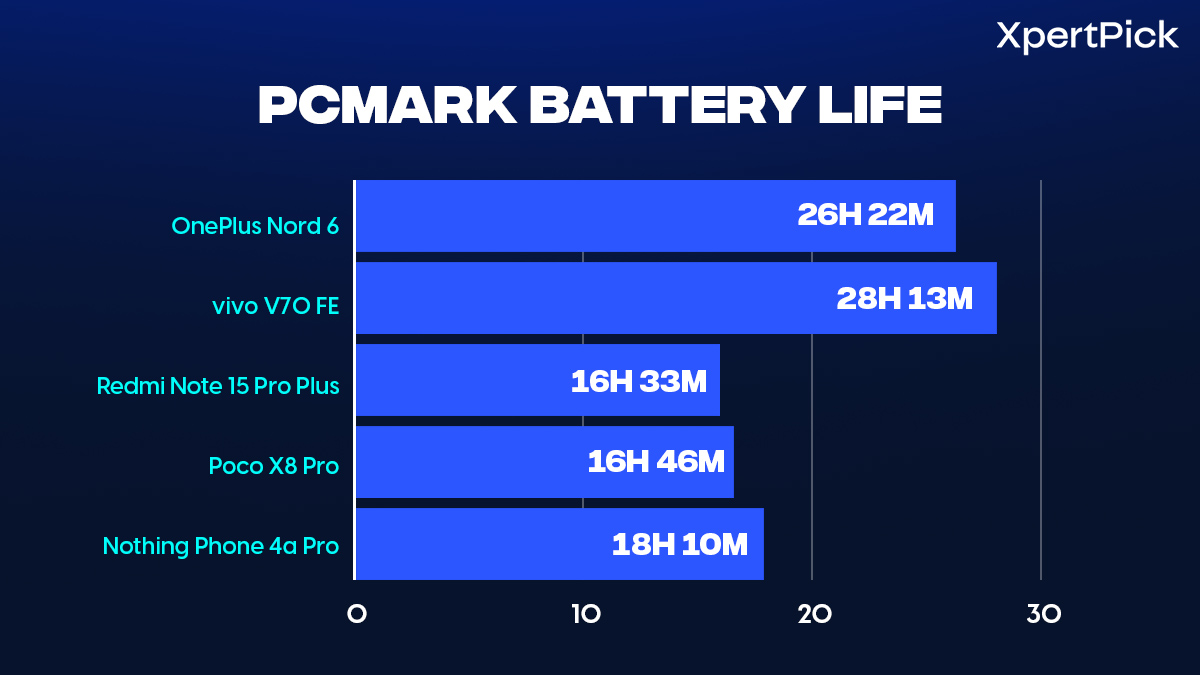
Battery Life: vivo V70 FE Leads, OnePlus Nord 6 Follows Closely
| Smartphone | PCMark Battery Life |
| OnePlus Nord 6 | 26h 22m |
| vivo V70 FE | 28h 13m |
| Redmi Note 15 Pro Plus | 16h 33m |
| Poco X8 Pro | 16h 46m |
| Nothing Phone 4a Pro | 18h 10m |
The OnePlus Nord 6 delivers a strong result at 26 hours and 22 minutes. That’s firmly in the top tier, and in day-to-day use, it translates into a phone you don’t really have to think about charging. The combination of a silicon-carbon battery and an efficient Snapdragon platform is clearly doing its job here.
The vivo V70 FE goes even further, reaching 28 hours and 13 minutes. That’s a noticeable step up rather than a marginal gain, and it points toward a setup where both battery capacity and software tuning are working in sync to maximise endurance.
The Redmi Note 15 Pro Plus lands at 16 hours and 33 minutes. It’s a respectable number on its own and enough for a full day of consistent use, but it sits well behind the top performers, suggesting a more balanced tuning between power and efficiency.
The Poco X8 Pro is right alongside it at 16 hours and 46 minutes. The difference is minimal, and the story remains similar, solid endurance, but clearly not chasing the kind of battery optimisation seen at the top.
The Nothing Phone 4a Pro comes in at 18 hours and 10 minutes. While it finishes below most of the lineup, it still holds up as a reliable all-day device, especially considering it isn’t built around aggressive battery capacity.
Taken together, the results show a clear split. The OnePlus Nord 6 and vivo V70 FE operate in a different league compared to the rest, and between the two, the vivo V70 FE ultimately comes out ahead as the most efficient device in this comparison.
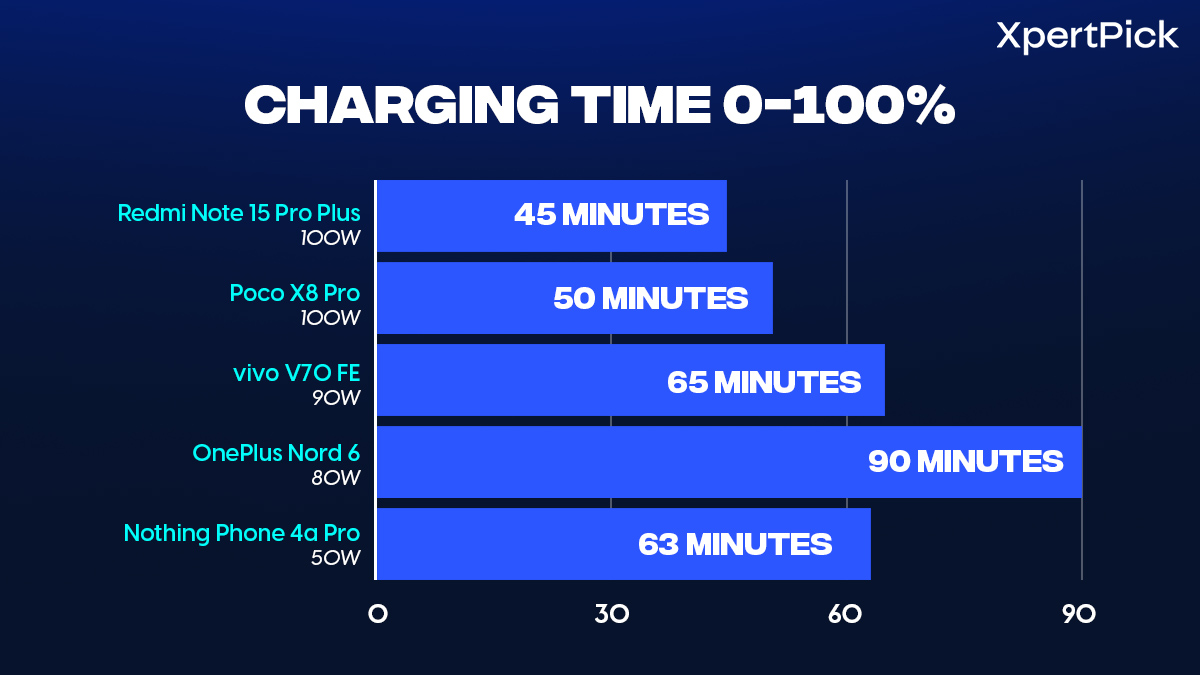
Charging Test: Redmi Note 15 Pro Plus Takes the Lead
| Smartphone | Charging Speed | 0–100% Time |
| Redmi Note 15 Pro Plus | 100W | 45 minutes |
| Poco X8 Pro | 100W | 50 minutes |
| vivo V70 FE | 90W | 65 minutes |
| OnePlus Nord 6 | 80W | 90 minutes |
| Nothing Phone 4a Pro | 50W | 63 minutes |
The Redmi Note 15 Pro Plus sets the pace here, reaching a full charge in just 45 minutes. With 100W charging in play, this is exactly the kind of result you’d expect—fast, efficient, and practical for quick top-ups during the day.
The Poco X8 Pro follows closely at 50 minutes, also backed by 100W charging. The difference is small in real use, and both phones sit comfortably in the “plug it in briefly and you’re good to go” category.
The vivo V70 FE takes 65 minutes to go from 0 to 100 percent. Considering its larger battery, the slightly longer time makes sense, and it still remains within a reasonable window for overnight or routine charging.
The Nothing Phone 4a Pro comes in at 63 minutes despite using a 50W charger. That’s a fairly efficient result for the wattage, showing that optimisation plays a role beyond just raw charging speed.
The OnePlus Nord 6 is the slowest here, taking 90 minutes for a full charge. Even with 80W charging, this suggests a more conservative charging curve, likely prioritising battery health and thermal management over outright speed.
In short, there’s a clear split between ultra-fast charging and more measured approaches. At the top, the Redmi Note 15 Pro Plus emerges as the fastest-charging device in this lineup, with the Poco X8 Pro not far behind.
Battery Behaviour: OnePlus Nord 6 Lasts Longest
The OnePlus Nord 6 is the clear battery champion. It delivers consistent multi-day usage and maintains performance stability even under heavy workloads like gaming and video recording.
The vivo V70 FE stands out for efficiency. Its Dimensity 7360 Turbo chip and conservative tuning allow it to extract more real-world usage per milliamp-hour than expected.
The Redmi Note 15 Pro Plus is tuned for versatility. It handles demanding tasks well but sacrifices some endurance under sustained load.
The Poco X8 Pro targets gamers. Its Dimensity 8500 Ultra and aggressive performance tuning prioritise frame rates, which impacts battery life during extended gaming sessions.
The Nothing Phone 4a Pro focuses on experience rather than endurance. Its clean software and optimisation ensure reliable single-day usage, but it is not built for multi-day battery life.
Battery and Charging Balance: vivo V70 FE Feels the Most Complete
The OnePlus Nord 6 makes a strong case for itself by pairing long runtime with dependable fast charging. Crossing the 26-hour mark in PCMark already puts it in a comfortable position for multi-day use, and while its 90-minute full charge isn’t the quickest here, it still fits into a predictable overnight routine without friction.
The vivo V70 FE approaches things from a different angle. It pushes the highest runtime in this lineup, going past 28 hours, and balances that with a 65-minute full charge. That combination feels less about raw speed and more about consistency, fewer charging cycles, and when you do plug in, it doesn’t take excessively long.
The Redmi Note 15 Pro Plus leans heavily into charging speed. A 45-minute full charge is the fastest result here, and it’s genuinely useful if you’re someone who relies on short bursts of charging through the day. The trade-off is clear in its runtime, which sits well below the top performers.
The Poco X8 Pro follows a similar philosophy. It charges quickly at 50 minutes and delivers solid, if not class-leading, endurance. It doesn’t dominate in either direction, but it stays reliable across both aspects without any obvious weaknesses.
The Nothing Phone 4a Pro takes a more balanced route. Its runtime of just over 18 hours and a 63-minute charge time don’t lead the chart, but together they create a predictable, no-surprises experience that works well for typical daily usage.
Looking at the bigger picture, this isn’t just about who lasts the longest or charges the fastest. It’s about how those two factors come together in everyday use. And in that context, the vivo V70 FE stands out as the most complete package, delivering class-leading endurance without compromising too much on charging time.
Value for Money: Poco X8 Pro Delivers the Strongest Package for the Price
Value isn’t just about the lowest price here. It’s about how much battery performance, charging convenience, and overall usability you’re getting for what you pay, and this lineup is surprisingly tight on pricing.
The OnePlus Nord 6 5G sits at ₹38,999 and immediately justifies it with sheer battery scale. A 9,000mAh silicon-carbon setup paired with a flagship-grade Snapdragon platform gives it both endurance and performance headroom, which is rare at this price point. But the slower 90-minute charging time slightly pulls it back from being the most practical all-rounder.
The vivo V70 FE, priced similarly around ₹37,999, takes a more refined approach. It doesn’t just rely on battery size, it translates that into the best real-world endurance in your testing, while still keeping charging within a reasonable window. You’re essentially paying for efficiency, not just capacity.
The Redmi Note 15 Pro+ 5G at ₹37,999 flips the equation. It gives you one of the fastest charging experiences in this segment, which genuinely changes how you use the phone day to day. The trade-off is visible in endurance, but if your usage pattern revolves around quick top-ups, this starts to make more sense.
The Nothing Phone 4a Pro 5G at ₹39,999 feels like the most lifestyle-driven pick. You’re not paying for extreme battery numbers here, you’re paying for a cleaner experience, design, and balanced efficiency. It holds up well, but it doesn’t stretch value in the same way the others do.
Then there’s the Poco X8 Pro at ₹32,999, which undercuts everything else by a noticeable margin. And that changes the conversation. It still delivers solid battery life, fast charging, and strong performance, but at a significantly lower entry point. You’re giving up top-tier endurance, yes, but not enough to feel like a compromise in daily use.
When you step back and look at price against what you’re actually getting, the answer becomes clearer. The Poco X8 Pro doesn’t win on absolute numbers, but it delivers the most complete experience relative to its price. And that’s what ultimately makes it the best value-for-money option in this lineup.
FAQs
Best battery phone under Rs 40,000 right now?
The vivo V70 FE ended up being the most balanced overall battery phone in this comparison. It combined strong endurance, stable efficiency, and fast charging without leaning too heavily on just raw battery size.
Longest lasting phone from this comparison?
The OnePlus Nord 6 comfortably lasted the longest thanks to its massive 9,000mAh silicon-carbon battery. In day-to-day usage, it was the phone that required the least charging anxiety overall.
Fastest charging phone here?
The Redmi Note 15 Pro Plus was clearly the quickest to recover during charging tests. The 100W charging setup made a noticeable difference during shorter top-ups.
Does bigger battery capacity always mean better battery life?
Not necessarily anymore. Software optimisation, chipset efficiency, thermals, and background battery behaviour now matter almost as much as battery size itself.
Most value-focused battery phone here?
The Poco X8 Pro delivered one of the strongest overall battery and charging combinations relative to its pricing, making it the easiest value recommendation in this lineup.