Best Performance Phones Under ₹30,000 in India (May 2026): Top Picks for Gaming and Multitasking

Five smartphones arranged side-by-side for a performance comparison. From left to right: Nothing Phone 3a Lite, Vivo T5x, Realme P4 Power, Realme P4 Pro, and Motorola Edge 70 Fusion.

Buying a performance smartphone under ₹30,000 should not be a daunting task, and that is exactly why this list exists. It is already difficult to keep up with the sheer number of smartphone launches happening at any given time, and on top of that, the multiple variations in which phones launch nowadays make it even harder to find and select the perfect model for yourself.

To help you buy the absolute best performance-focused smartphone under ₹30,000 for your specific needs, we picked and thoroughly tested seven devices across a rigorous series of productivity, thermal, and gaming stress tests. This list is built specifically for users who analyse hardware down to the finest detail and care deeply about how a device holds up under heavy, real-world workloads.

The Realme P4 Pro emerges as the winner for overall performance in this comparison. Additionally, if you are looking for a device best suited for daily tasks, rapid app loading, and general everyday speed, the Moto Edge 70 Fusion is the one to go for. Meanwhile, the Nothing Phone 3a Lite stands out for its exceptional thermal management and long-term consistency. In contrast, the Realme P4 Power delivers the best AI performance and the least frame drops in gaming. Lastly, the Vivo T5x remains the ideal choice for an entry-level, value-focused performance smartphone.

Performance Winners Across Categories

  • Realme P4 Pro (₹30,999) – Best Overall Performance
  • Moto Edge 70 Fusion (₹29,999) — Best Everyday Speed and App Loading
  • Nothing Phone 3a Lite (₹27,900) — Best Thermals and Sustained Smoothness
  • Realme P4 Power (₹29,999) – Best Gaming Stability and AI Performance
  • Vivo T5x (₹26,999) — Best Entry-Level Value Performance

Key Specifications and Hardware Overview

Attributes Realme P4 Pro Moto Edge 70 Fusion Nothing Phone 3a Lite Realme P4 Power Vivo T5x
Price ₹30,999 ₹29,999 ₹27,900 ₹29,999 ₹26,999
Best For Overall Performance Everyday Speed and App Loading Thermals and Sustained Smoothness Gaming Stability and AI Performance Entry-Level Value Performance
Processor Snapdragon 7 Gen 4 Snapdragon 7s Gen 4 MediaTek Dimensity 7300 Pro MediaTek Dimensity 7400 Ultra MediaTek Dimensity 7400 Turbo
Display

6.8″ AMOLED, 144Hz

(1280 x 2800 pixels)

6.8″ pOLED, 144Hz

(1080 x 2400 pixels)

6.77″ AMOLED, 120Hz

(1084 x 2392 pixels)

6.8″ AMOLED, 144Hz

(1280 x 2800 pixels)

6.67″ IPS LCD, 120Hz

(1080 x 2392 pixels)

Rear Camera 50MP OIS + 8MP UW 50MP OIS + 13MP UW 50MP OIS Main 50MP OIS Main 50MP + 2MP
Battery & Charging 7,000mAh (80W Fast Charging) 7,000mAh (68W Fast Charging) 5,000mAh 10,001mAh 7,200mAh (44W Fast Charging)
RAM / Storage Up to 12GB / 256GB Up to 12GB / 256GB 8GB / Up to 256GB Up to 12GB / 256GB Up to 8GB / 256GB


Realme P4 Pro: Best Overall Performance
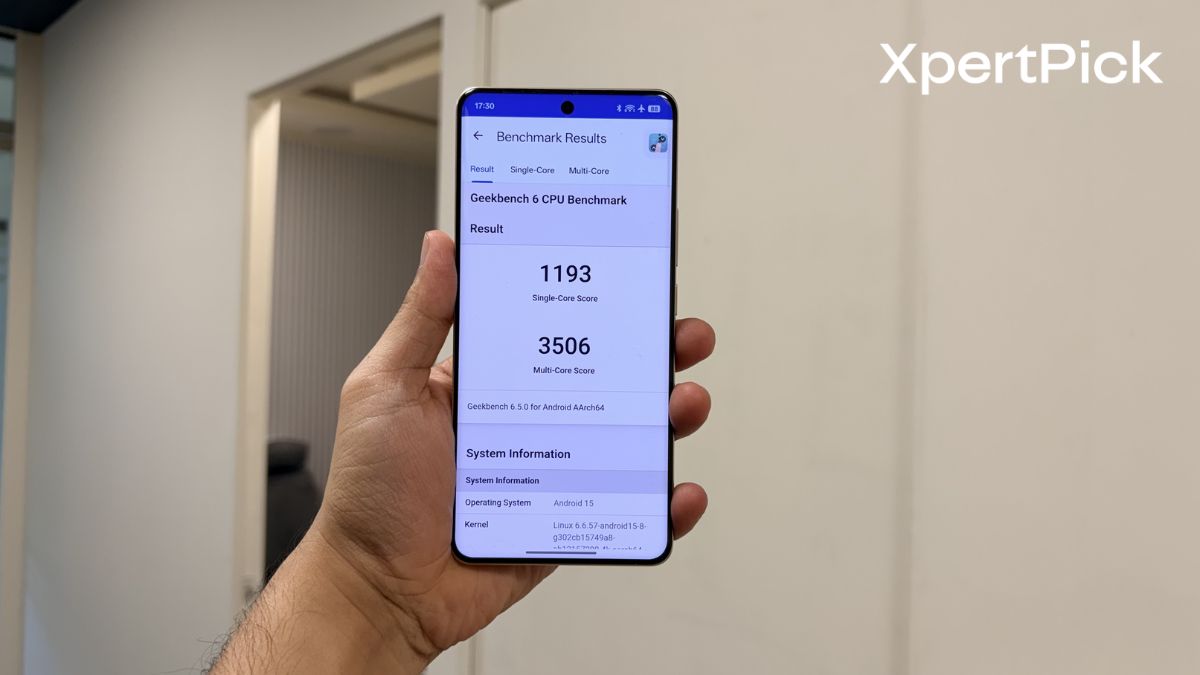
Realme P4 Pro displaying Geekbench 6 CPU benchmark scores on screen during performance testing

The reason for choosing the Realme P4 Pro as the best in terms of overall performance is its dominance in performance-focused benchmarks like 3DMark Wild Life Extreme, along with its high stability in the same test. Moreover, its performance in CPU-focused benchmarks like Geekbench 6 is also quite strong, as it delivers the second-highest single-core score and the highest multi-core score.

In gaming as well, while running graphically intensive titles like Minecraft, it scores the second highest in terms of 5% average FPS. Similarly, in BGMI, it achieves the second-highest 5% average FPS score, proving that the smartphone can deliver high stability across all areas, whether in synthetic benchmarks or gaming.
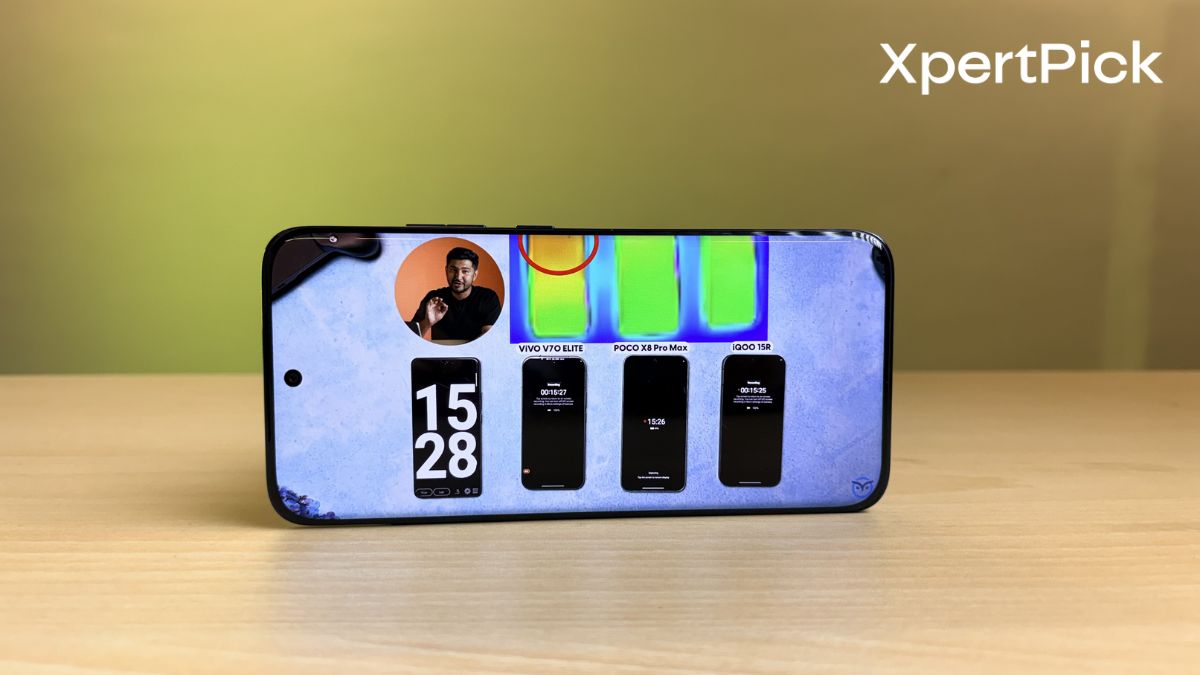
In short, in terms of CPU, GPU, and thermals, the Realme P4 Pro takes the lead and is therefore crowned the best overall performance phone under ₹30,000.

Realme P4 Pro XP Lab Data

  • AnTuTu v10: 1,009,232
  • Geekbench 6: 1,193 (Single-Core) | 3,506 (Multi-Core)
  • 3DMark Wild Life Extreme: 1,813 (99.3% Stability)
  • CPU Thermal Throttling: 87% Sustained Performance
  • Thermals: 40.8°C (Peak temperature recorded after heavy graphical stress test)
  • Storage Speeds: 2,066.7 MB/s (Sequential Read) | 1,813.0 MB/s (Sequential Write)
  • Gaming Performance:
    – BGMI: 73.0 Average FPS | 61.2 (5% Low FPS)
    – Minecraft: 43.5 Average FPS | 23.9 (5% Low FPS)

Pros and Cons

Pros:

  • Unmatched GPU Burst Power: Scores a massive 1,813 in 3DMark Wild Life Extreme, delivering raw graphical rendering capabilities that outpace other segment competitors.

  • Monstrous Battery Longevity: A colossal 7,000mAh capacity translating to an incredible 19 hours and 14 minutes score in the PCMark battery stress test.

  • Fluid 144Hz Display: Offers an ultra-smooth 144Hz refresh rate with a sharp 453 PPI density.

Cons:

  • Weak AI performance: Scores low in the Geekbench AI benchmark compared to other smartphones in this category.

  • Bloatware: Realme devices often come pre-loaded with apps and software that many users may consider bloatware.

Moto Edge 70 Fusion: Best Everyday Performance and App Loading

Moto Edge 70 Fusion playing a video playback endurance test during smartphone performance evaluation

Moto Edge 70 Fusion holds the absolute highest AnTuTu score and the top Geekbench Single-Core score in the group. Combined with its chart-topping internal sequential storage read/write speeds, this phone will open heavy apps, load files, and zip through daily tasks faster than any other phone on this list. Moreover, the Hello UI on Motorola phones provides a relatively cleaner Android experience which many users prefer.

To summarise, the Moto Edge 70 Fusion is best suited for users looking for a phone that delivers strong performance in practical everyday tasks such as opening and closing multiple applications, browsing photos in the gallery, and editing documents.

Moto Edge 70 Fusion XP Lab Data

  • AnTuTu v10: 1,156,810
  • Geekbench 6: 1,263 (Single-Core) | 3,417 (Multi-Core)
  • 3DMark Wild Life Extreme: 1,182 (99.3% Stability)
  • CPU Thermal Throttling: 88% Sustained Performance
  • Thermals: 37.2°C (Peak temperature recorded after heavy graphical stress test)
  • Storage Speeds: 2,114.6 MB/s (Sequential Read) | 2,116.4 MB/s (Sequential Write)

Gaming Performance:
– BGMI: 89.0 Average FPS | 59.9 (5% Low FPS)
– Minecraft: 31.6 Average FPS | 19.7 (5% Low FPS)

Pros and Cons

Pros:

  • Chart-Topping Processing Speed: Leads the entire segment with a massive AnTuTu score of 1,156,810 and the highest Geekbench Single-Core score (1,263), guaranteeing lightning-fast app launching and incredible day-to-day snappiness.

  • Blazing-Fast Storage Speeds: Features exceptionally quick internal storage hardware, clearing over 2,114 MB/s sequential read and 2,116 MB/s sequential write speeds for instant file indexing and near-zero loading screens.

  • Excellent Thermal Control: Employs superior heat dissolution, keeping the device remarkably cool at a comfortable 37.2°C even after intensive graphical benchmarks.

Cons:

  • Choppy 3D Gaming Under Load: Struggles significantly under heavy geometrical rendering simulations like Minecraft, averaging just 31.6 FPS and experiencing noticeable stutters with a 5% low threshold of 19.7 FPS.

  • Weak Dedicated AI Performance: Falls way behind in dedicated hardware NPU capabilities, scoring poorly on Geekbench AI benchmarks compared to category leaders.

Nothing Phone 3a Lite: Best Thermals and Sustained Smoothness

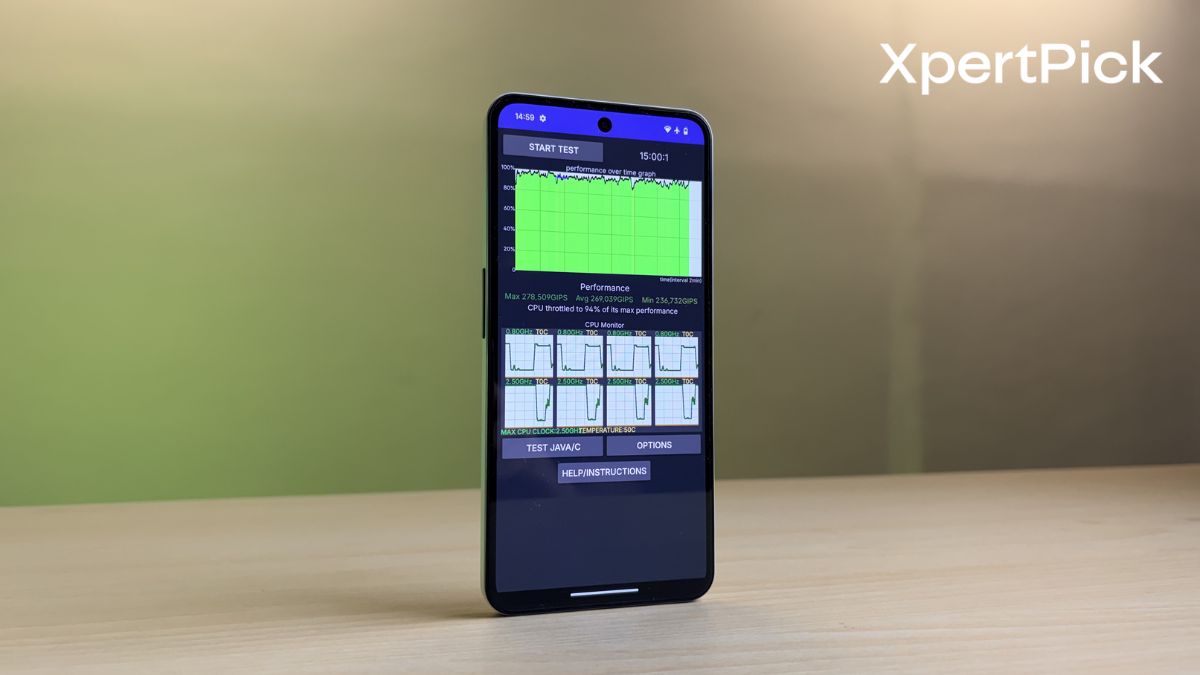
Nothing Phone 3a Lite displaying CPU throttling and thermal stability test results during performance benchmarking

The Nothing Phone 3a Lite is the phone you should consider if you’re after excellent thermal performance. It recorded the highest figures in terms of frame stability during the 3DMark Wild Life Extreme Stress Test and also achieved the highest stability in the CPU throttling test. Despite having the lowest raw GPU score, excellent optimisation allowed it to register the highest peak average frame rate in BGMI while staying completely cool to the touch.

Nothing Phone 3a Lite XP Lab Data

  • AnTuTu v10: 929,009

  • Geekbench 6: 1,009 (Single-Core) | 2,986 (Multi-Core)

  • 3DMark Wild Life Extreme: 857 (99.6% Stability)

  • CPU Thermal Throttling: 94% Sustained Performance

  • Thermals: 32.4°C (Peak temperature recorded after heavy graphical stress test)

  • Storage Speeds: 1,093.0 MB/s (Sequential Read) | 7,449.0 MB/s (Sequential Write)

  • Gaming Performance:
    – BGMI: 93.1 Average FPS | 56.5 (5% Low FPS)
    – Minecraft: 33.1 Average FPS | 20.3 (5% Low FPS)

Pros and Cons

Pros:

  • Exceptional Thermal Management: Stays astonishingly cool under heavy load, peaking at a category-lowest 32.4°C and sustaining an incredible 94% of its CPU performance without thermal throttling.
  • Peak Frame Rates in Optimised Titles: Highly optimised for mainstream e-sports gaming, managing to squeeze out the highest peak average frame rate in BGMI on this entire list.
  • Excellent Dedicated AI Capabilities: Features a powerful dedicated NPU, scoring a strong 2,706 in Geekbench AI Quantized testing to run on-device smart workloads and computational photography efficiently.

Cons:

  • Weakest Raw Graphics (GPU) Power: Posts the lowest 3DMark score in the segment, struggling significantly to maintain comfortable frames in heavy, geometry-dense titles like Minecraft.
  • Bottlenecked App Loading Speeds: Outfitted with UFS 2.2 storage hardware that caps sequential reads at a modest 1,093 MB/s, resulting in noticeably longer game asset loading and initial file indexing screens compared to its UFS 3.1 competitors.

Realme P4 Power – Best Gaming Stability and AI Performance

Realme P4 Power running Minecraft during gaming performance and frame rate testing

The Realme P4 Power is best suited for users looking for good gaming performance, particularly high average frame rates in games like BGMI and Minecraft. It is also a good phone whose GPU and NPU are relatively well suited for running AI models, thanks to the high scores it achieved in the Geekbench AI benchmark. Moreover, the Realme P4 Power scored the second highest in the AnTuTu storage test, which translates to smooth app and file loading.

Realme P4 Pro XP Lab Data

  • AnTuTu v10: 1,009,232
  • Geekbench 6: 1,193 (Single-Core) | 3,506 (Multi-Core)
  • 3DMark Wild Life Extreme: 1,813 (99.3% Stability)
  • CPU Thermal Throttling: 87% Sustained Performance
  • Thermals: 40.8°C (Peak temperature recorded after heavy graphical stress test)
  • Storage Speeds: 2,066.7 MB/s (Sequential Read) | 1,813.0 MB/s (Sequential Write)
  • Gaming Performance:
    BGMI: 73.0 Average FPS | 61.2 (5% Low FPS)
    Minecraft: 43.5 Average FPS | 23.9 (5% Low FPS)

Pros and Cons

Pros:

  • Unmatched GPU Burst Power: Scores a massive 1,813 in 3DMark Wild Life Extreme, delivering raw graphical rendering capabilities that outpace other segment competitors.

  • Fluid 144Hz Display: Offers an ultra-smooth 144Hz refresh rate with a sharp 453 PPI density.

Cons:

  • Aggressive Thermal Build-up: Reaches the highest peak temperature in its category at 40.8°C, which forces the CPU to throttle down to 87% of its max speed under heavy stress.

  • Slow Single-core Performance: Falls noticeably behind in single-core speeds compared to top daily multitasking performance leaders like the Moto Edge 70 Fusion.

Vivo T5x – Best Entry-Level Value Performance

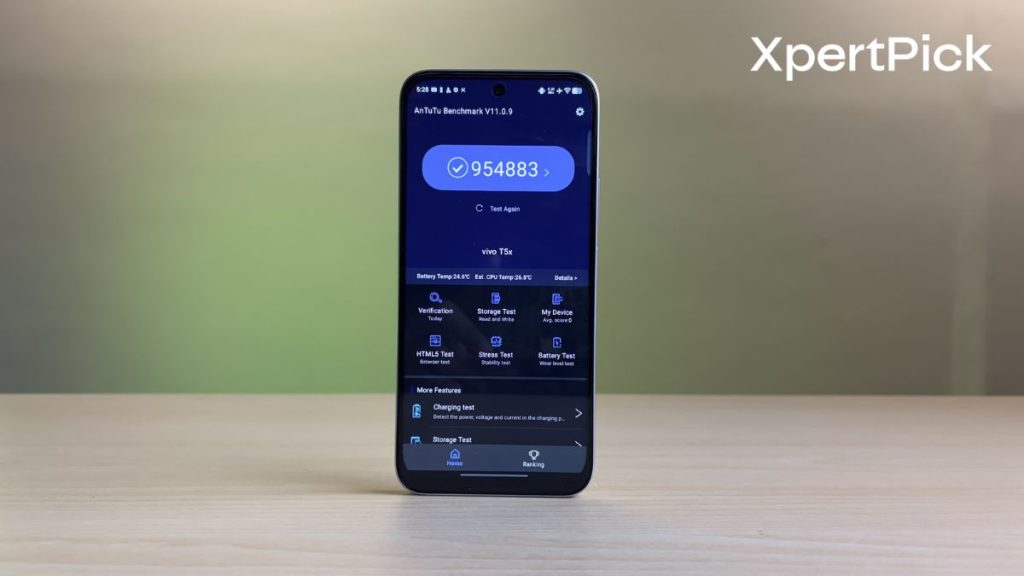
Vivo T5x displaying AnTuTu benchmark score during smartphone performance testing

The Vivo T5x is the most affordable smartphone in the group, yet it still punches well above its weight with a respectable AnTuTu score and solid CPU thermal stability. Moreover, it ranks second-highest in sequential read and write speeds, as well as random read and write speeds, meaning it performs very well when loading or transferring large files and applications. While it sits at the bottom for intensive 3D gaming titles like Minecraft, it still offers great value for consumers looking for highly capable daily performance at a relatively affordable price point.

Vivo T5x XP Lab Data

  • AnTuTu v10: 954,883
  • Geekbench 6: 1,060 (Single-Core) | 2,715 (Multi-Core)
  • 3DMark Wild Life Extreme: 1,015 (99.5% Stability)
  • CPU Thermal Throttling: 93% Sustained Performance
  • Thermals: Data Not Recorded
  • Storage Speeds: 2,069.2 MB/s (Sequential Read) | 1,891.3 MB/s (Sequential Write)

Gaming Performance:

 – BGMI: 59.2 Average FPS | 51.0 (5% Low FPS)
Minecraft: 28.7 Average FPS | 16.9 (5% Low FPS)

Pros and Cons

Pros:

  • Excellent Thermal Stability: Demonstrates highly dependable sustained processing efficiency, holding onto an impressive 93% of its maximum CPU performance under prolonged heavy workloads.

  • Rapid Storage Speeds: Built with very fast internal hardware, clearing 2,069.2 MB/s sequential read and 1,891.3 MB/s sequential write speeds for swift app installations and short system boot times.

  • Competent Daily Performance: Delivers a respectable 9.5 Lakh AnTuTu score and reliable single-core processing (1,060 Geekbench score) that ensures smooth navigation through everyday apps.

Cons:

  • Struggles with Heavy 3D Gaming: Lacks the graphical power required to run geometry-dense titles smoothly, dropping to a low average of 28.7 FPS in Minecraft with frequent stutters.
  • Weak Multicore Performance: registers the lowest Geekbench Multi-core benchmark score (2,715) on this list, making it less ideal for heavy content creation or complex productivity multitasking under load.

No posts to display